
Ecommerce giant Amazon is embedding AI across its seller journey for its Indian users. At the core of this rollout is its AI-powered Seller Assistant, a 24/7 chatbot that is built into Seller Central. Seller Assistant leverages Amazon Bedrock, Amazon Nova foundation models, and Anthropic Claude to offer AI-driven guidance, surface business insights, and assist sellers with routine marketplace operations.
“Amazon has provided these AI-powered features to its 1.7 Mn sellers in India, aiming to make commerce operations more efficient and cost-effective. The rollout is phased, with India starting after Smbhav 2025. The AI models are trained on various commerce data and are part of Amazon Bedrock, leveraging advanced AI chips and robust cloud infrastructure,” said Abhijit Kamra, director of seller experience for emerging markets (Product, AI and Smart Commerce).
Amazon Smbhav is the company’s flagship event for MSME startups and entrepreneurs.
This announcement comes ahead of its annual multiday shopping event, Prime Day, which is set to take place in July. This would be the biggest rollout, in terms of scale, for Indian sellers.
Integrating Wider AI CapabilitiesAmazon is positioning Seller Assistant as an AI-powered tool for small businesses, integrating capabilities across seller onboarding, catalog creation, inventory management, advertising and cross-border expansion.
The tool guides new merchants through the onboarding process and automates parts of catalog creation, including generating product titles, descriptions and attributes. Amazon said the system can pre-fill up to 70% of listing fields from a product image or URL and assist with image enhancement.
For inventory management, the company uses machine learning models to generate restocking recommendations, while its fulfillment network handles warehousing, logistics and delivery. On the advertising front, sellers can access AI-driven account diagnostics through Amazon’s Customized On-Demand Ads Experts (CODE) programme, which provides recommendations aimed at improving campaign performance. The company also highlighted its Vine programme, which enables eligible products to receive reviews from a curated pool of reviewers.
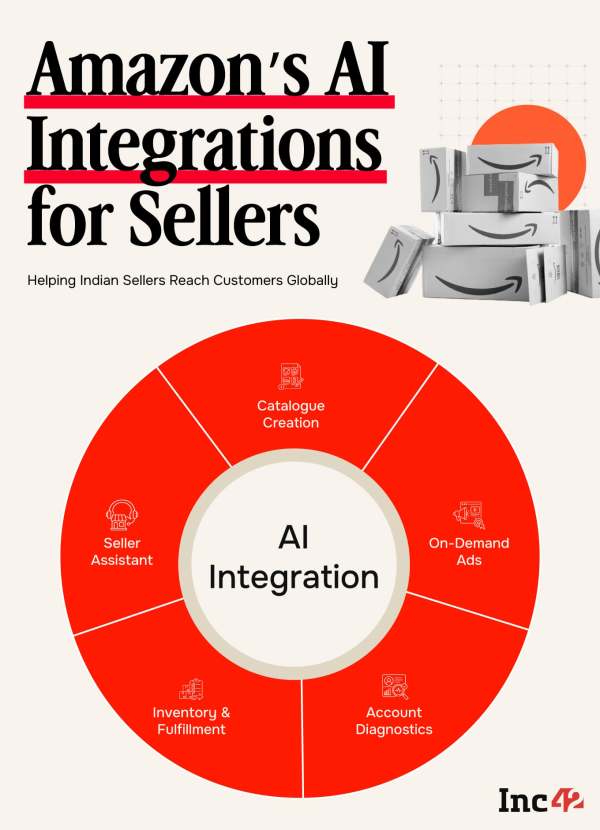
Ahead of Prime Day, Amazon has expanded Seller Assistant’s capabilities for merchants looking to sell internationally. The feature provides product recommendations, demand insights and market-level guidance to help sellers identify export opportunities. It also assists with country-specific compliance requirements, including documentation and regulatory checks, and offers step-by-step tracking of the international expansion process.
“We’ve already reached a stage where the operational effort required from sellers has fallen by nearly 70%. At the same time, listing errors, which happen due to manual processes, have declined by around 10%. As a result, sellers benefit on two fronts: they save time and costs through greater operational efficiency, while improved listing accuracy can also contribute to better sales performance,” said Kamra, when asked about how these capabilities have so far helped sellers. He added that the initiative is aimed at impacting 15 Mn businesses by 2030.
To drive adoption of its AI tools, Amazon India has rolled out Seller Connect programmes in over 20 cities. The company said more than 5,000 sellers have attended training sessions focused on catalog creation, inventory management, fulfillment operations, and growth planning.
Kamra said Amazon was particularly keen to observe how its recently launched tools, including those for product listings and inventory management, perform during high-volume shopping events such as Prime Day, especially after receiving positive feedback from sellers during the initial rollout.
Amazon views these AI tools as part of its long-term flywheel strategy. By reducing the operational effort and costs associated with running an online business, the company believes sellers can grow more efficiently and potentially pass on some of those savings to customers through lower prices.
The Ecomm Battle Turns To AIAmazon’s move comes at a time when ecommerce and retail platforms are increasingly embedding generative AI into seller workflows. Online sellers are using the technology for tasks ranging from product listing creation and catalog management to inventory planning and marketing. The trend is also extending beyond large enterprises, with small businesses and MSMEs increasingly adopting AI-powered tools as part of their day-to-day commerce operations.
Arch-rival Flipkart and unbranded focussed Snapdeal have introduced AI-powered seller tools, while SaaS players serving merchants are also building AI capabilities for catalog management, marketing and customer engagement.
Meesho too has stepped up its efforts through voice AI and AI-powered personalisation in discovery.
The push reflects a broader shift in ecommerce from AI-assisted customer experiences to AI-powered merchant operations, where platforms are looking to reduce friction in listing, advertising and inventory management.
India’s ecommerce market is expected to reach $300 Bn by 2030, with MSMEs emerging as a key growth driver. However, while online marketplaces have expanded access to customers, many small businesses continue to grapple with challenges around onboarding, catalog management, logistics, and compliance.
The post Amazon Bets On AI-Powered Assistant To Streamline Seller Operations appeared first on Inc42 Media.
-
Who Will Be the Referee for the Netherlands vs Japan Clash at the 2026 World Cup?

-
Ranking the Best and Worst FIFA World Cup Collaborations: Topo Chico, CHARLY, Guinness, Levi’s, Nike, Patta and More

-
ITV’s Commentary and Expert Team for Netherlands vs Japan, World Cup 2026

-
Word of the day: Emblazon

-
Ollie Robinson ruled out of 2nd NZ Test with injury