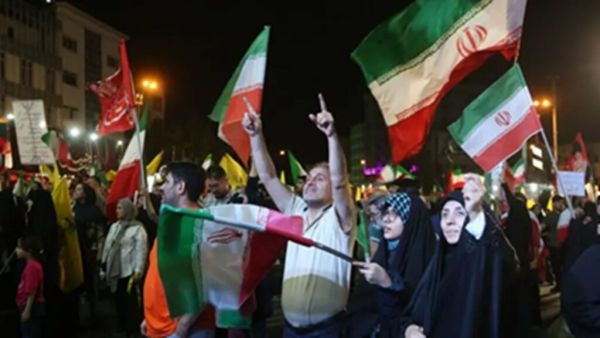
Tehran/Mashhad, June 14. A historic agreement is expected to be reached on Sunday to end the long-running military tension and war-like situation between the US and Iran. US President Donald Trump has also issued a positive statement regarding this upcoming agreement. However, the situation regarding the exact time or date of signing this agreement has not been completely clarified by the Government of Iran yet. Meanwhile, this diplomatic effort to join hands with America has sparked strong opposition within Iran itself. Fierce demonstrations are being seen in major cities of Iran against this possible agreement.
Protestors’ anger erupted in Tehran and Mashhad
According to the report of BBC Persian Service, opponents of this agreement in Iran have taken to the streets and opened a front against their own government. A massive rally was organized in the main Ibn Sina Square in the capital Tehran. The protesters participating in this rally raised slogans against Iran’s current Foreign Minister Abbas Araghchi and Parliament (Majlis) Speaker Mohammad Baghar Ghalibaf. It is noteworthy that both these leaders are playing a key role in back-channel and direct talks with America.
Apart from Tehran, heavy tension was also seen in Mashhad, Iran’s second largest city on Saturday evening. Dozens of protesters gathered here in front of the regional building of the Foreign Ministry and strongly criticized Foreign Minister Abbas Araghchi’s statements to America’s policy. In a video released by Fars News Agency, protesters can be seen chanting aggressive slogans against Araghchi
Why is this agreement being opposed?
The people commanding the demonstration are said to be close to Iran’s ultra-radical and extremist organization “Persistence Front” (Jabh-e Padardari). The factions opposing the agreement mainly have the following objections:
Fear of losing strategic influence: Opponents strongly believe that this agreement being made with America is not in Iran’s national interests under any circumstances. This will weaken Iran’s dominance and military influence in the Gulf region, especially the world’s most important oil route, the Strait of Hormuz.
Distrust in America: Hardliners argue that by relying on the US, Iran is compromising its national security and sovereignty.
Foreign Minister’s statement: Blockade will be removed, but sovereignty will not be compromised
Meanwhile, to allay internal opposition and apprehensions, Foreign Minister Abbas Araghchi shared some key points of the agreement in a television interview. He explained that: “Under this possible agreement, the US Naval Blockade on Iranian ports will be completely removed, which will provide great relief to Iran’s economy.”
Along with this, he assured the country that Iran’s control over the Strait of Hormuz and its strategic position will remain a part of the country’s major deterrent (military deterrent capability) and there will be no compromise on it. Despite this, an ideological war has broken out between the public and a section of the government regarding the move towards diplomacy within the country.
-
Katia Itzel Garcia appointed as referee for Tunisia vs Netherlands clash

-
CM Rise Schools: 75 CM Rise schools to become high-tech; will offer various facilities...
-
JEECUP Counselling 2026: First round of JEECUP counselling begins; choices can be filled until June 30; check the full schedule...

-
New PMRC-2026 Research Fellowship Launched: Opportunities for Researchers from Junior to Senior Levels; Check Eligibility Criteria..

-
NCERT: Why did naming the book 'Krishna' spark a controversy? NCERT presents its stance on the Kannada textbook..