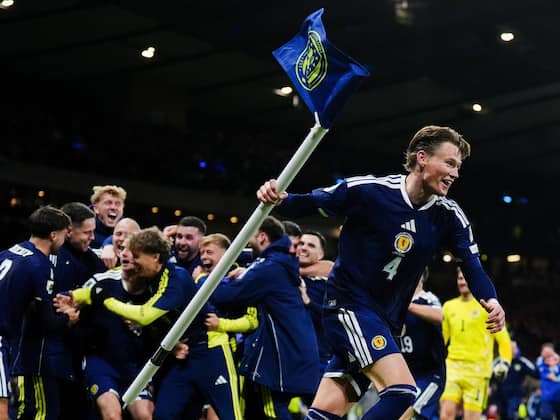
Scotland have come a long way under Steve Clarke, and the journey’s defining moment came from an extraordinary strike. Kenny McLean, positioned inside his own half, unleashed a 50-yard effort in the play-off against Denmark that sealed a 3,000-mile trip across the Atlantic. It was the third spectacular goal of an unforgettable evening for Scotland, following Lawrence Shankland’s close-range finish, Scott McTominay’s acrobatic overhead kick, and Kieran Tierney’s stunning long-range effort — before McLean added his stoppage-time masterpiece to the night’s highlight reel.
This performance drew deeply from Scotland’s storied football past — one marked by heartbreak, heroic near-misses, and flashes of brilliance that have sustained hope through decades of disappointment. Their first World Cup appearance in the Americas produced perhaps their most iconic goal — Archie Gemmill’s dazzling solo run against the Netherlands in 1978, a strike so legendary that it still stands tall despite more recent heroics from McLean, McTominay, and Tierney. That match ended in a Scottish win, though “Ally’s Army” ultimately fell short in Argentina as manager Ally McLeod’s confidence tipped into over-optimism.
Now, a World Cup fixture in Miami against Brazil is set to revive memories of 1982, when David Narey’s thunderous strike briefly put Scotland ahead before they succumbed 4-1 and exited a third consecutive World Cup on goal difference.
This time, the draw looks equally daunting. Scotland share their group with 2022 semi-finalists Morocco and the ever-powerful Brazil. The Scots and the Seleção seem destined to cross paths — this will be their fifth encounter, with the 1974 draw still standing as Scotland’s only point against the five-time champions. Morocco, meanwhile, defeated Scotland 3-0 in 1998, a result that stunned many at the time.
On paper, Scotland’s best hope of advancing lies in finishing among the strongest third-placed teams, which would require a decent goal difference and a win over Haiti. Yet history warns against complacency — they drew with Iran in 1978 and fell to Costa Rica in 1990. Across their eight previous World Cup campaigns, Scotland have registered only four wins: against Zaire (as they were then known) in 1974, the Netherlands in 1978, New Zealand in 1982, and Sweden in 1990.
Back then, qualifying for the World Cup was almost expected. That’s partly why November’s euphoric play-off victory over Denmark carried such emotion — it marked the end of Scotland’s long exile from football’s biggest stage. Before this, they had appeared in at least eight World Cups but none in the 21st century, missing six consecutive editions after once qualifying for six of seven.
Now, Clarke is building a compelling argument to be regarded as Scotland’s most successful manager. While his achievements have largely come on smaller stages, no other manager has guided Scotland to three major international tournaments. Prior to his tenure, the nation endured two decades without qualification for any major event, a cycle Clarke decisively broke.
Yet doubts linger about his record in the most critical matches. Scotland managed just one point apiece at Euro 2020 and Euro 2024, and were widely seen as underperforming in the latter. They scored only once in each tournament — through Callum McGregor and McTominay respectively. Their last victory at a major finals remains a 1-0 win over Switzerland at Euro 1996, courtesy of Ally McCoist — who will return to the United States this summer, now as a seasoned pundit rather than a player.
Should Clarke fail to secure that long-awaited tournament victory — or finally steer Scotland into the knockout rounds — questions will inevitably be raised about the Scottish Football Association’s decision to extend his contract by four more years. Still, his leadership has brought stability, unity, and a renewed sense of purpose to the national side.
For captain Andy Robertson and vice-captain John McGinn, both now in their thirties and among Scotland’s most capped players, this World Cup represents the culmination of their international careers. Neither has truly peaked in previous tournaments, but McGinn, fresh from leading Aston Villa to Europa League glory, and McTominay, instrumental in Napoli’s Scudetto triumph, arrive in arguably their best form yet.
Clarke’s squad blends experience with a touch of youth. Nineteen-year-old Findlay Curtis was initially the youngest member until Billy Gilmour’s injury led to the late call-up of Tyler Fletcher, a teenager with just 17 minutes of league football to his name.
Though Fletcher’s inclusion slightly lowers the squad’s average age, Scotland still field one of the oldest teams at the tournament. Veteran goalkeeper Craig Gordon, aged 43, stands as the most senior — having lived through three previous World Cup campaigns. Born just six months after Narey’s goal against Brazil, Gordon embodies Scotland’s enduring connection to those past glories.
And there remains one even older figure of Scottish descent whose shadow may loom over this World Cup. The Tartan Army, known for their humour, humility, and devotion, are expected to bring warmth and colour to the tournament — especially in Miami, where kilts may be a rarer sight than in Boston. Yet behind their self-deprecating wit and the grounded, determined ethos of Clarke’s squad lies a collective ambition — modest but meaningful — to reach the last 32 and finally end three decades of unfulfilled promise. In that spirit, there is little of Donald Trump in this Scotland team, despite his maternal roots tracing back to their soil.
-
Pope Leo XIV Urges Spanish Church To Listen To Abuse Victims, Ensure Reparations
-
DMK Clarifies Stalin's '3-Month Govt' Remark, Says No Call To Topple Vijay-Led Regime
-
Yusuf Pathan Met Amit Shah, Claims Kalyan Banerjee As TMC Crisis Deepens

-
Zojila Tunnel Breakthrough Achieved: Kashmir-Ladakh All-Weather Link Moves Closer To Reality

-
TS EAMCET 2026 Counselling Schedule Released At eapcet.tgche.ac.in; Phase 1 Registration Begins June 19