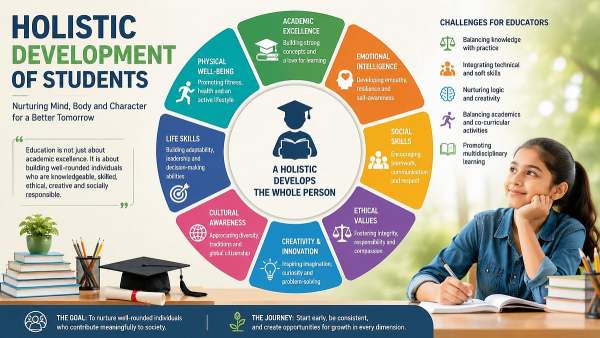
Holistic development in education goes beyond academics, focusing on knowledge, skills, creativity, values and personal growth. Educators face the challenge of balancing multiple dimensions to nurture well-rounded students.
One of the most frequently discussed themes in contemporary educational discourse is the concept of "holistic development of students." Educational institutions, at all levels, are increasingly expected to nurture well-rounded individuals rather than merely producing academically successful graduates.
However, despite the popularity of the term, there is often little clarity regarding what exactly holistic development means and how it can be achieved in practice. The word "holistic" is derived from the concept of the "whole" or "totality." It is based on the philosophy that the whole is greater than the sum of its individual parts. In simple terms, it suggests that while individual competencies are important, true development occurs when all dimensions of a person's personality evolve in an integrated manner.
Context of Education:
Let us examine the issue more closely in the educational context. Every educational system seeks to prepare students for life, work, and citizenship. However, life itself is multidimensional and requires a wide range of competencies. Therefore, the expectation from educational institutions is not limited to academic excellence alone.
-
Oliver Glasner’s influence shines at the World Cup as Japan’s Daichi Kamada hails former Crystal Palace manager after draw with Netherlands

-
World Cup 2026: Labuan Bajo Immigration Chief Backs Japan, Predicts 2-0 Victory Over Tunisia

-
France reveal 2026 FIFA World Cup kits: design inspiration, release details, and pricing

-
Noah Lyles runs a world-best 14.67 seconds to win the 150 meters at Golden Spike meet

-
Maharashtra MPs offered Rs 50 cr to rebel, says Shiv Sena (UBT)