The 1970 FIFA World Cup remains one of football’s most cherished tournaments. It is still remembered as a symbol of a more innocent era, when the sport transitioned from pure athleticism to global pop culture. The Telstar ball, cotton jerseys, grainy colour broadcasts, and the average of 2.97 goals per game — a post-war record — all reflected a game standing at the crossroads of tradition and modernity.
Professionalism and commercialisation were fast approaching, and the sport was becoming global. The 1966 World Cup had highlighted this paradox — northern European football was thriving on the field, yet Europe’s influence over FIFA was waning. Mexico 1970 became the first World Cup held outside Europe and South America. Critics argued that the heat and altitude would stifle the quality of play expected at such a grand stage.
Initially, those doubts seemed justified. Some matches were sluggish, such as the goalless opener between Mexico and the USSR. Belgium appeared uninspired in Group 1, while Italy advanced through Group 2 — containing Sweden, Israel, and Uruguay — with minimal flair, scoring just once in their only victory.
However, these low-scoring games proved to be exceptions in a tournament bursting with goals. Morocco impressed in Group 4, while West Germany defeated Bulgaria 5-2 and overcame the exciting Peru side led by Teofilo Cubillas 3-1. Mexico and the USSR also found their rhythm with four-goal victories on the second matchday. Among an all-star cast that featured Franz Beckenbauer, Giacinto Facchetti, Gerd Muller, Gigi Riva, Gianni Rivera, Uwe Seeler, and Lev Yashin, one particular fixture stood above the rest — the Group 3 encounter between reigning champions England and the two-time winners Brazil.
In preparation, England — like many others — obsessed over altitude. Training methods varied wildly; Bulgaria trained in the snowy mountains near Sofia, Israel trained in Ethiopia, and Uruguay prepared in Quito and Bogota. England too spent time at high altitude, with Alf Ramsey primarily concerned about Guadalajara’s heat after witnessing the 1968 Olympics there. Team doctor Neil Phillips shared his concern.
While Brazil had been taking doctors and psychiatrists to tournaments since 1958, England only began travelling with a doctor in 1963. Phillips, a part-time general practitioner, prepared extensively, studying altitude effects, heat, and tropical diseases. He even consulted Dr Griffith Pugh, the Everest physiologist, and collaborated with experts in Addis Ababa. Phillips developed sodium tablets, examined antibiotics like Streptotriad and Thalazole to combat local illnesses, and compiled a medical guide for players — a testament to his meticulous approach.
England’s preparation also reflected growing commercial influences: Zeiss provided sunglasses, Findus supplied frozen foods, Malvern offered bottled water, Gatorade the energy drinks, and Umbro designed the Airtex shirts. Unknowingly, England’s setup was nearly as advanced as Brazil’s.
Brazil’s Selecao arrived in Mexico City 32 days before their opening match against Czechoslovakia. Coach Mario Zagallo declared they were the first to arrive and would be the last to leave. There were no major acclimatisation issues, though some players, including Roberto Miranda and Jairzinho, experienced mild discomfort due to the altitude.
England’s training built gradually — from cricket matches to high-altitude practice games in Colombia and Ecuador — before final acclimatisation in Guadalajara. “I was better off in jail,” joked Bobby Moore, recalling his infamous shoplifting incident in Bogota.
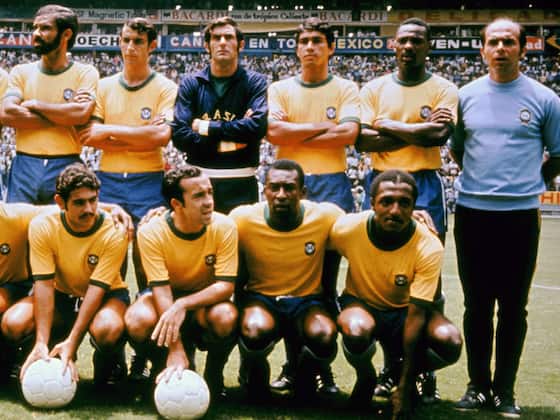
Daytime kick-offs boosted FIFA’s European TV revenues but tested players in extreme heat. Despite such conditions, England exuded confidence after Brazil’s emphatic 4-1 win over Czechoslovakia. Ahead of the big match, captains Bobby Moore and Carlos Alberto were photographed together at Estadio Jalisco in Guadalajara.
England’s optimism seemed misplaced after their laboured 1-0 win against Romania. In contrast, Brazil dazzled — Pele and Tostao’s quick interplays, Rivellino’s powerful left foot, Gerson’s sweeping passes, and Jairzinho’s deadly finishing displayed their finest football since 1958. Their shape, somewhere between a 4-3-3 and a 4-5-1, was fluid and efficient. England, however, focused too much on what they perceived as Brazil’s defensive weaknesses.
Clodoaldo and Brito’s early lapse against Czechoslovakia, which led to Petras’s goal, reinforced England’s impression that Brazil’s defence was vulnerable. British media mocked Brazil’s ‘schoolboy marking’, missing the point that Zagallo’s team used zonal marking instead of man-to-man.
Zagallo later explained, “Our way of defending was to position ourselves in zones and cover spaces, not mark man-to-man. If we had pressed high, we would have run out of energy by the second half. By conserving our energy, we could then use our technical superiority once we regained possession.”
Brazil exploited England’s man-marking system with intelligent movement. Tostao drifted from the centre, creating space for Pele and Jairzinho. Both forwards dropped deep, while Jairzinho often cut inside, pulling English defenders and midfielders such as Alan Mullery out of position.
Zagallo’s tactics reflected his deep understanding of space and efficiency, perfectly suited for Mexico’s demanding conditions. Alf Ramsey was equally astute — his team’s ability to control possession in the heat was proof of his tactical intelligence. A forward-thinking coach, Ramsey had once played in Tottenham’s ‘push and run’ side under Arthur Rowe and favoured quick passing. His ‘Wingless Wonders’ system, with Martin Peters and Alan Ball playing as narrow wingers, allowed Bobby Charlton creative freedom — though by 1970, Charlton was past his prime.
Despite disciplined play and full-back overlaps, England lacked the flair that Brazil possessed in abundance. When Brazil surged forward in the second half, Jairzinho’s strike — a result of fluid teamwork and individual brilliance — sealed the 1-0 victory. England squandered their chances, including Jeff Astle’s miss and Alan Ball’s shot that hit the post in the 77th minute.
The game was billed as a clash of opposites — Europe versus South America, defence versus attack, structure versus creativity. For all its hype, the match was cautious and decided by fine margins. At half-time, England still believed they could win. On the sidelines, Zagallo nervously wondered, “My God, Brito and Piazza, will they hold out? And Felix — can he withstand the pressure?” His defenders did, and Brazil’s balance between artistry and resilience shone through.
Astle’s miss, Gordon Banks’s legendary save from Pele, and the iconic shirt swap between Moore and Pele became immortalised, even though the match itself was technically ordinary. As authors Roger MacDonald and Eric Batty noted in ‘Scientific Soccer in the Seventies’, the game was “tight and defensive, with both teams unwilling to take risks. Dramatic, yes, but in footballing terms, almost ordinary.”
Indeed, the match featured misplaced passes and unconvincing defending from both sides. Neither team played with complete freedom, as both sought not to lose. Yet, its significance transcended the scoreboard. For England, it marked the beginning of a long decline. For Brazil, it cemented their golden era and set them on course for a third World Cup triumph.
To this day, Jairzinho fondly recalls his goal, Piazza still beams with pride at having beaten England, and Tostao treasures the match that confirmed his place in Brazil’s first XI. Gerson, too, still feels the envy of having missed it. For all of them, that victory remains unforgettable — a defining moment in football history.
By Samindra Kunti
Adapted from Samindra Kunti’s book Brazil 1970: How the Greatest Team of All Time Won the World Cup, which recounts how the 1970 World Cup — initially expected to be dull — became football’s most spectacular event. Led by Mario Zagallo and stars like Pele, Gerson, and Tostao, Brazil’s triumph not only defined their golden era but also marked the end of an age when artistry ruled the game.
-
Gray Hair: Graying at a young age? Change ‘these’ habits, otherwise the problem may worsen

-
Natural hair toner for summer hair care

-
“Only politics in the name of cow..” Shankaracharya Avimukteshwarananda’s sharp attack on BJP, calls Ayodhya Ram Temple Trust fake

-
Apple unveils Siri AI makeover as Tim Cook bids farewell
-
Young man was eating Idli by cutting it like pizza, when Shashi Tharoor saw it he said – This is Idli, not Id-Slice!