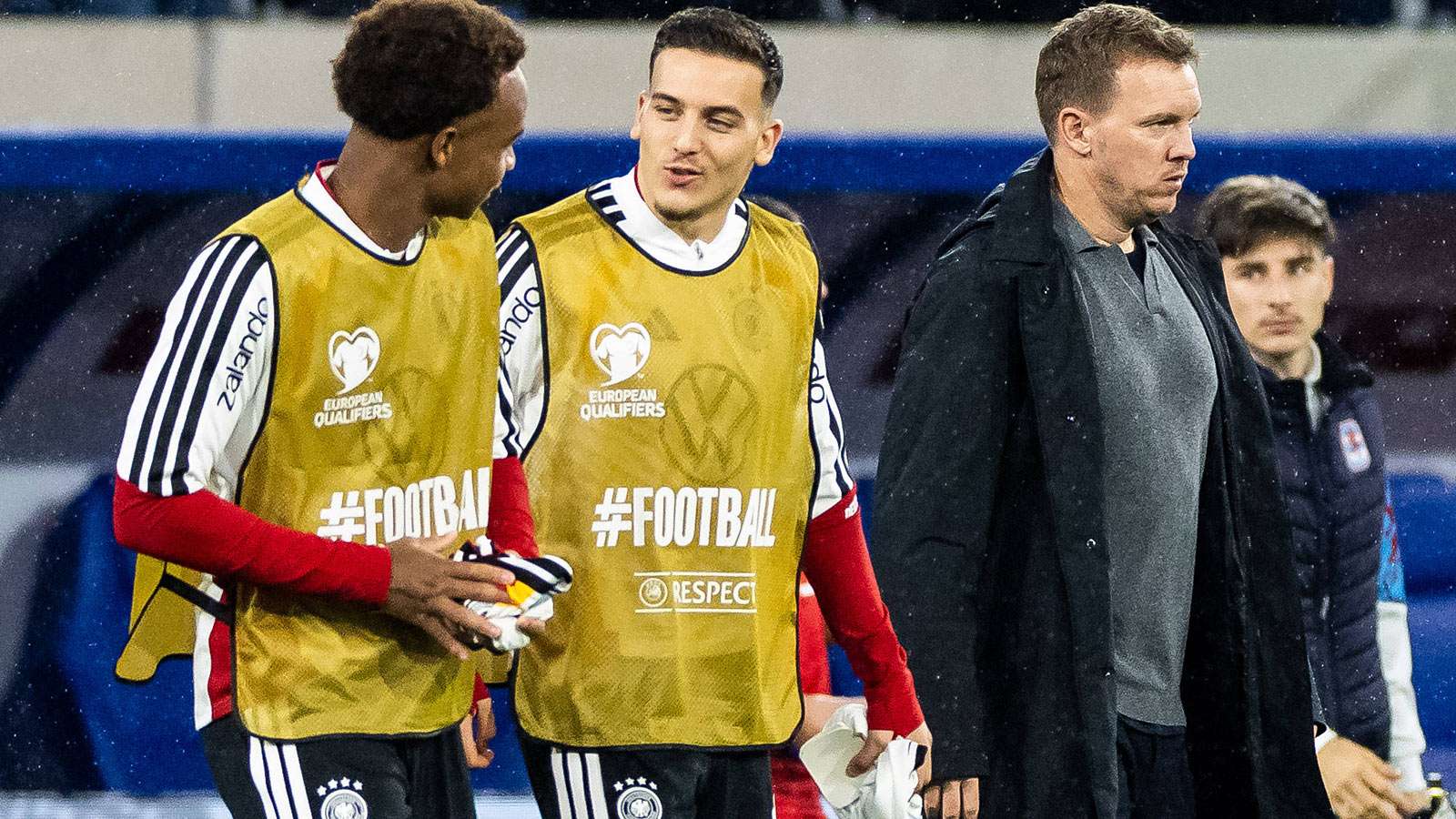
Ouedraogo replacing Karl—would that have been a bold move? Not in Julian Nagelsmann’s eyes, which immediately raises the question: what exactly went wrong with Said El Mala? Or perhaps more importantly, what is the broader issue at stake here? This commentary explores those questions.
There is no denying that Lennart Karl’s exclusion from the World Cup squad is a major setback. It’s painful for the team, the coaching staff, and especially for the 18-year-old himself. “It just hurts beyond words,” Karl shared on Instagram. The football community and fans feel that pain too.
Karl’s fearless and inventive style—sometimes puzzling, yet often remarkably effective—will be greatly missed. His unpredictability often served as the emotional bridge between tactical structure and instinct, as well as between the players and the crowd.
But wait—confident, daring, and capable of pulling off stunning tricks? Doesn’t that description fit another player as well?
Indeed, many fans were hoping to see Said El Mala included in the World Cup squad and on the field. Supporters of Cologne and football lovers who appreciate pace, flair, and creativity were certainly among them. Some might even wonder what exactly caused El Mala to lose Nagelsmann’s trust. While it’s not for speculation, it’s fair to say that El Mala is every bit as exciting to watch as Karl.
Yet Nagelsmann’s choice to omit El Mala from the Luxembourg qualifier and the subsequent squad was not unexpected. The coach likely has valid sporting reasons to keep the 19-year-old out at this stage.
He must have his rationale; otherwise, his credibility as a top-level football strategist would be questioned—and that’s clearly not the intent here.
World Cup squad selections have split opinions—some experts call it a “catastrophic mistake,” while others see it as “extremely risky.”
Nagelsmann evidently doesn’t see sufficient footballing value in El Mala—and, it seems, no other justification for bringing him to the United States.
However, he sees something promising in Assan Ouedraogo, who made his debut in World Cup qualifying despite an injury-affected season. Meanwhile, Chris Führich, despite his strong performances for VfB Stuttgart, doesn’t appear to provide anything that Nagelsmann doesn’t already have elsewhere in his squad.
This leads to another key observation. The DFB squad currently includes three goalkeepers—one of whom, the first-choice keeper, carries an injury—five centre-backs, two left-backs, eight central midfielders, two playmakers, two right-wingers, and four centre-forwards. Notably, there’s no dedicated right-back or left winger. The tally of eight midfielders—ranging from defensive anchors to attacking playmakers and versatile all-rounders—stands out. And yes, Ouedraogo is among them.
Still, it would be unlike Nagelsmann and his team to panic before the Curacao match, regretting the absence of a left winger or right-back. They clearly had their reasons; otherwise, Josha Vagnoman or even El Mala might have been called up.
Label it “a catastrophic mistake” or “extremely risky” if you wish, but Nagelsmann and his coaching staff are not in the habit of sabotaging their own plans.
Nagelsmann’s communication: The El Mala, Undav, and Baumann cases
This isn’t a defence of Nagelsmann’s selections but rather a counterpoint to the growing public perception that the national coach has lost control.
In truth, Nagelsmann remains consistent—particularly in his sometimes awkward communication style. Several of his remarks during his tenure, especially around the World Cup squad announcement, have drawn criticism: from the flexible “performance principle” to his claim in March that El Mala lacked match fitness.
Yet El Mala went on to start all ten Bundesliga matches for Cologne after 7 March, notching up five goals and an assist. Nagelsmann can also be reasonably questioned for his management of Deniz Undav, and for how he handled the goalkeeper situation involving Oliver Baumann and Manuel Neuer.
Under pressure, Julian Nagelsmann tends to respond with determination.
Calling his statements “unfortunate” might be an understatement. Making contradictory claims is never wise—especially since, as everyone knows, fans and the media never forget.
Critics have described his approach as needlessly combative or diplomatically clumsy. In short, the 38-year-old sometimes defends himself aggressively or reacts impulsively when unprovoked. He could avoid much criticism by communicating more simply, objectively, and clearly.
That kind of clarity could help him manage expectations, narrow down interpretations, and ease external pressure.
When the pressure mounts, Nagelsmann often becomes defiant.
Some even believe that El Mala’s chances diminished in proportion to the public’s growing support for him. This, of course, remains speculation.
2026 World Cup: Germany’s national team squad
The classification of players by position—goalkeeper, defender, or attacker—follows the DFB’s model, which doesn’t differentiate between specific midfield roles or wingers.
Position
Player
Club
Shirt number
Goalkeepers
Oliver Baumann – TSG Hoffenheim – 12
Manuel Neuer – FC Bayern Munich – 1
Alexander Nübel – VfB Stuttgart – 21
Defenders
Waldemar Anton – Borussia Dortmund – 3
Nathaniel Brown – Eintracht Frankfurt – 18
Pascal Groß – Brighton & Hove Albion – 13
Joshua Kimmich – FC Bayern Munich – 6
Felix Nmecha – Borussia Dortmund – 23
Aleksandar Pavlovic – FC Bayern Munich – 5
David Raum – RB Leipzig – 22
Antonio Rüdiger – Real Madrid – 2
Nico Schlotterbeck – Borussia Dortmund – 15
Angelo Stiller – VfB Stuttgart – 16
Jonathan Tah – FC Bayern Munich – 4
Malick Thiaw – Newcastle United – 24
Attackers
Nadiem Amiri – Mainz 05 – 20
Maximilian Beier – Borussia Dortmund – 14
Leon Goretzka – FC Bayern Munich – 8
Kai Havertz – Arsenal – 7
Assan Ouedraogo – RB Leipzig – 25
Jamie Leweling – VfB Stuttgart – 9
Jamal Musiala – FC Bayern Munich – 10
Leroy Sané – Galatasaray Istanbul – 19
Deniz Undav – VfB Stuttgart – 26
Florian Wirtz – Liverpool FC – 17
Nick Woltemade – Newcastle United – 11
-
Taurus Daily Horoscope Today (Apr 20 - May 20), June 7, 2026: Achieve Desired Goals and Maintain Steady Progress
-
Gemini Daily Horoscope Today (May 21 - Jun 20), June 7, 2026: Rise in Position and Reputation, Influence Remains Strong

-
Virgo Daily Horoscope Today (Aug 23 - Sep 22), June 7, 2026: Progress with Discipline, Maintain Self-Control
-
Leo Daily Horoscope Today (Jul 23 - Aug 22), June 7, 2026: Steady Progress and Growing Respect
-
Libra Daily Horoscope Today (Sept 23 - Oct 22), June 7, 2026: Joyful Times Ahead, Strengthen Bonds with Friends