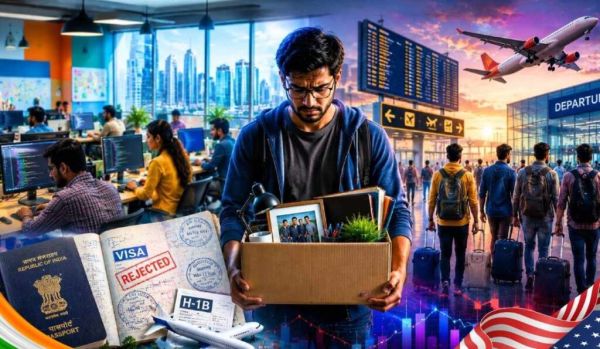
The long-held American dream for Indian technology professionals appears to be under strain.
A growing number of Indian tech workers are returning from the United States even as opportunities at home become harder to find, creating uncertainty on both sides of the world.
For decades, the H-1B visa represented a career breakthrough for Indian engineers. It was seen as a gateway to Silicon Valley and global opportunities. But that journey is increasingly becoming a round trip as return migration accelerates and fresh movement to the US slows down.
According to staffing firm Xfino, the gap between Indians moving to the United States and those returning home is narrowing rapidly. The firm estimates that, for the first time in years, the number of returnees could exceed the number of professionals heading to the US before the end of 2026.
Migration shift
The numbers highlight the changing trend. In 2026 alone, 7,300 Indian tech workers have already returned to India, despite the year being only halfway through.
Also read: ‘End H-1B Visa Abuse Act’: Republican lawmakers seek 3-year suspension, tougher rules
The figure stood at 15,100 in 2025, up from 9,800 in 2024. At the same time, outbound migration has begun to slow. While 21,200 professionals moved to the United States in 2025, the number for 2026 so far stands at just over 9,100.
Visa pressure
A major factor behind the shift is growing policy uncertainty in Washington.
The H-1B visa programme, which has long served as the backbone of Indian tech migration to the US, is facing increasing scrutiny. Stricter compliance requirements, proposals such as a $100,000 sponsorship fee and tighter processing norms have made employers more cautious about hiring foreign workers.
The risks are also increasing for those already in the United States. Workers who lose their jobs have only 60 days to secure a new sponsor. Failure to do so means they must leave the country.
One expert quoted in the discussion described the emotional impact of such uncertainty: “Even though you have done all you could, you have legally obliged, you have economically contributed as much as you could, and they can still create such an antagonising environment for you that it’s no longer viable for you to live. Then that leaves really deep scars, and people don’t forget that.”
Also read: H-1B lottery 2027: Fewer applicants, new wage slabs, AI to weed out fraud
The expert added that even if current policies are eventually reversed, “those long-term scars will continue”.
The discussion cited the example of Kash Patel, the current director of the FBI, while referring to Indian-origin success stories in the United States.
Weak hiring
The challenge for returning professionals is that India’s technology job market is also facing headwinds.
According to Xfino’s Active Tech Jobs Outlook, active technology job openings fell to 93,000 in June, down 14 per cent from 108,000 a month earlier.
The decline marks the sharpest monthly drop in more than a year. The slowdown spans IT services companies, technology startups and software product firms.
Major Indian technology companies such as Tata Consultancy Services, Wipro and Infosys are already dealing with concerns over artificial intelligence-driven disruption to their traditional businesses.
You have impact
Experts say artificial intelligence is playing a significant role in the slowdown.
As AI adoption accelerates across software development and technology services, India is beginning to feel the effects.
This is happening at a time when thousands of H-1B workers who may have lost jobs in the US could be returning home, increasing competition for a shrinking number of opportunities.
However, one expert argued that the return of highly skilled professionals should not necessarily be viewed negatively.
Also read: Indian H-1B workers face 60-day window as US tech layoffs intensify: Report
“The inundation of very qualified individuals who have experience and exposure and the resources is not a bad thing,” the expert said.
“Why wouldn’t India open its arms back to its own Indian citizens who are now substantially more qualified to come in and build this next generation transition for the country?”
The Nvidia exception
Amid the broader slowdown, one company stands apart.
While several major technology firms have reduced overseas hiring, Nvidia continues to expand its H-1B certification efforts.
The company behind many of the chips powering the global AI boom has increased hiring even as rivals scale back.
According to the discussion, foreign hiring at Google has fallen by more than half, while approvals at Amazon have dropped by nearly a third.
Nvidia, however, continues to recruit aggressively and is reportedly offering compensation packages that include base salaries exceeding Rs 4.5 crore annually for some senior positions, before stock awards and bonuses.
The message, according to the discussion, is simple: when talent is indispensable, nationality becomes secondary.
Uncertain future
Despite Nvidia’s hiring push, the broader picture remains challenging for most Indian technology professionals. The path to the United States is becoming narrower due to tighter visa rules, fewer sponsors and a weaker employment market.
At the same time, India’s own technology sector is experiencing slower hiring and growing competition for available positions.
As the discussion concludes, Nvidia may be an exception. But exceptions, by definition, are rare.
For many Indian tech workers, the future remains uncertain on both sides of the world.
The content above has been transcribed from video using a fine-tuned AI model. To ensure accuracy, quality, and editorial integrity, we employ a Human-In-The-Loop (HITL) process. While AI assists in creating the initial draft, our experienced editorial team carefully reviews, edits, and refines the content before publication. At The Federal, we combine the efficiency of AI with the expertise of human editors to deliver reliable and insightful journalism.
-
Pashu Kisan Credit Card: Livestock-rearing farmers will be able to avail collateral-free loans with this card..

-
SBI Card Rules: Monthly Caps and No Exemptions in Several Categories—SBI Cards Revises Rules; When Will They Take Effect?

-
ITR Filing 2026: Why is filing an ITR a smart move? Even if you don't owe tax, you should definitely file a return for these 5 benefits..

-
Gautam Gambhir Backs Sai Sudharsan For No. 3 Role Ahead Of Afghanistan Test, Eyes 4-Spinner Strategy For Sri Lanka Tour

-
From Cricket To Javelin Glory: Rumesh Tharanga Pathirage Outshines Neeraj Chopra's Mark With Record Throw Of 92.62m In Rome Diamond League