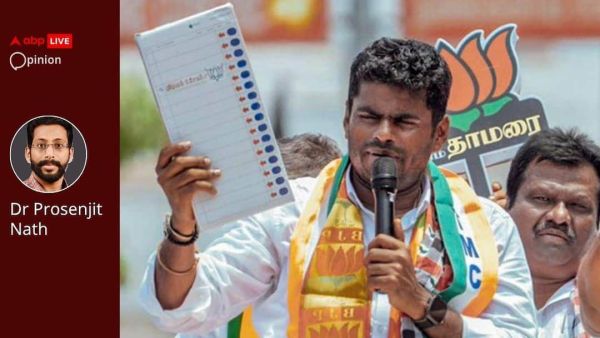
It is difficult to say who needs whom more today, the Bharatiya Janata Party (BJP) or K. Annamalai. Over the last few years, a few new political entrants have been projected as aggressively as the former IPS officer. His clean public image, administrative credentials, and energetic campaigning helped him emerge as the face of the BJP in Tamil Nadu, a state where the party has historically struggled to establish an independent mass base.
Yet politics is ultimately measured by outcomes, not optics. As the BJP recalibrates its strategy in Tamil Nadu and strengthens its alliance with the AIADMK, questions are being raised about Annamalai’s future role and about the larger direction of the party in the state. Regardless of the immediate political calculations, Annamalai’s journey offers several important lessons for the BJP not just in Tamil Nadu, but across India.
The Cost of Trading Ideology for Convenience
The BJP has spent the last decade building a distinctive political identity in Tamil Nadu. While electoral success remained limited, the party succeeded in introducing a new political vocabulary centred on nationalism, governance, anti-corruption, and civilisational pride. Annamalai became the principal vehicle for that message.
The challenge emerged when the BJP sought electoral gains through renewed dependence on traditional regional alliances. Electoral alliances are a practical necessity in many states, and politics often requires compromise. However, there is a fine line between strategic cooperation and ideological dilution.
The BJP's long-term objective in Tamil Nadu cannot simply be to become a junior partner in coalition politics. Its goal must be to create an independent social and political constituency. If every election cycle pushes the party back into dependence on larger regional players, the process of building an autonomous base becomes slower and more difficult.
Annamalai’s experience demonstrates that political growth cannot be outsourced. A party cannot inherit another party’s social support merely by sharing a platform. Durable expansion requires patient organisational work, ideological clarity, and grassroots mobilisation.
Sanatana Dharma as a Cultural Bridge
One of Annamalai’s most significant contributions was his ability to articulate issues related to Sanatana Dharma without appearing confrontational or exclusionary. In a political environment where sections of Dravidian politics have often defined themselves in opposition to Hindu cultural traditions, he attempted to present Hindu civilisational identity as a source of social cohesion rather than division.
This approach was important because Tamil Nadu’s cultural landscape is far more complex than the stereotypes often portrayed in national political discourse. The state possesses a rich temple tradition, deep spiritual heritage, and a strong sense of civilisational continuity. Annamalai recognised that engaging with these traditions could provide the BJP with a cultural entry point that transcended conventional electoral arithmetic.
His political messaging suggested that the debate was not merely about religion but about cultural self-confidence and historical continuity. Whether one agrees with this approach or not, it succeeded in shifting public conversations and forcing political opponents to respond to issues they had previously dominated.
For the BJP, the lesson is clear: cultural engagement should be a bridge to wider social participation, not a boundary that narrows political outreach.
Leadership Matters
Modern politics increasingly revolves around leadership. Parties may possess strong organisational structures, but charismatic and credible leaders remain essential for expanding into new territories.
Annamalai brought something uncommon to Tamil Nadu politics a combination of administrative experience, youthful energy, and a reputation for personal integrity. He represented a break from traditional political dynasties and factional power structures.
The BJP’s rapid rise in public visibility in Tamil Nadu cannot be understood without acknowledging his role. Even critics concede that he succeeded in making the party more relevant in public discourse than it had been for decades.
Political organisations should be careful not to undervalue leaders who create momentum. While institutions are larger than individuals, institutions often depend on individuals to communicate their vision effectively. The challenge for the BJP is to integrate emerging leaders into broader strategic frameworks without diminishing the qualities that made them successful in the first place.
Beyond Electoral Arithmetic
Indian politics frequently becomes obsessed with alliances, caste equations, and electoral calculations. These factors matter, but they are not sufficient to build enduring political movements.
The BJP’s growth in states such as Uttar Pradesh, Assam, and Tripura was not achieved solely through coalition management. It resulted from years of ideological outreach, cadre-building, and the cultivation of local leadership. Tamil Nadu will require a similar long-term approach.
Annamalai’s rise indicated that there is a constituency in the state willing to listen to alternative political narratives. The task before the BJP is to convert that curiosity into sustained political support. This cannot be achieved through electoral arrangements alone.
The party must continue investing in local leadership, strengthening grassroots networks, engaging with Tamil cultural identity, and presenting credible governance alternatives. Success in Tamil Nadu will depend on whether the BJP can become a genuine stakeholder in the state's political life rather than merely a participant in election-time alliances.
A Defining Moment
The debate surrounding K. Annamalai is ultimately larger than one individual. It reflects a fundamental question confronting the BJP: should the party prioritise immediate electoral gains, or should it continue the slower process of building an independent ideological and organisational presence in challenging regions?
The answer will shape not only the BJP’s future in Tamil Nadu but also its broader national expansion strategy. Annamalai’s political journey suggests that long-term growth comes from conviction, consistency, and grassroots engagement not from shortcuts. Whether the party fully absorbs that lesson remains to be seen, but the experience has already provided a valuable blueprint for the future.
-
Player Once 'Shut Down' by Asnawi Mangkualam Left Out of Argentina Squad for 2026 World Cup

-
Top IITs with Impressive Placement Records Beyond Computer Science

-
RPSC Announces RAS Recruitment 2026: Apply Now for 607 Positions

-
Punjab Government Implements New Regulations on Private School Fees
-
Barkatullah University Moves Towards Renaming as Vagdevi Bhojpal University