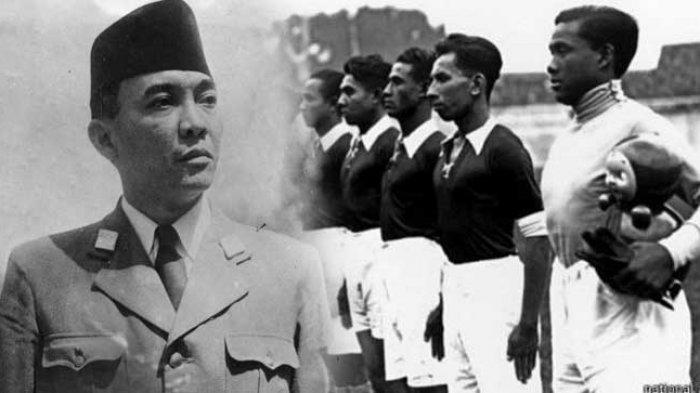
“As long as the independence of Palestine has not been handed over to the Palestinians, Indonesia will continue to stand against Israeli colonialism.”
Just one step away, Indonesia’s national football team could have reached the 1958 FIFA World Cup finals.
However, President Soekarno chose to relinquish that ticket to the finals.
The reason: Indonesia refused to face Israel, deciding to withdraw in solidarity with Palestine.
History records that Indonesia was once extremely close to participating in the world’s biggest football tournament. Yet, that golden opportunity was given up when the government decided not to play against Israel as a statement of solidarity with Palestine.
This decision was made during the administration of Indonesia’s first president, Soekarno. The country’s political stance toward Palestine at the time became the main reason behind its refusal to face Israel in the 1958 World Cup qualifiers.
In one of his speeches, Soekarno firmly expressed his support for the Palestinian struggle. “As long as the independence of Palestine has not been handed over to the Palestinians, Indonesia will continue to stand against Israeli colonialism,” Soekarno declared in his now-famous statement.
Based on that principle, Soekarno ordered the Indonesian national team not to play against Israel in the qualifying round for the 1958 World Cup. The government viewed competing against Israel as a form of recognition of that state.
The Lost Chance to the World Cup
At that period, Indonesia’s national team was considered a strong force in Asia. The Garuda squad even earned the nickname “The Asian Tiger” due to its impressive performances in the qualifiers.
Indonesia had a real chance to reach the World Cup finals for the first time since independence. During the qualification stage, Indonesia defeated China 2-0 in the first leg. Though they lost 3-4 in the second leg, Indonesia still advanced to the next round on aggregate and was set to face Israel, the West Asia zone champion.
However, by refusing to play against Israel, Indonesia withdrew from the competition, losing its chance to appear in the 1958 World Cup in Sweden.
Soekarno’s decision extended beyond football. During the 1962 Asian Games held in Jakarta, the Indonesian government also refused to allow Israel’s participation. At that time, Indonesia had no diplomatic relations with Israel and denied visas to its athletes and officials.
Indonesia’s Solidarity with Palestine
Indonesia’s support for Palestine had been evident since the early years of Soekarno’s leadership. The country’s first president was known internationally as a consistent critic of Israel’s policies toward Palestine.
One of the clearest examples was when Indonesia gave up its chance to play in the 1958 World Cup to uphold its foreign policy principles supporting Palestine.
At that time, Indonesia was on the brink of qualifying for the World Cup finals after defeating China in the Asian qualifying match held on 12 May 1957. That victory gave Indonesia a strong opportunity to continue its journey to Sweden. However, in the next round, Indonesia was scheduled to face Israel, the West Asia zone champion.
The issue arose because Indonesia did not recognize Israel’s sovereignty and refused to play in that country. “That would be the same as recognizing Israel,” said Maulwi Saelan, Indonesia’s goalkeeper at the time, quoting President Soekarno’s words.
The Indonesian government then sought a compromise by requesting FIFA to hold the match at a neutral venue, but the request was rejected. Consequently, Indonesia decided to withdraw from the qualifiers, even though its path to the finals was wide open. “Yes, we obeyed. We didn’t go,” Saelan said.
Soekarno’s Three Stances for Palestine
1. Refusing to respond to Israel’s congratulatory message
After Indonesia gained recognition of its sovereignty in 1949, several countries extended their congratulations, including Israel. Israel’s Foreign Minister at the time, Moshe Sharett, sent a telegram formally recognizing Indonesia. Vice President Mohammad Hatta responded with a note of thanks but did not initiate diplomatic relations. Soekarno, however, chose not to respond at all.
2. Committing to the fight for Palestine’s independence
In 1962, Soekarno once again reaffirmed Indonesia’s stance on Palestine during a public address. “As long as the independence of Palestine has not been handed over to the Palestinians, Indonesia will continue to stand against Israeli colonialism,” Soekarno declared emphatically.
3. Rejecting Israel’s participation in the 1962 Asian Games
When Indonesia hosted the fourth Asian Games in 1962, the government refused to issue visas to the Israeli delegation. Officially, the decision was based on the absence of diplomatic relations between the two countries. However, this policy was also deeply tied to Indonesia’s political stance against colonialism and its unwavering support for the Palestinian cause.
-
Thane Zilla Parishad Announces Second Round Of RTE Admissions For Waiting-List Candidates From June 4 To June 12

-
Delhi Parents Association Alleges CBSE Rushed On-Screen Marking System For Class 12 Without Adequate Teacher Training Or Feedback

-
Kerala SSLC SAY Hall Ticket 2026 Released At sslcexam.kerala.gov.in; Exams Begin June 9

-
UPSC Successfully Implements Face Authentication In 2026 Civil Services Prelims, Blocks Impersonation Across 2,072 Venues

-
Suryakumar Yadav Faces Uncertain Future Amid T20I Captaincy Speculations