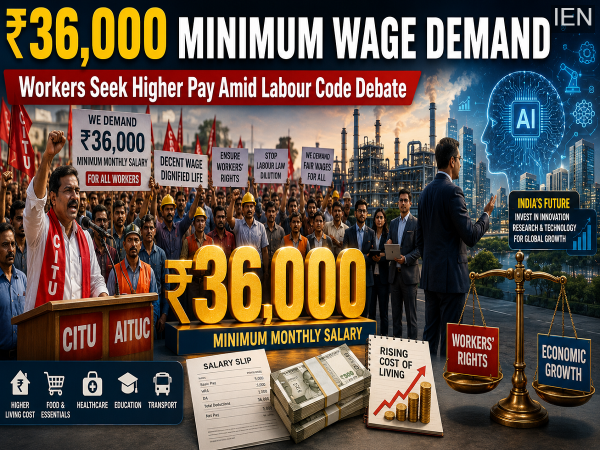
India's labour policy debate has intensified as major trade unions have renewed their demand for a significantly higher minimum wage for workers across the country. During a recent protest in Mysuru, Karnataka, representatives from leading labour organizations called for a nationwide minimum monthly salary of ₹36,000, arguing that existing wage levels are inadequate to meet rising living costs.
The demand comes at a time when the implementation of India's new labour codes continues to face resistance from worker groups, who fear that the proposed reforms could weaken employee protections and bargaining power.
Trade Unions Step Up Opposition to Labour Reforms
Members of prominent labour organizations, including the Centre of Indian Trade Unions (CITU) and the All India Trade Union Congress (AITUC), organized demonstrations to voice concerns over the government's labour reform agenda.
Union leaders argued that workers across sectors are struggling to cope with inflation, increasing household expenses, and stagnant wage growth. According to them, a minimum monthly wage of ₹36,000 is necessary to ensure a decent standard of living for workers and their families.
The protest also highlighted concerns about the four labour codes introduced to simplify and modernize India's labour laws. While the government has described the reforms as measures to improve ease of doing business and create a more flexible labour market, trade unions believe certain provisions could reduce workers' rights and job security.
Why Are Labour Unions Demanding a Higher Minimum Wage?
Labour organizations claim that the current wage structure in many sectors does not reflect the actual cost of living in urban and semi-urban areas. Rising prices of food, housing, healthcare, education, and transportation have increased financial pressure on working-class households.
Union representatives argue that a revised minimum wage framework should take inflation and changing economic conditions into account. They maintain that a ₹36,000 monthly wage would help workers meet basic needs while improving their overall quality of life.
The demand is also linked to broader calls for stronger social security measures, better working conditions, and improved protection for employees in both organized and unorganized sectors.
Concerns Over the New Labour Codes
The new labour codes aim to consolidate dozens of existing labour laws into a simplified framework covering wages, industrial relations, social security, and workplace safety.
However, worker groups have expressed concerns that certain provisions may make it easier for employers to hire and terminate workers, potentially reducing job stability. Trade unions argue that employee welfare and collective bargaining rights should remain central to any labour reform initiative.
The issue is expected to remain a key point of discussion between policymakers, industry bodies, and labour organizations in the coming months.
Industry Leaders Call for Greater Focus on Innovation
While labour unions focused on worker welfare and wage reforms, business leaders emphasized another major challenge facing India's economy: innovation and technological advancement.
Veteran banker and industrialist Uday Kotak urged Indian companies to significantly increase investments in artificial intelligence (AI), research, and innovation. He noted that leading global technology firms are investing billions of dollars annually in AI development and advanced technologies.
According to Kotak, Indian businesses must accelerate their efforts in research-driven growth if they want to remain globally competitive in the coming decade.
AI Investment Seen as Key to Future Growth
Experts believe artificial intelligence will play a crucial role in shaping industries ranging from manufacturing and healthcare to finance and education. Countries and companies that invest heavily in innovation are likely to gain a competitive advantage in the global economy.
Kotak emphasized that Indian corporations need to move beyond traditional business models and allocate greater resources toward research, product development, and emerging technologies. Strengthening innovation capabilities could help create new employment opportunities while enhancing productivity and economic growth.
The Road Ahead
The discussions around labour reforms and wage demands highlight the balancing act facing India's policymakers. On one hand, worker groups are seeking stronger protections and higher wages to cope with rising living costs. On the other, industry leaders are calling for increased investment in technology and innovation to strengthen the country's long-term economic prospects.
As debates over labour codes, wage structures, and technological transformation continue, both worker welfare and economic competitiveness are likely to remain at the center of India's policy agenda.
-
FIFA Changes Rules for 2026 World Cup, Fans Now Banned from Bringing Their Own Water Bottles

-
Indonesia National Team Still Without a Win Against Oman in 38 Years, Says Tarik Sektioui Ahead of Clash

-
The World Cup Song Nobody Saw Coming | How Bosnia’s Underdog Anthem Conquered the Internet | Sports

-
Sikkim State Lottery Result: June 4, 2026, 6 PM Live - Watch Streaming Of Winners List Of Dear Supreme Thursday Weekly Draw

-
Save The Dates! Argentina FIFA World Cup 2026 Schedule, Complete Fixtures, IST Timings And Live Streaming