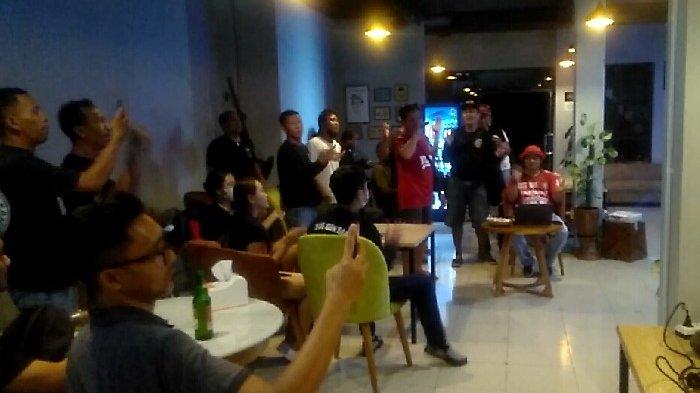
The excitement for the 2026 FIFA World Cup is already building across Bali.
As the world’s biggest football tournament approaches, TVRI Bali, the official broadcast rights holder, has reminded the public and business owners to comply with official public viewing (nobar) regulations to avoid any violation of FIFA’s broadcasting rights.
TVRI has divided the public viewing licenses into two main categories: commercial and non-commercial.
The commercial category applies to venues such as hotels, restaurants, cafes, beach clubs, bars, and other businesses that gain financial profit from hosting viewing events.
Meanwhile, the non-commercial category is designated for community-based social gatherings that do not charge any entry fee.
“There are two types of public viewing events — commercial and non-commercial. For commercial places such as hotels and cafes, they automatically fall under the commercial category. The cost will be determined based on the number of tables and the venue’s capacity,” said Mustito.
For commercial events, the official licensing fee starts from IDR 10 million and covers the entire duration of the 2026 World Cup, from the group stage to the final match.
“The minimum rate is ten million rupiah for the entire tournament, not per match. This is a legitimate fee as it goes directly into the state’s non-tax revenue (PNBP) under the Ministry of Finance,” Mustito explained.
He also emphasized that organizers of non-commercial viewings are strictly prohibited from collecting any form of admission fee.
“The most important rule to remember for non-commercial viewings is that organizers are absolutely forbidden from charging any kind of entry fee to the public,” he stressed.
Satellite Broadcasts of the 2026 World Cup Will Be Encrypted
Beyond public viewing regulations, TVRI Bali also issued a reminder regarding the broadcast system for the 2026 World Cup.
Mustito confirmed that satellite transmissions would be fully encrypted in accordance with FIFA’s broadcasting protection policies.
Therefore, he urged the public to switch to digital terrestrial broadcasts or use a Set Top Box (STB).
“Those who rely on satellite broadcasts will not be able to watch the matches because the signal will definitely be scrambled. The solution is to install an outdoor antenna and switch to digital TV or use a Set Top Box (STB),” he explained.
TVRI Bali confirmed that all digital transmitter infrastructure across the island is ready to deliver the 2026 World Cup broadcasts in HD quality.
“Currently, all of TVRI’s digital transmitters in Bali — from Bukit Bakung Jimbaran, Kintamani, Gunung Seke in Karangasem, to Gunung Kutul in Pupuan — are fully operational and ready to broadcast high-definition digital signals across the island,” Mustito concluded.
The 2026 World Cup to Be the Largest Edition in History
The 2026 FIFA World Cup will mark the largest edition in the history of the tournament.
The event, hosted by the United States, Mexico, and Canada, will take place from 11 June to 19 July 2026.
For the first time ever, FIFA will adopt a 48-team format, divided into 12 groups.
A total of 104 matches will be played across 16 stadiums in the three host nations.
This new format is expected to make the 2026 World Cup the most festive tournament in football history.
In addition to offering more matches, the updated structure also provides greater opportunities for teams from Asia, Africa, and Oceania to compete on the global stage.
Indonesia also has a chance to make history by qualifying for the 2026 World Cup if it advances from the fourth round of the Asian qualifiers in October.
-
Best ways to decorate your garden with old tires

-
The weather of UP will change again from June 7, rain alert in many districts even today, storm will blow at a speed of 50 km.

-
Miss Grand All Stars judge says Dominican contestant showed ‘aggressiveness’ after score dispute

-
Are you troubled by sugar cravings and unnecessary munching, include these healthy snacks in your diet…

-
Engaged Teacher Asks Her First-Graders For Marriage Advice