
Arvind Jayatilak,
senior writer
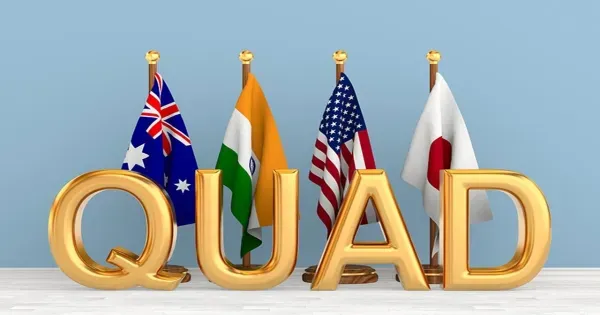
The meeting of the foreign ministers of India, America, Japan and Australia group Quad (Quadrilateral Security Dialogue) was concluded in the Indian capital New Delhi. The group countries discussed the Hormuz crisis and North Korea’s nuclear program in the meeting and expressed their commitment to move forward on the policy of ‘zero tolerance’ on terrorism. The member countries, in their joint statement, committed to a ‘free and open Indo-Pacific’ and have taken a great initiative to share technology and capabilities to monitor maritime activities in the region. It has been named Indo-Pacific Maritime Services Cooperation Initiative.
Through this, ships and maritime security in the Indian Ocean and Pacific region can be easily monitored. It is noteworthy that about 60 percent of the world’s maritime trade route passes through the Indo-Pacific region. In such a situation, monitoring this area is necessary for the Quad group. The member countries of the group have prepared a common framework for important minerals such as critical rare earth minerals. It is not hidden from anyone that 90 percent of the rare earth minerals required for every electronics and high-end products are supplied from China, but now the group countries have broken China’s dominance in this matter.
This initiative of the group countries has increased China’s uneasiness and it has expressed a strong reaction saying that conflict should not be created through small groups. This is not the first time that China’s anxiety has increased regarding the Quad group meeting. Last year, when the historic annual Leaders Summit of Quad (Quadrilateral Security Dialogue) countries was held in Wilmington, Delaware, America, even then China was in a panic. Then, in their joint statement, the member countries, while referring to the South China Sea, had bluntly said that ‘We are concerned about the situation in the eastern South China Sea and everyone should respect international laws.’
The truth is also that China is solely responsible for the challenge to the sovereignty of this region. To deal with this situation created by him, the need for an organization like Quad was felt. It will be remembered that while addressing the Indian Parliament in 2007, the then Prime Minister of Japan Shinzo Abe had clearly said that we all have to be prepared to deal with the emerging strategic challenges in the Indo-Pacific region. His visionary thinking and vision later became the basis for the formation of Quad.
If you notice, China’s uneasiness has increased since the formation of Quad. He feels that the countries included in the Quad are conspiring against him. He sees the Quad as an emerging ‘Asian NATO’. He knows that the strength of the Quad will control his arbitrariness in the region and his desire to rule the world through the sea will not be fulfilled. It has to be understood that the Quad member countries had already advised China to stay within its limits during their first virtual conference.
Then US National Security Advisor Jack Sullivan had said that America is under no illusion about China’s aggression with Australia, harassment around Japan’s Senkaku Islands and border tensions with India. It is ready to deal with every situation in the Indo-Pacific region. It will be remembered that last year, in the same region, 13 countries including America had made an effort to put a decisive check on China’s increasing bullying and bullying by shaping the ‘Indo-Pacific Economic Group’ (IPEF) trade agreement. All countries are troubled by this action of China.
On the other hand, it is challenging the sovereignty and security of other countries by stationing a security fleet in this area. In such a situation, it has become very important to crack down on him. The good thing is that a consensus is emerging among the member countries of this region. All countries are ready to curb China’s activities by using satellite systems.
The coming together of the island countries with India will further increase China’s restlessness and restlessness, but the way the countries of the Indo-Pacific region are forming a front against China, it is clear that China’s dominance will no longer prevail in this region. This initiative against China is also necessary because the Indo-Pacific region is the main axis of the global economy. At present, this region has become a field of battle between global powers geo-politically and strategically. (These are the personal views of the author)
-
Jeremy Doku reveals talks with Jurgen Klopp and Sadio Mane before turning down Liverpool move

-
Wayne Rooney backs Manchester United as surprise contenders in next Premier League season

-
World Cup 2026: Introducing the debutant nations ready to make history 🌍

-
Julian Nagelsmann emphasises a key factor behind selecting Assan Ouedraogo ahead of Said El Mala

-
World Cup 2026 Warm-Up Result – Havertz’s Early Goal Stuns as USA Fall to Germany 1-2