
Every patio, driveway, and garage slab you have ever walked on starts as a wet grey soup. The proportions in that soup need to be precise, because slip-ups can mean the slab cracks or refuses to set properly. It’s why builders have come up with shorthands that serve as memory hacks.
One of these is the 20/30/40 rule, which can best be described as a performance-based design guideline. In it, the 20 is the percentage of cement, the binder that holds everything together. Skimp on it and the slab will not bond well. Next is 30, representing sand, which gives concrete a smoother, more workable texture. Get it wrong, and the surface ends up rough or full of voids.
Finally, the 40 is the percentage of coarse aggregate, which usually means gravel or crushed stone. This is what mainly gives the slab its structure once it hardens, by providing bulk and resisting compression. Go light on it and the slab loses strength. Concrete losing strength is actually one of the common causes that ruin a concrete driveway. Add all of these ratios together and you actually get 90%. That’s because the remaining 10% is the honorable mention: water. The ratio for water matters too, because it helps the structure.
You might also come across a separate guideline called the 10/20/30/40, which sounds like the same rule, but it isn’t. In that version, cement drops to 10% and water becomes 20%, while sand and gravel stay at 30% and 40%. That said, both rules deal with flatwork – anything you walk on rather than build up, like driveways, patios, and sidewalks. It sits alongside other quick references like the 4-2-1 rule for concrete, which covers the ratio of gravel, sand, and cement in a basic mix.
Where the rule starts to show its limits
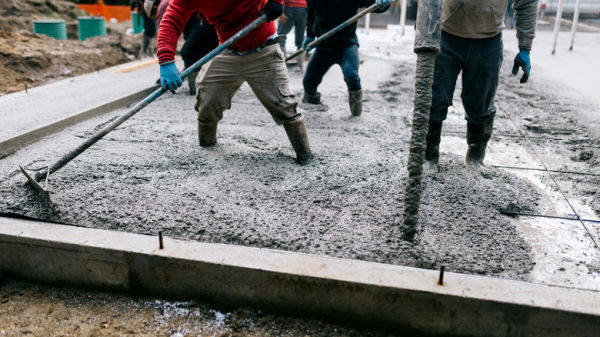
It’s worth mentioning that none of this is a strict legal requirement. The 20/30/40 rule is a simplified sanity check for everyday residential pours, like a small patio. If something bigger is involved, structural engineers will run more sophisticated mix calculations based on factors like compressive strength targets, freeze-thaw exposure, and how the concrete is being placed.
As someone who’s simply trying to work out how much cement you need for a slab for home, a concrete calculator will help you translate the slab’s dimensions into cubic yards (the volume needed) in a few seconds.
Besides the amounts and ratios, you also have to be precise with the timing, which isn’t something the shorthand immediately conveys. That’s because the clock starts ticking the moment the cement and water meet inside the mixing drum, since that’s when the chemical reactions kick off. Regardless of the composition of the so-called soup, ready-mix concrete typically has a working window of about 90 minutes from the time it is batched to when it needs to be poured and finished.
There’s also something called the Rule of Sixes, which is another shorthand builders lean on. It says you should use at least six bags of cement per cubic yard of concrete, no more than six gallons of water per bag, and let the slab cure for at least six days. Of course, the Rule of Sixes and any other rule you may run into are not in competition, so it’s not like one is better than the other. They simply cover different parts of the same job.