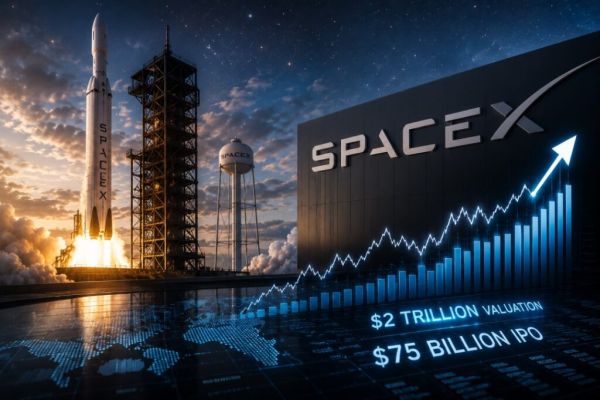
For years, SpaceX existed in a strange financial category. It was one of the world’s most discussed private companies, yet ordinary investors could only watch from a distance while venture firms, wealthy individuals and insiders captured most of the gains. That situation may soon change. Reports that Elon Musk’s space company is preparing for a public listing in 2026 have triggered intense excitement across financial markets, technology circles and retail investing communities.
The numbers attached to the proposed offering are difficult to ignore. SpaceX is reportedly targeting a public listing that could raise around $75 billion and value the company close to $2 trillion. If those figures hold, the listing would become one of the largest stock market debuts ever attempted.
The excitement surrounding the possible IPO reflects more than fascination with Elon Musk himself. Investors increasingly view SpaceX as something unusual in the technology world: a company that combines national security contracts, commercial internet services, launch dominance and long-term space ambitions inside a single business. Unlike many high-profile technology startups that relied heavily on speculation for years, SpaceX now generates large amounts of real revenue through satellite internet services and commercial launches.
Yet the frenzy surrounding the expected listing also raises harder questions about valuation, competition and whether late-stage investors can still expect the kind of explosive returns that early SpaceX backers enjoyed.
Starlink Has Changed the Financial Story Around SpaceX
For much of its early history, SpaceX was treated primarily as a rocket company. Investors focused on launch technology, reusable boosters and Musk’s ambition to build a path toward Mars. The company’s commercial future looked ambitious but uncertain because the economics of private space travel remained difficult to prove at scale. That picture has changed sharply through Starlink.
The satellite broadband business has quietly become one of the company’s largest commercial engines. Starlink now operates thousands of satellites in low Earth orbit, providing internet access across rural regions, ships, airlines and remote industrial sites. The network has expanded rapidly as governments, businesses and consumers seek alternatives to traditional telecommunications infrastructure.
Financial figures reported around the company suggest the scale has become substantial. Starlink’s connectivity business reportedly generated more than $11 billion in revenue during 2025 while producing operating income that many younger technology companies still struggle to achieve. Subscriber growth has also risen sharply, with the company reportedly crossing more than 10 million users worldwide by early 2026.
That matters because investors tend to value recurring subscription businesses differently from manufacturing or aerospace companies. SpaceX no longer depends solely on launching rockets for government contracts. It now controls a telecommunications network with direct consumer revenue flowing in every month.
This combination partly explains why investors are discussing SpaceX less like a traditional aerospace firm and more like a technology conglomerate with multiple revenue streams. Some analysts compare the company simultaneously to satellite providers, defence contractors, telecommunications businesses and cloud computing firms.
The company’s launch business still remains central. Falcon 9 continues dominating commercial launches, while reusable rocket technology has lowered costs in ways that reshaped the economics of space transport. Yet much of Wall Street’s attention now focuses on whether Starlink could eventually become even larger than the launch division itself. The answer may depend heavily on Starship.
Starship Carries Both Opportunity and Financial Risk
If Starlink changed SpaceX’s commercial future, Starship may determine how far that future extends.
The next-generation rocket system represents Musk’s most ambitious engineering project inside the company. Starship is intended to carry heavier payloads, support lunar missions, transport future generations of satellites and eventually support long-duration missions deeper into space. SpaceX also hopes the system can lower launch costs sharply through full reusability.
The project, however, has already consumed enormous financial resources. Development spending reportedly exceeded $15 billion as engineers continue testing engines, launch systems and recovery methods. Some launches succeeded partially while others ended in explosions or technical failures, reflecting the difficulty of building reusable spacecraft at such scale.
Investors considering the IPO will likely examine Starship carefully because it influences several future revenue ambitions tied to SpaceX. The rocket is expected to launch larger Starlink satellites capable of improving bandwidth and reducing operating costs. Musk has also discussed possible orbital data centres and broader commercial uses tied to artificial intelligence computing in space.
Those ideas remain speculative, but they have already influenced conversations around companies connected indirectly to SpaceX’s growth. Semiconductor firms such as Nvidia and Taiwan Semiconductor Manufacturing Company attract attention because satellite computing networks and AI processing would require enormous chip capacity. Networking providers, cloud computing companies and communications hardware manufacturers may also benefit if satellite internet usage expands further.
This explains why some investors view the SpaceX listing as larger than a single stock market event. The IPO has become tied to wider enthusiasm surrounding artificial intelligence, satellite connectivity and next-generation computing systems. At the same time, risks remain substantial.
Space businesses still operate in a capital-intensive industry where technical failures can become extremely expensive. Launch delays, satellite losses or regulatory disputes can affect profitability quickly. Governments also play a large role in commercial space markets through defence contracts, telecommunications approvals and launch regulations.
Competition is increasing as well. Amazon continues investing heavily in Project Kuiper, its own satellite internet business. Chinese space firms are expanding launch activity rapidly. Traditional aerospace companies still compete for defence and government contracts. SpaceX currently dominates many parts of the commercial launch market, but maintaining that position requires constant spending on technology, manufacturing and launch capacity.
The IPO itself also arrives during a period when public investors have become more cautious about expensive technology listings. A valuation approaching $2 trillion leaves little room for disappointment. Investors buying at those levels may not experience the explosive gains seen by early venture capital firms that entered SpaceX years earlier when valuations were far lower.
That reality has created debate about whether the smartest investment opportunities connected to SpaceX may actually sit elsewhere.
Some market analysts argue that suppliers tied to AI chips, satellite networking and computing hardware may benefit from SpaceX’s growth without carrying the same valuation risk. Others believe the company’s unique combination of launch dominance and satellite services still gives it advantages difficult for competitors to match.
What remains clear is that the planned listing reflects how dramatically SpaceX has changed since its early years as a risky private rocket startup.
-
'I just want to play for India': The simple dream driving RCB pacer Rasikh Salam Dar

-
How To Make Fresh Mango Frooti At Home That Tastes Like Store-Bought

-
2026 Honda City Vs Hyundai Verna: Detailed Comparison

-
7,500mAh battery and MediaTek processor… burn the new Honor smartphone in the market! You will also be happy with the price

-
Belgium beats Croatia 2-0, Lukaku scores 90th goal in return