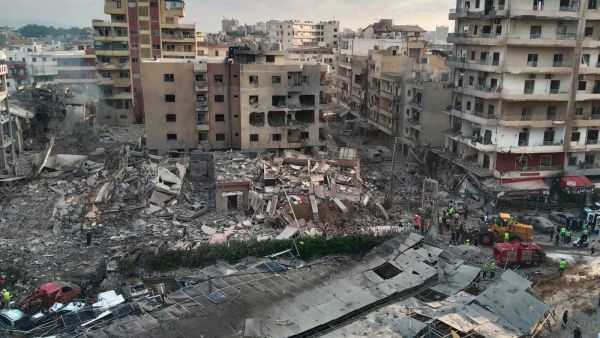
Dubai: The US military said that Iranian missiles fired at Kuwait and Bahrain failed or were shot down, and that the US launched strikes on an Iranian facility in response.
US Central Command said the strikes were on an Iranian military ground control station on Qeshm Island, near the Strait of Hormuz, that is home to a desalination plant.
Iran had fired missiles toward Kuwait and Bahrain, but failed to hit their targets, the US said. The two fired at Kuwait fell apart en route, while US and Bahrain forces intercepted the missiles aimed at Bahrain.

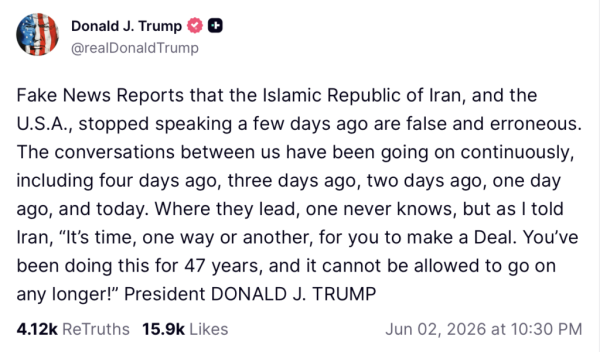
The activity happened after Iran stopped communicating with mediators about extending a ceasefire in the war with the US and Israel, according to reports on Tuesday, June 2, from two semiofficial Iranian news agencies. President Donald Trump disputed the claim and said talks were continuing.
The reports by the Fars and Tasnim news agencies, both believed to be close to Iran’s paramilitary Revolutionary Guard, came as tensions flared in Israel’s separate-but-related fight against the Iranian-backed militia Hezbollah in Lebanon.
A regional official involved in the mediation, speaking on condition of anonymity to discuss the talks, told The Associated Press that Iran had not communicated at all on Tuesday after saying that a ceasefire needed to be enforced in Lebanon for negotiations to continue.
In other developments, the US military said it fired a missile to halt another oil tanker trying to reach an Iranian port in violation of the American blockade. It was the seventh ship stopped by the military while trying to run the blockade, US Central Command said in a social media post.
The Botswana-flagged merchant vessel M/T Lexie was stopped by an aircraft firing a Hellfire missile into its engine room after the crew ignored repeated warnings over 24 hours, the post said.
Trump says talks going on continuously
Trump called reports of a cessation in talks “false and erroneous.”
“The conversations between us have been going on continuously, including four days ago, three days ago, two days ago, one day ago and today,” Trump said in a social media post. “Where they lead, one never knows, but as I told Iran, It’s time, one way or another, for you to make a Deal.”
US Secretary of State Marco Rubio did not address the reported cutoff in communications as he testified at a congressional hearing in Washington. Instead, he sounded an optimistic note about the nuclear dimension of the negotiations, while cautioning that there’s no guarantee of reaching “a deal that’s acceptable.”
Iran has been trying to increase pressure on Trump over negotiations on the Iran war ceasefire and loosening the Islamic Republic’s chokehold on the Strait of Hormuz and the oil, gas and other commodities that normally pass through it. Trump then could potentially push Israeli Prime Minister Benjamin Netanyahu to halt or slow the advance of his forces, which have moved deeper into Lebanon than at any time in over a quarter of a century.
Inflation takes an economic toll on Iran
Meanwhile, year-on-year inflation in Iran reached a level in May unseen since World War II, underlining the economic pain average Iranians are facing. While the US is eager to ease the Islamic Republic’s grip on the strait — through which a fifth of all traded oil and natural gas passed in peacetime — Iran faces economic challenges as its oil-backed economy remains under a US naval blockade.
Economic pressure touched off nationwide protests in Iran in 2017 into 2018, when rising food prices sparked demonstrations that killed over 20 people and saw hundreds arrested. The next year, an increase in government-subsidized gasoline prices caused protests that saw over 300 people reportedly killed.
Then came the protests over the collapsing value of Iran’s currency, the rial, at the start of this year. They were the most intense demonstrations to shake the Islamic Republic since its 1979 revolution and the chaotic years that followed. Iran’s theocracy met January’s protests with a crackdown on demonstrators in January that killed over 7,000 people, according to activists’ estimates.
Prices climb at an unprecedented rate
Iran’s Central Bank said the consumer price index, which measures a basket of goods and services, reached 77.2 per cent in May compared with the year before. The rate is 8.5 per cent higher than in April, the bank added. Inflation in daily and general needs — like medicine, taxi fares, tobacco and communication fees — rose 113.8 per cent from the year before.
A private economic think tank in Iran, the Bamdad Institute of Economic Studies, described the current figures as “an unprecedented rate since World War II.” Iran’s Central Bank did not acknowledge the significance of the figures.
The previous record came in 1942. During the war, the British and Soviets invaded Iran and took over its railway, disrupting food supplies. The lack of food, worsened by a poor harvest, sparked hyperinflation and a famine. Hunger and a typhus outbreak killed many.
-
Sagittarius Tarot Horoscope Today, June 3, 2026: A journey awaits, promising joyful news

-
Taurus Tarot Horoscope Today, June 3, 2026: Strengthen Communication and Keep Balance in Relationships

-
Scorpio Tarot Horoscope Today, June 3, 2026: Will Share Good News and Connect with Friends

-
Gemini Tarot Horoscope Today, June 3, 2026: Will Keep Promises to Loved Ones and Stay Proactive

-
Cancer Tarot Horoscope Today, June 3, 2026: Stay cautious and act with initiative