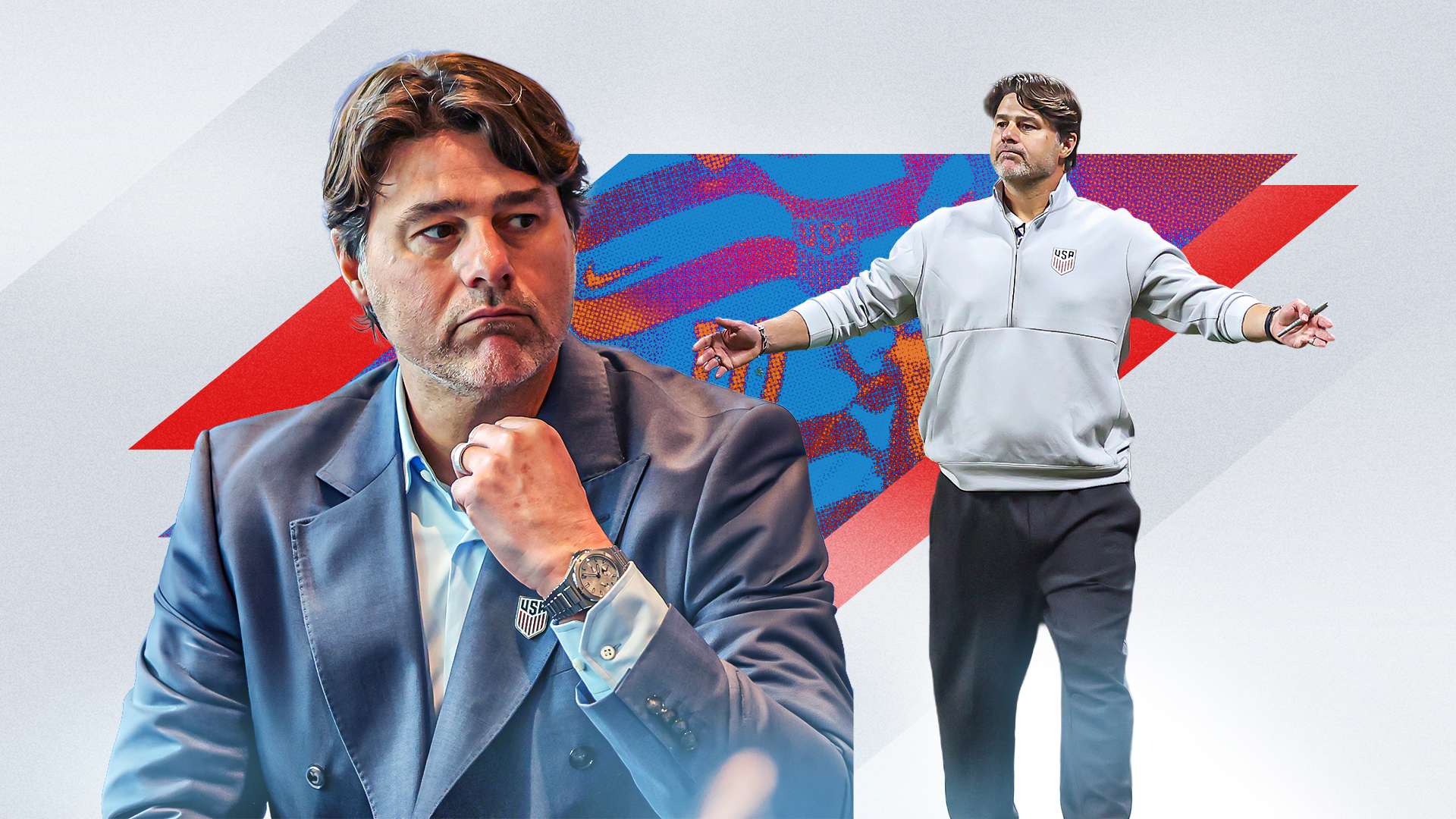
On September 13, 2024, Mauricio Pochettino was all smiles as he stepped into his new role. Wearing a sharp blue suit with a U.S. Soccer badge on the lapel, he was officially introduced to the vibrant and often unpredictable world of American football. Surrounded by his new leadership team, Pochettino looked determined to make a strong first impression — and in the United States, boldness often makes the biggest impact.
That day in New York, Pochettino made his intentions clear. He set the tone for what would become a two-year journey that could reshape the image of the American game. “We need to really believe and think big. We need to believe that we can win, that we can win all the games. We can win the World Cup,” he declared with conviction.
Now, on the eve of the World Cup, Pochettino’s defining moment has arrived. He has guided this U.S. men’s national team through turbulence to reach this point. The progress hasn’t been smooth, and many still question just how much improvement has actually been made. Is this team stronger than the one he inherited? Are the players truly ready to deliver this summer? Can he instill the belief he has been preaching — both within his squad and across the nation?
These are the questions that linger, and they cannot yet be answered. Pochettino’s appointment was never about the early months, but about this ultimate moment. His time has come, and while he believes in the USMNT, the question remains — will everyone else?
World Cups are chaotic, unpredictable, and rarely follow the script. For Pochettino, the time for his grand plan to unfold has finally come. To understand that plan, one must first understand the man behind it — only then can one appreciate why he accepted this challenge in the first place.
Dream becomes a nightmare
In 1994 and 1998, Pochettino waited for a call that never came. Representing Argentina at a World Cup was his lifelong dream — one he chased relentlessly while playing for Newell’s Old Boys, Espanyol, and later Paris Saint-Germain. That dream had its roots in his early days in Murphy, Argentina, where he worked on his family’s farm while nurturing footballing ambitions. His moment finally arrived in 2002.
But his first World Cup turned out to be a nightmare. Argentina entered the 2002 tournament in Japan and South Korea as one of the favorites, but crashed out in the group stage. A key moment came when Pochettino fouled Michael Owen, leading to David Beckham’s decisive penalty in a 1-0 loss to England — a result that sealed Argentina’s exit.
“We arrived at the World Cup in our best condition,” he recalled. “It was one of the most disappointing times in our national team’s history. We had beaten Germany in Germany, Brazil in Brazil, Spain too. But at the World Cup, we lost — and everyone remembers only how bad we were. No one remembers the good days.”
Road to America
Since that heartbreak, Pochettino’s coaching journey has been filled with success and learning. From Espanyol to Southampton, and then five iconic years at Tottenham Hotspur, he built his reputation as one of football’s most respected minds. His stints at Paris Saint-Germain and Chelsea gave him experience managing superstars and navigating intense pressures.
All those experiences led him to the United States. By the time the U.S. crashed out of the 2024 Copa America group stage, the national setup needed a spark — and Pochettino was seen as the man to ignite it. This was more than a coaching job; it was about becoming the face of American football ahead of its biggest-ever moment on home soil.
The task was as cultural as it was tactical. Whoever took charge would not only shape the team’s style but also represent American football to the rest of the world — and elevate it to global standards, fast.
After leaving Chelsea, Pochettino was looking for a project, and he found one that offered redemption — a chance to create new World Cup memories. But even he wasn’t fully prepared for the unique challenges of American football.
Start of something
Pochettino’s debut as USMNT manager was a celebration. On a lively October 2024 night in Austin, Texas, fans were buzzing with excitement. Posters handed out before the match read “Believe” — echoing the spirit of the fictional coach Ted Lasso.
The U.S. beat Panama 2-0 that night, a promising start. But the next test came quickly — a rotated squad lost to Mexico just days later, marking the beginning of a rollercoaster tenure filled with highs and lows.
In November, the U.S. defeated Jamaica twice. In January, a largely MLS-based team crushed Venezuela and Costa Rica by a combined 6-1 scoreline. Everything seemed to be falling into place — Pochettino was rejuvenating veterans while introducing new faces. But then came March 2025, a turning point still discussed today.
Turning point
That month, the U.S. lost 1-0 to Panama in the CONCACAF Nations League semi-final after conceding a last-minute goal despite dominating. Days later, Canada beat them. Frustrated, Pochettino demanded more fight from his players.
“We are USA,” he said. “You cannot win just by wearing the shirt or being here. You must show it — work hard, win duels, and suffer. Otherwise, it’s never enough.”
Things worsened before the Gold Cup. Christian Pulisic and Yunus Musah opted for rest. Weston McKennie, Tim Weah, and Gio Reyna were unavailable due to the Club World Cup, while several others — Sergino Dest, Antonee Robinson, Folarin Balogun, and Ricardo Pepi — were injured.
Pochettino used that summer to reset the team’s culture. “If you come to camp to play golf or relax, that’s not the culture we want,” he said. “We must be focused and give all our energy to the national team. If we want to be good next year, we must treat today as the most important day.”
Cultural reset
By May, as World Cup preparations intensified, Pochettino spoke at U.S. Soccer’s new National Training Centre about the cultural challenges. Having lived and worked in Argentina, Spain, France, and England, he knew the U.S. was different. The key was to respect that difference while reshaping it.
“Now we are seeing the real American player,” he said. “We have created our own culture and philosophy. If we want to compete with Brazil or Argentina, we must see sport differently than before.”
These changes began not against global giants, but against teams like Trinidad & Tobago, Saudi Arabia, and Haiti. The foundations were built during the Gold Cup — a grueling summer across the U.S. without many stars. Pochettino leaned on hungry newcomers and veterans eager to prove themselves. The team reached the final, losing to Mexico, but rediscovered their identity.
Later that year, the U.S. beat Japan, Ecuador, Australia, Paraguay, and Uruguay — finishing 2025 with a dominant 5-1 win over Uruguay. Though defeats to Belgium and Portugal followed in March, a 3-2 victory over Senegal in their World Cup camp reignited belief.
Optimism is high in the U.S. — higher than it has been in years. But is it enough to realize Pochettino’s early promise: winning the World Cup?
Reason to believe?
Realistically, the U.S. is unlikely to win the World Cup this time. There are too many elite, battle-tested teams. Yet, Pochettino’s mission was never solely about lifting the trophy — it was about instilling belief that one day, it could happen. Maybe not this year, maybe not even in four years, but someday soon.
Pochettino’s era has been defined by belief — belief in him, belief in his players, and belief in the idea that American football can compete with the world’s best. This journey traces back to 1994, when the U.S. first took its place on the global stage.
Throughout his tenure, Pochettino has repeated the same mantra — referencing the Miracle on Ice and asking his players, “Why not us?” His most famous phrase captures his philosophy perfectly: “Let’s be realistic and do the impossible.”
Now, as his American chapter reaches its climax, Pochettino remains fearless. Whether his boldness will yield results remains to be seen. But until the final whistle blows, he’s asking America to believe — in him, his players, and their shared dream.
-
UP: Man wanted for businessman's murder killed in encounter in Ghazipur

-
French Open 2026: Poland's Maja Chwalinska Beat Anna Kalinskaya To Reach Maiden Major Semi-Finals
-
Spain's 2026 World Cup Group H Schedule Revealed! Spanish Jersey Becomes Most Wanted in Pontianak
-
Hoping for Quad leaders meeting this year on sidelines of global meet: Rubio

-
CBSE says 3.8 million-packet DoS attack on website thwarted