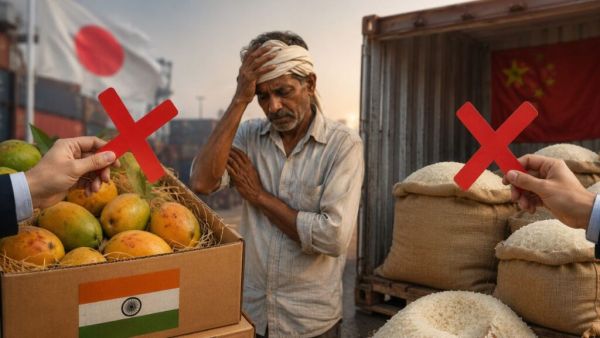
Japan has completely banned buying fresh mangoes from India this year. On the other hand, China has also repeatedly sent back Basmati rice coming from India, terming it as bad. Due to these two decisions, India’s agricultural business is suffering huge losses and questions are also being raised on the quality of Indian goods in the world. There has been no official statement or response from the Government of India on this entire matter yet.
Japan has completely banned the import of fresh mangoes from India this season. The reason for this came to light when a team of Japanese officers came to see the Vapor Heat Treatment Plant of a factory built in Rahmanpur, Uttar Pradesh. During this visit, the Japanese team found many deficiencies and defects in the methods of cleaning mangoes and killing insects there.
In Japan, there are very strict rules regarding the insect called fruit fly and they do not tolerate even the slightest negligence in it. Due to the malfunction of this factory, the export of India’s best and expensive mangoes like Alphonso, Kesar, Langra and Banganpalli has completely stopped. This ban has dealt a big blow to those farmers who work hard throughout the year to grow these special mangoes.
Yokohama Plant Protection Association of Japan has clearly stated that any mangoes passed after March 25, 2026 will not be allowed to enter Japan. Earlier in the year 1986 also, Japan had imposed a similar ban on Indian mangoes. At that time, it took a long time of 20 years for India to remove this ban and re-enter the Japanese market and that ban was removed in the year 2006.
Why did China return Basmati rice?
The Customs Department of China has rejected Indian Basmati rice about 70 times and sent it back to India. Chinese officials say that dangerous insects named ‘Khapra Beetle’ have been found in the rice sent from India. Pesticides that kill insects have been found in rice grains in quantities much above the prescribed limit. For this reason, China has refused to allow this rice to enter its country.
If we look at the business figures, China is not a big buyer of Indian Basmati rice. India sends only 1,000 to 2,000 tonnes of Basmati rice to China every year, which is only 0.01% to 0.05% of India’s entire Basmati export. China actually buys more common rice and broken rice from India. The main market of Indian Basmati rice is in Middle East countries like Saudi Arabia, Iran, Iraq, UAE and Yemen. Apart from this, Britain and America also buy it. Middle East countries alone account for about 60% to 70% of the world’s total Basmati market.
What effect will this have on the country?
Talking about money loss, Japan is not the biggest buyer of Indian mangoes because India sends most of its mangoes to UAE, America and Britain. Despite this, this decision of Japan and China has dealt a blow to India’s agriculture sector. India earns a lot of foreign earnings from Basmati rice. On one hand, China is returning rice and on the other hand, the Indian government has already banned sending common rice abroad to prevent inflation in the country.
Due to both these reasons, India’s overall income from agriculture has declined. This crisis shows that there are shortcomings in our country’s factories and checking system. If India has to become the third largest economic power in the world, then it will have to upgrade its factories to the international level.
future problems
The food quality standards of India’s agricultural products are not matching the international level because our domestic processing centers and thermal treatment plants are running on old technology where testing and disinfection is not done properly. Apart from this, pesticides that kill insects are used excessively during farming, which fails the stringent standards of foreign countries.
If this problem continues like this, then in the coming time, other big countries can also ban Indian fruits and grains, due to which their confidence in India in the international market will be completely lost and the finished goods of the farmers will remain within the country.
-
Summer Special : Have you ever had mango pulao? Try it at home before the end of the season
-
Double burst of maximum features! Huawei’s entry of two smartphones in China… equipped with 200MP camera and satellite calling

-
Anil Kumble predicts India’s playing XI for the one-off Test against Afghanistan. Read

-
Liverpool opens talks with Andoni Iraola to become the coach

-
Suryakumar Yadav’s Lean Patch Continues As Mumbai Indians Star Fails To Deliver For New Team After IPL 2026 Woes: Check Details Inside