The phrase 'Golden Generation' in English football is often traced back to Adam Crozier, the then-chief executive of the Football Association, who famously used it to describe the England team after their stunning 5–1 victory over Germany in a World Cup qualifier in Munich. While the performance was remarkable, the label would go on to create immense expectations and perhaps unintended pressure for years to come.
That moment in 2001 set a benchmark. Crozier’s declaration suggested England had reached a peak in terms of talent, despite being 35 years removed from their last World Cup triumph. The nation had enjoyed moments of promise, such as the Euro ’96 semi-final run, but Crozier’s statement placed an enormous burden on Sven-Göran Eriksson’s squad.
Ultimately, England never quite fulfilled the promise of that so-called 'Golden Generation'. The term lingered, even as successive squads failed to live up to expectations. That group aged, evolved, and eventually faded, paving the way for a new era. Only after the original 'Golden Generation' had moved on did England re-emerge as genuine World Cup contenders once again.
Across the last seven World Cup tournaments, England’s squads have undergone significant changes. Four different managers have taken charge during that stretch, with a fifth now preparing for 2026. A handful of players bridged multiple eras, while others were phased out too soon—or perhaps stayed too long.
With that in mind, here’s a ranking of England’s World Cup squads of the 21st century, from 2002 through to the team chosen by Thomas Tuchel for 2026, based on overall talent and balance:
7. 2014
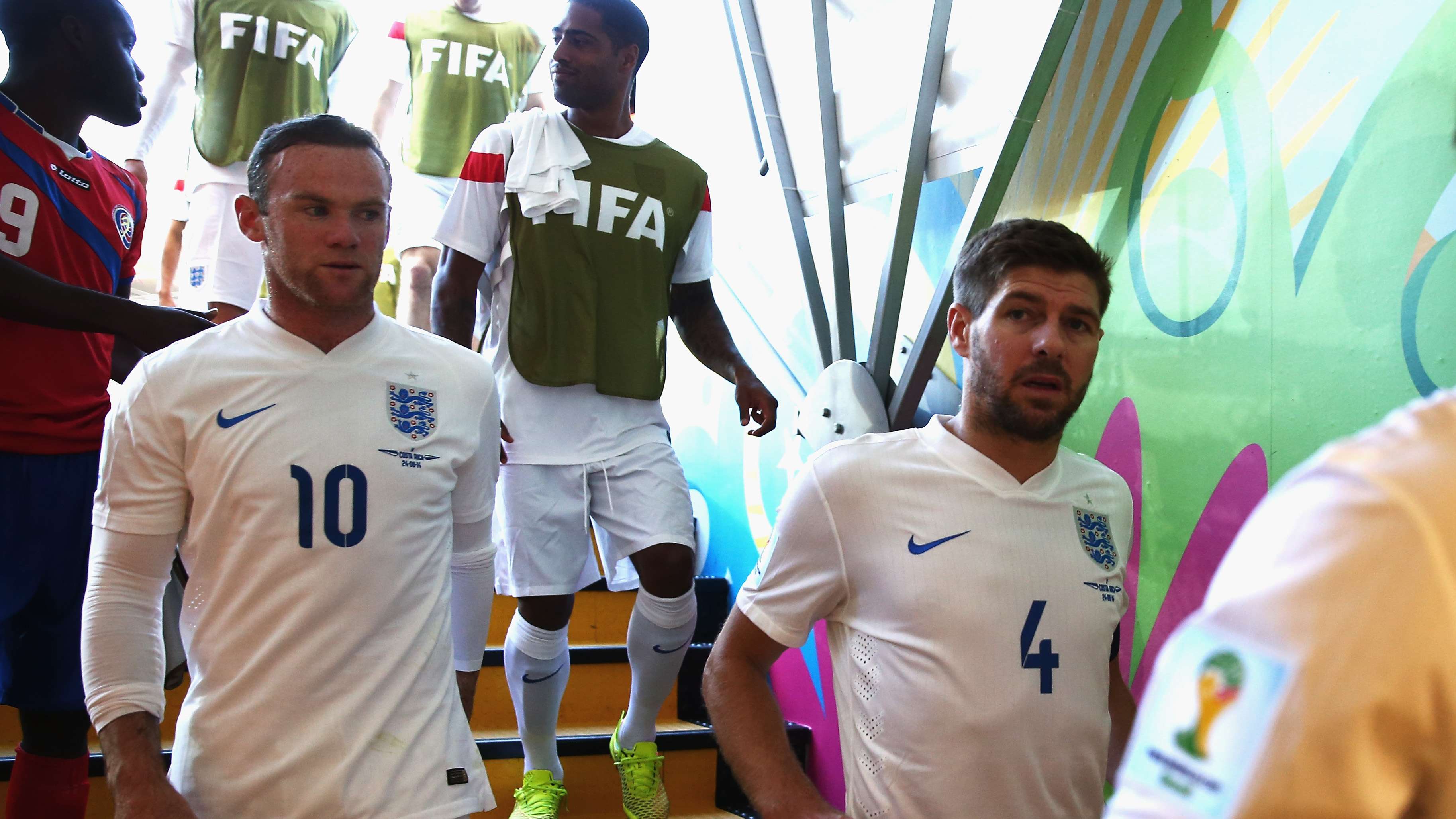
England’s 2014 World Cup campaign in Brazil was one to forget. Drawn in a challenging group with Italy, Uruguay, and Costa Rica, the Three Lions made an already tricky task look far more daunting. A loss to Italy was followed by defeat to Uruguay, and after Costa Rica stunned the Azzurri, England were mathematically eliminated before their final group game.
The squad lacked players at their peak. Steven Gerrard captained the side but was still reeling from a painful end to Liverpool’s Premier League campaign. Wayne Rooney and Frank Lampard were past their prime, while the youthful energy of Daniel Sturridge and Raheem Sterling couldn’t compensate for a shaky defence led by Gary Cahill and Phil Jagielka. It was a campaign to forget.
6. 2010
Fabio Capello’s 2010 squad still had remnants of the 'Golden Generation', but also showed signs of decline. England’s World Cup hopes suffered an early blow when captain Rio Ferdinand was injured in the first training session in South Africa, forcing Jamie Carragher or Matthew Upson to fill in alongside John Terry.
Injuries to Rooney and Gareth Barry — the latter seen as key to balancing Gerrard and Lampard in midfield — further weakened the team. While the squad boasted world-class names like Rooney, Gerrard, Lampard, Terry, and Ashley Cole, the overall depth was thin. England exited in the Round of 16 after Rob Green’s blunder against the USA and Frank Lampard’s infamous disallowed goal against Germany became the tournament’s defining memories.
5. 2002
England’s 2002 squad, managed by Eriksson, was rich in star power with David Beckham, Michael Owen, Rio Ferdinand, Sol Campbell, and Paul Scholes. However, injuries to Gary Neville and Steven Gerrard disrupted the balance. Danny Mills took over at right-back, while Gerrard’s replacement, Danny Murphy, was himself injured before the tournament, leading to Trevor Sinclair’s late call-up.
Sinclair ended up starting three matches on the left flank, highlighting England’s long-standing 'left-sided problem'. Beckham’s metatarsal injury also limited his influence. Yet, England still managed notable highs — including victory over Argentina and a dominant display against Denmark. Their journey ended when Ronaldinho’s audacious free-kick lobbed David Seaman, halting what might have been a deeper run. Despite flashes of brilliance, this team wasn’t England’s most talented.
4. 2018
Under Gareth Southgate, England’s 2018 squad reached the semi-finals, matching their best World Cup finish since 1966. However, their performance arguably exceeded their actual ability. There were bright spots — Harry Kane and Dele Alli’s chemistry at Tottenham, and Raheem Sterling’s stellar form for Manchester City — but also obvious weaknesses.
Kyle Walker played as part of a back three with a pre-Manchester United Harry Maguire, while Ashley Young was deployed as a left wing-back. Jesse Lingard started regularly, and Ruben Loftus-Cheek featured off the bench, revealing a lack of depth. England’s eventual extra-time loss to Croatia exposed those shortcomings, though the run rekindled belief in the national team.
3. 2022
Following their Euro 2020 final appearance, England entered the 2022 World Cup in Qatar with momentum. Declan Rice, Bukayo Saka, and Phil Foden had established themselves among the Premier League’s brightest stars. Right-back competition between Trent Alexander-Arnold and Kyle Walker was fierce, while Jude Bellingham added a new dimension with his creativity and drive.
Harry Kane continued to deliver up front, while experienced names like Jordan Pickford, John Stones, and Maguire provided stability. Kalvin Phillips and Mason Mount were still reliable, with Jack Grealish and Marcus Rashford offering impact options off the bench. Despite a strong showing, England’s quarter-final exit to France — marked by Kane’s missed penalty — felt like a squandered opportunity.
2. 2026
Thomas Tuchel’s 2026 squad appears to have learned from the past. The team is brimming with talent but displays a more pragmatic approach. Kane enters the tournament as the Ballon d’Or frontrunner after a 60-goal season for Bayern Munich. Declan Rice has arguably been the Premier League’s standout performer, while Bellingham and Saka exude world-class quality.
Balance has been a key focus. Elliot Anderson anchors the midfield with discipline, and Reece James offers a more stable option than Alexander-Arnold at right-back. However, the defence remains inexperienced, and the inclusion of Anthony Gordon and Rashford on the wings has drawn debate. With Cole Palmer and Foden left out, England may lack game-changers from the bench. Still, in terms of raw talent, this is arguably England’s best squad in two decades.
1. 2006
England’s 2006 World Cup squad in Germany remains the most star-studded of the 21st century. The back four — Gary Neville, Rio Ferdinand, John Terry, and Ashley Cole — was formidable. Gerrard and Lampard formed a powerhouse midfield pairing, while Wayne Rooney and Michael Owen led the attack. Rooney was recovering from injury but near his peak, and Owen, though slower, remained a lethal finisher.
Depth was equally impressive, with Sol Campbell, Michael Carrick, and Owen Hargreaves on the bench, alongside teenage prodigy Theo Walcott — whose inclusion proved premature. Yet, despite the talent, internal club rivalries and tactical rigidity under Eriksson undermined their potential. Owen’s injury during the group stage added further woes.
Rooney’s red card against Portugal in the quarter-finals summed up the campaign, as England again fell to a penalty shootout. A team capable of winning it all instead departed early, leaving fans wondering what might have been.
-
SIP for ₹1 Crore: How Much Should You Invest Monthly in 5, 10, 20, or 25 Years?

-
PPF Returns: Invest Before This Date Every Month to Earn More Interest on Your Savings

-
8th Pay Commission Extends Suggestion Deadline to June 15; Employees Get More Time to Submit Demands

-
8th Pay Commission: Will a Higher Fitment Factor Trigger a Salary Boom? Here's What Experts and Unions Say

-
Indian Bank Loan Customers May Pay More Soon; MCLR and TBLR Rates Revised From June 3