To anyone who’s ever regularly driven a classic car as well as modern ones, one thing becomes immediately obvious: Older vehicles almost always are entirely different beasts. Obviously it varies from car to car, but features we take as fundamental today can be entirely different, if not omitted entirely, on classics — which, to some, is part of the appeal.
There’s no denying that classic cars provide a quaint, analogue driving experience that simply cannot be replicated by most modern vehicles, albeit at the cost of performance, safety, and sometimes reliability. It’s that experience we’ll be talking about today — more specifically, the quirks that younger generations just will not understand unless they’re taught.
Okay, let’s get the obvious and flamboyant stuff out of the way. It’s easy to say something like, “No reverse cameras, so we have to teach young people how to move their necks to look behind them.” As humorous an image as that is to picture, we’re more referring to mechanical features that are less intuitive, in many cases replaced or modernized in today’s cars. This could be because of the technology they used becoming hopelessly out of date, or the cars themselves no longer being produced.
If you’re a Gen Y or older, you might feel a tinge of nostalgia for many of these features, or possibly a bit of dread. For everyone after that, if you’re considering a classic car as a daily driver, you might want to brush up on these gadgets and features — you might just find one or more in your vehicle and not know how they work.
Transmission column shifters
These were historically known as Three on the tree, and were the typical standard gearbox on a lot of classic American cars and trucks. As opposed to a floor shifter or console shifter, the column shifter is mounted on the steering column behind the wheel, on the right side on left-hand drive cars and vice versa on right-hand drive cars. It’s that big stick that’s poking out of the side; it kind of resembles a wiper stalk, but it’s longer and beefier, in order to handle all the times it’s been slammed into gear over the years. They come in either automatic or manual configuration, with the manuals being by far the most enigmatic to modern users.
Column shifters are commonly found on cars with wide front bench seats, granting plenty of room for three-abreast seating, another trend that’s since died out with modern cars. Like other manual transmissions, column shifters also grant the various benefits one would expect, such as engine braking, inexpensive entry price, and so on. This shifter was first used in 1938, seeing its heyday in the 1950s with full-size American cars having these, automatics, or sometimes floor shifters. Column shifters were used in a lot of foreign cars as well, like the Saab 96 and the infamous Trabant.
However, by the 1970s, column shifters started to see a decline. It was difficult to incorporate more than three speeds, and with increasingly demanding emissions regulations and a general cultural shift to four- and five-speed cars, we simply neglected column shifters, until automakers quietly phased them out. By the mid-1980s, column shifters were all but nonexistent, with the last American vehicle so-equipped being a 1987 Chevrolet / GMC K-frame truck.
Parking brake pedals
Let’s face it: There are very few cars that even feature a third pedal at all in 2026, and most of them are either too exotic to be within the typical Gen Z’s budget, they’re specialized performance cars, or they’re being discontinued, like the 2026 Toyota Supra. Fewer still, if any, have a mechanical parking brake pedal — those fell out of fashion decades ago, with trucks today all having electronic parking brakes. Imagine, then, the daunting venture of having not two, but four pedals on the floor. Which do you press? Why won’t this one retract? Oh my.
Rewind to the 1990s and prior, though, and three or four pedals were often standard on cars, minivans, and trucks, though apparently they’re becoming more enigmatic to people today. In fact, stories are out there of thieves who failed to steal cars after realizing they’re stick shifts, or collectors crashing multi-million dollar pieces because they didn’t know how to drive a manual. Similarly, we wouldn’t be surprised if newer generations didn’t realize they left the parking brake on and drove like that for ages because they didn’t know what the parking brake pedal did.
Sadly, the days of the base-model manual sedan have effectively ended with the death of the Nissan Versa, meaning if you want such a vehicle in the U.S., you’re pretty much landlocked to buying used or classic. Thankfully, there’s somewhat of a resurgence in the car community, with manual transmissions growing in popularity lately, so the death of the manual may be far off. The same can’t be said for cars with mechanical foot-operated parking brakes, however. Even the hand-levers are sadly becoming increasingly rare these days.
Carburetor choke lever
This one may take some explaining for Generation Y as well, or anyone who hasn’t driven a carbureted car, for that matter. Think of a lawn mower or weed whacker; you know how you have to move the choke lever to start them up? The same thing applies to old carbureted cars. Mind you, not every classic car has a manual choke — indeed, some have automatic chokes, like old air-cooled Volkswagens. But for those without such a feature, you instead have a physical lever somewhere by the steering column, usually denoted by a butterfly valve logo; pull it out to choke the carburetor.
Why do these exist, though? In short, a manual choke lever controls a component known as a choke valve; these are devices that close off the carburetor’s air intake, preventing the carburetor from drawing in air. The resulting air/fuel mixture is far richer than normal, ideal for cold starts — once the car is started, you would then open the choke manually to allow nominal air in and let the engine breathe. How fast it’s opened depends on the engine and environment, but in general, you want the choke lever fully open when the engine’s warmed up.
Of course, the delicate balance of a carburetor choke is somewhat of an arcane art in today’s world of fuel injection; carbureted automobiles haven’t been produced in serious quantity in decades, much less ones with manual chokes. Is it impossible to learn? No, but it’s certainly not an intuitive thing to do in modern cars, especially with people who might not even know what a carburetor is.
Roll-up windows
Imagine the sad state of affairs one would find themselves in if they got into a car with a middle schooler who then tried to “open the door” by using the roll-up window crank like a door handle, if not being entirely clueless as to its function. Before you ask AI what the weird second handle on the door is, try giving it a whirl yourself.
Roll-up windows are simplicity itself in operation, but they’re deceptively complicated if you open up the door card and look inside. The way they work is not unlike a scissor lift on the side of a building — basically, the crank has a gear on the inside. That gear is then connected to a scissor mechanism, which holds the window in two places. When you rotate the crank up, the gear moves one of the scissor blades (which has teeth on it) upwards as well, which in turn raises the window. Obviously the reverse direction lowers the window.
There are actually some specialized modern cars which still rock roll-up windows, such as commercial trucks like bare-bones Ford models or Jeep Wranglers. However, you’d be hard-pressed to find any fitted to normal passenger cars in the past decade or two. Moreover, the aforementioned vehicles will no longer offer window cranks in future models, meaning this is officially the first generation which will no longer “roll the windows up” when it gets too windy in the cabin. Unless someone decides to reimplement them for some reason, expect this to be forever among old car features you’ll seldom see any more.
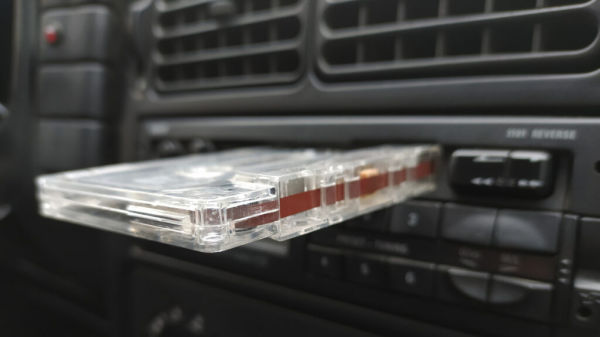
Cassette players
“Be kind, rewind” was practically the motto for those of us who grew up in the 70s to the 90s. Whether for VHS tapes, 8-tracks, or cassettes, if you played the media, you then had to manually rewind it as a common courtesy. We’re used to this — and loathed it whenever people didn’t do this, because the end of the movie would start first and there’s a special level of Hell for people who left the reel on a critical moment that was spoiled. Grudges aside, though, imagine the confusion of modern generations if they play a cassette and the music just… ends. Is it broken?
No, it’s not broken. Cassettes contain analogue music, meaning you have to rewind them like VHS tapes. Many cassette players have a search function, making it easy to skip tracks or rewind to the beginning of a track or tape. Moreover, it’s possible to make mixtapes of your favorite music you find on the radio; have a look into a 30-odd year old binder and you’re likely to find a bunch of cassettes with songs scribbled onto them.
It may be hard to believe, but cassette players haven’t been in cars in over 20 years now. These days, the technology is seen as vintage, even quaint, but nevertheless remains popular among audiophiles. Moreover, if you have an older car and enjoy the aesthetic, a Bluetooth or 3.5mm-compatible electronic cassette adapter is one piece of tech you can use to keep those pesky touchscreens away.