
India’s passenger vehicle market carried its momentum into May 2026, but beneath the headline growth numbers, a fascinating battle is unfolding among the country’s biggest carmakers.
While Maruti Suzuki continued to dominate the charts by a considerable margin, the contest for second place remained intensely competitive.
Tata Motors managed to stay ahead of Mahindra for another month, though the gap narrowed significantly as both manufacturers posted healthy growth. Meanwhile, Hyundai, Toyota and Kia consolidated their positions, while Honda emerged as one of the fastest-growing brands of the month, reported Autocar.
The latest sales figures also reveal how changing consumer preferences, rising SUV demand, electrification and new model launches are reshaping India’s automotive landscape.
Maruti Suzuki Remains In A League Of Its Own
At the top of the leaderboard, Maruti Suzuki continued to demonstrate why it remains India’s largest passenger vehicle manufacturer.
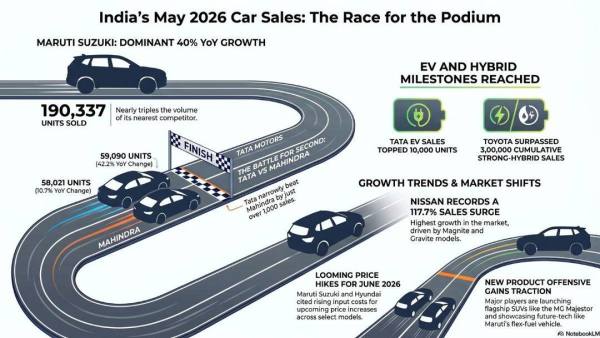
The company sold 1,90,337 units in May 2026, marking a 40 per cent increase compared to the same period last year. Month-on-month sales also edged up by 1.4 per cent from April's 1,87,704 units.
SUVs remained a key growth driver, contributing 79,267 units during the month, while small cars such as the Alto K10, Wagon R and S-Presso accounted for 81,555 units.
The company is also preparing to showcase India’s first flex-fuel passenger vehicle on June 4, signalling its intention to diversify beyond conventional powertrains. At the same time, Maruti Suzuki has announced a price increase of up to Rs 30,000 across select models from June, citing rising input and operational costs.
Tata And Mahindra Continue Their Battle For Second Place
The closest contest in the market remains the fight for the No. 2 position.
Tata Motors retained second place with domestic passenger vehicle sales of 59,090 units in May, up 42.2 per cent year-on-year. However, Mahindra was not far behind, recording SUV sales of 58,021 units, reflecting growth of 10.7 per cent from a year ago.
The difference between the two manufacturers narrowed to just over 1,000 units, making it one of the most closely watched rivalries in the industry.
Tata attributed part of its performance to strong retail demand, with Vahan registrations increasing by more than 50 per cent year-on-year. The company also crossed a significant milestone during the month, with electric vehicle sales exceeding 10,000 units for the first time.
Fresh momentum from the updated Tiago and Tiago EV, both of which recently received design, feature and safety upgrades, also supported volumes.
Mahindra, meanwhile, continued to benefit from strong demand across its SUV portfolio. Popular models including the Scorpio, Thar, XUV 3XO and the newer XUV 7XO remained key contributors to sales.
The company noted that volumes could have been even higher were it not for supply-chain constraints affecting certain suppliers.
Hyundai Looks To Regain Momentum
Hyundai retained fourth position with sales of 47,837 units, up 9.1 per cent compared to May 2025.
However, the company recorded a month-on-month decline of 7.8 per cent from April's 51,902 units, making it one of the few major manufacturers to report sequential weakness.
Despite that, Hyundai highlighted that sales during the first two months of FY2027 reached 99,739 units, representing growth of 13 per cent year-on-year.
The brand continues to draw strength from its SUV portfolio, led by the Creta, Venue and Exter, while hatchbacks such as the Grand i10 Nios and i20 continue to attract buyers.
Like several rivals, Hyundai has also announced price increases across select models from June amid rising production costs.
Toyota And Kia Keep Building Scale
Toyota and Kia continued to strengthen their positions among India’s leading passenger vehicle manufacturers.
Toyota sold 30,574 vehicles during May, up 4.4 per cent year-on-year. The company also crossed a major milestone, surpassing 3,00,000 cumulative strong-hybrid vehicle sales in India.
Models such as the Innova Hycross, Urban Cruiser Hyryder and Glanza remain central to Toyota’s growth strategy.
Kia, meanwhile, delivered one of its strongest performances yet.
The Korean carmaker reported its highest-ever May sales at 27,586 units, reflecting a robust 23.6 per cent increase over the previous year.
The Seltos and Sonet remained volume leaders, while newer products including the Carens Clavis and Syros helped expand the company’s footprint.
Honda Emerges As A Surprise Performer
Although its overall volumes remain modest compared to larger rivals, Honda delivered one of the strongest growth rates among mainstream manufacturers.
The company sold 5,111 vehicles in May, up 29.4 per cent from 3,950 units a year earlier.
Demand remained driven by the Amaze and Elevate, while the updated City sedan contributed additional momentum following its recent refresh.
Honda also showcased the ZR-V as its flagship SUV offering, signalling its intent to strengthen its premium positioning in India.
MG Faces Headwinds, Nissan Sees Triple-Digit Growth
Lower down the sales rankings, MG Motor and Nissan experienced sharply contrasting fortunes.
JSW MG Motor reported sales of 6,048 units, a marginal decline of 4.1 per cent year-on-year. The company said it maintained volumes despite global supply-chain disruptions, elevated commodity costs and higher freight expenses.
During the month, MG launched the Majestor SUV at a starting price of Rs 40.99 lakh. Positioned above the Gloster, it now serves as the company’s flagship internal combustion engine SUV.
Nissan, meanwhile, emerged as the fastest-growing manufacturer among major players.
The company recorded domestic wholesales of 2,948 units, representing a remarkable 117.7 per cent increase over the previous year.
The Magnite continued to drive volumes, while the recently launched Gravite added further support. Nissan is also preparing to unveil the Tekton SUV on July 9 as it seeks to strengthen its position in India’s increasingly competitive SUV market.
SUVs, EVs And New Launches Drive The Market
The May sales figures underline several themes shaping India’s passenger vehicle industry.
SUVs continue to dominate buyer preferences across segments, helping brands such as Mahindra, Hyundai, Kia and Toyota maintain momentum. Electric vehicles are gaining traction, with Tata crossing the 10,000-unit EV sales milestone. Meanwhile, a steady stream of product launches and upgrades is keeping competition intense across price points.
For now, Maruti Suzuki remains comfortably ahead of the pack. But the battle behind the market leader, particularly between Tata Motors and Mahindra, is becoming one of the most intriguing contests in India’s automotive industry.
-
Vitamin D: What will happen due to deficiency of Vitamin D? Read immediately, know the dangers and start treatment without delay

-
Vitamin D: What will happen due to deficiency of Vitamin D? Read immediately, know the dangers and start treatment without delay
-
Expenditures revealed on American couple’s trip to India

-
OnlyFans model marries herself in a $20K wedding dress

-
Hailey Bieber’s ‘pig’s foot’ Valentino pumps divide fashionistas