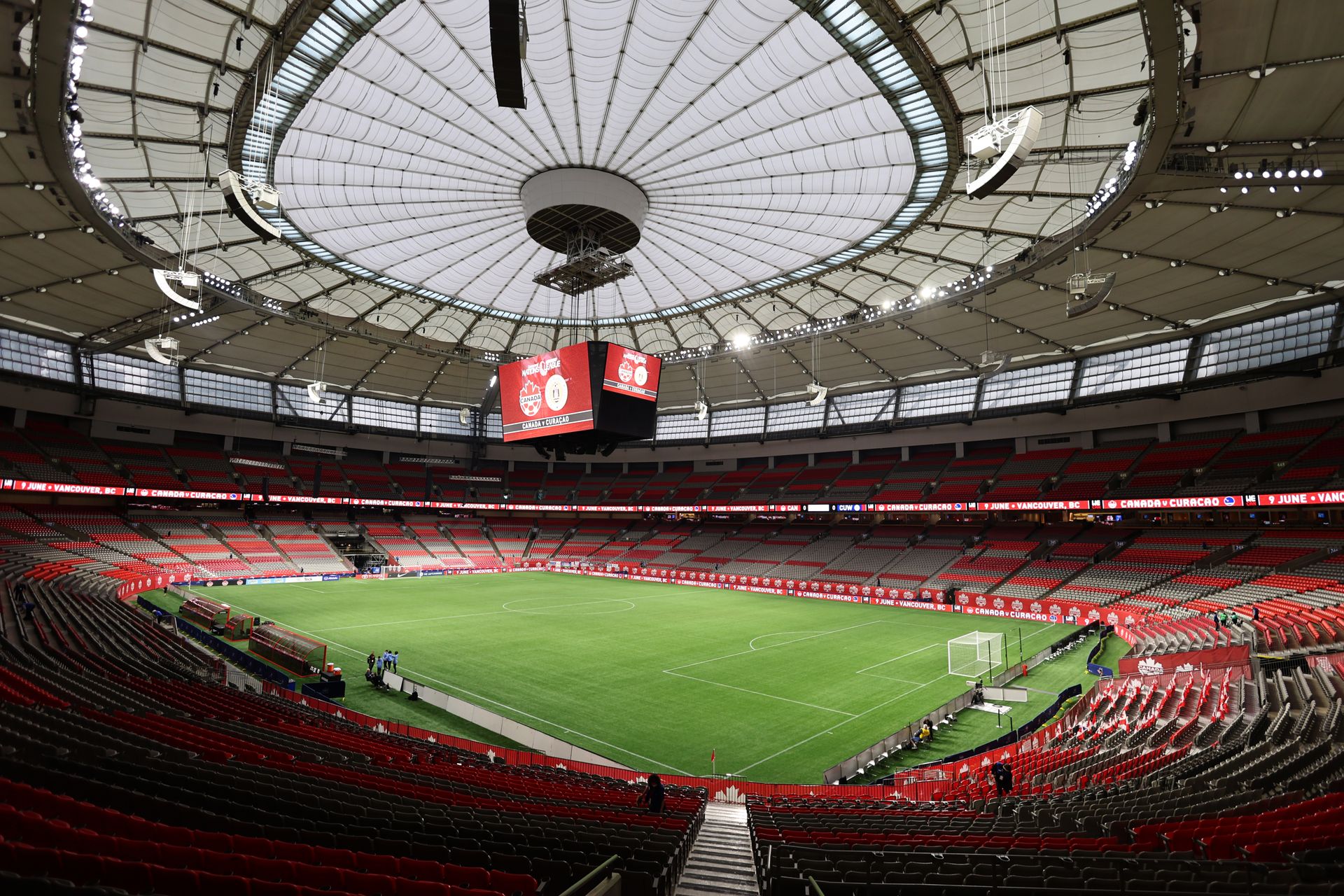
BC Place in Vancouver stands as one of the two Canadian venues selected for the FIFA World Cup 2026 and is set to host at least two fixtures involving Jesse Marsch’s Canada team this summer.
The stadium is among the 16 official venues across Canada, Mexico, and the United States for the 2026 World Cup. While it has never before hosted a men’s World Cup match, BC Place famously staged the 2015 Women’s World Cup final between the United States and Japan.
Here’s everything you need to know about the stadium — from its capacity and history to its role during the World Cup 2026.
For fans attending matches, public transport will be the most convenient way to travel to and from BC Place. Additional services will be arranged to accommodate the expected crowds.
The stadium is well connected through Vancouver’s SkyTrain network — accessible via the Expo Line to Stadium–Chinatown or the Canada Line to Yaletown–Roundhouse stations.
Since BC Place is situated in downtown Vancouver, authorities also recommend walking or cycling to the stadium. The city operates several bike and scooter sharing programmes, making eco-friendly travel a practical option.
Located in the heart of Vancouver, British Columbia, BC Place is a key sporting landmark and one of Canada’s two host sites for the World Cup 2026. Besides staging matches for the 2025 CONCACAF Gold Cup, the venue previously hosted nine games, including the final, during the 2015 Women’s World Cup. In 2026, it will welcome seven matches across June and July.
The stadium holds a unique position in North American sports history, having served as home ground for different eras of the Vancouver Whitecaps — both in the North American Soccer League and Major League Soccer. Opened in 1983, it has been the base for the Canadian Football League’s BC Lions throughout its existence. The CFL, a variation of American football, features distinct rules such as more players and fewer downs.
BC Place was the final home for the NASL’s Vancouver Whitecaps before the league folded in the 1980s. When Major League Soccer expanded to Vancouver in 2011, the stadium became the natural choice for the franchise. That same year, it underwent major renovations, introducing upgraded facilities and a modern retractable roof.
As the home of the Vancouver Whitecaps, BC Place will stage seven World Cup matches in 2026, including at least two games involving Canada, along with one fixture each in the Round of 32 and the Round of 16.
Situated along the north shore of False Creek in Vancouver, British Columbia — the country’s most densely populated urban area — BC Place is a central fixture of the city’s sports and entertainment scene.
For the World Cup, BC Place will feature a seating capacity of 54,000, making it the larger of the two Canadian host stadiums.
Since its inauguration in 1983, BC Place has been home to the successful BC Lions CFL team.
The venue regularly welcomes Canadian national team fixtures and serves as the home ground for the Vancouver Whitecaps, who have competed in Major League Soccer since 2011 and were runners-up in the 2025 MLS Cup.
In total, BC Place will host seven matches during the 2026 World Cup, including two in the knockout rounds.
June 13: Australia vs Turkiye (Group D)
June 18: Canada vs Qatar (Group B)
June 21: New Zealand vs Egypt (Group G)
June 24: Switzerland vs Canada (Group B)
June 26: New Zealand vs Belgium (Group G)
July 2: Winner Group B vs 3rd Group E/F/G/I/J (Round of 32)
July 7: Winner Match 85 vs Winner Match 87 (Round of 16)
-
Meerut kabaddi player murder: DNA test to be conducted; family performs last rites

-
Forest guard caught red-handed while accepting Rs 15,000 bribe in J-K's Kishtwar; arrested

-
INLD holds protests across Haryana over fuel price hike

-
RCB Star Tim David Fined, Suspended For First IPL 2027 Match After Throwing Ice Bag At Umpire Nitin Menon In Final

-
Higher Purses, Sharper Fields And Comeback Wins: How The DP World PGTI Season Is Deepening Indian Professional Golf