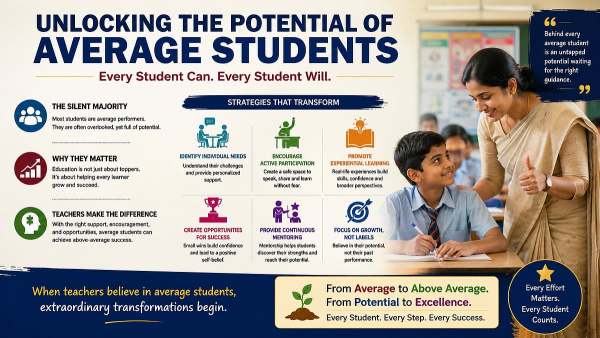
In the race for academic excellence, average students often remain overlooked despite forming the majority of classrooms. Educators play a crucial role in identifying their strengths, building confidence, and helping them reach their full potential.
In today's highly competitive world, excellence has become the most sought-after goal in education. Whether it is a class test, board examination, entrance test, sports competition, or co-curricular activity, students and parents alike aspire to achieve the highest levels of success.
However, educational reality presents a different picture. The abilities and performance levels of students in any classroom generally follow a typical “bell-shaped distribution”. A small percentage of students excel consistently, another small percentage may struggle significantly, while the overwhelming majority fall somewhere in the middle. These students are often labelled as "average students."
Unfortunately, in the relentless pursuit of excellence, this large group of average learners frequently goes unnoticed. They neither attract attention through exceptional achievements nor demand intervention because of poor performance. They occupy a silent space within the classroom, often remaining invisible to teachers and peers.
These students constitute what may be called the "silent majority" of the classroom. They usually score average marks, hesitate to ask questions, rarely volunteer answers, and often avoid participating in competitions or leadership roles.
-
Ukraine’s potential 2026 World Cup squad: Serhiy Rebrov reveals his lineup ahead of the March internationals

-
🏆 Countdown to Kick-off: Take Our World Cup Quiz to Test Your Knowledge!

-
Manchester United Show Interest in Former PSG and Aston Villa Winger Moussa Diaby

-
Sea of Indonesian Fans Fills North Sumatra Main Stadium for 2026 AFF U19 Cup Opener

-
Argentina Tops Demand as Football Jersey Sales Rise in Palangka Raya, Central Kalimantan — Messi’s 2026 World Cup Schedule Revealed