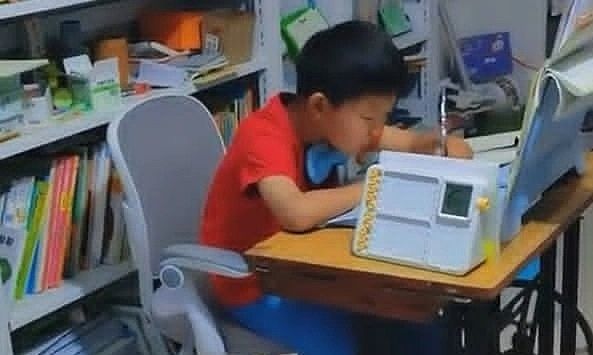
The clip, shared on May 20 by the Weibo account of Dazhong Dailya newspaper in the eastern province of Shandong, shows the primary school boy at a converted sewing machine in Anyang, in central China’s Henan Province, working the foot treadle in a steady rhythm as his pen glides across the page.
The boy had long struggled to sit still while studying, his mother told mainland media in comments reported by Dazhong Daily. He would fidget with his eraser, shake his legs and repeatedly get up from his seat, sometimes spending half an hour staring at a single problem. Rather than keep nagging him, she moved his grandmother’s old sewing machine into his study and let him channel that restless energy into the pedal.
The fix appeared to work, she said. With his hands and feet both occupied, the boy stayed focused for more than an hour, with noticeably better efficiency, and would settle in at the machine on his own. She added that it was an old Chinese brand called Feiren, oiled so it ran almost silently, and that she had fitted it with a new tabletop and a support to keep him from hunching too low over his work.
|
A Chinese boy pedals a sewing machine in a steady rhythm while doing his homework. Photo courtesy of Weibo |
The footage drew a mix of admiration and skepticism, according to the South China Morning Post. Some commenters argued the method even made physical sense. One pointed to traditional Chinese medicine, in which tiptoe and pedaling movements are thought to draw internal heat downward and help settle the mind during intense study. Another suggested that, from a sensory integration standpoint, the rhythmic motion and gentle vibration could stimulate the brain while calming a child who cannot sit still.
For many, the image was nostalgic. Some recalled doing their own homework on a grandmother’s sewing machine in childhoods when their families could not afford a proper desk, while others praised the mother for meeting her son’s fidgeting with creativity rather than frustration.
Not everyone was persuaded. One commenter cited by the South China Morning Post argued that parents should rethink the balance between schoolwork and daily life, warning that heavy homework loads eat into children’s rest and lead to fatigue, poor concentration and weaker eyesight.
Homework has long been a flashpoint in Chinese households. Amid fierce academic competition, Dazhong Daily reported, many parents fill their children’s after-school hours with online lessons and private tutoring, and some have reached for stranger focus aids, having children stand on footballs or work bicycle-style pedals while they study.
-
Centre Appoints Lokhande Prashant Sitaram As New CBSE Chairperson

-
Sikkim State Lottery Result: June 2, 2026, 6 PM Live - Watch Streaming Of Winners List Of Dear Prestige Tuesday Weekly Draw

-
Shiv Sena's Aaditya Thackeray Conducts Toss With Ajinkya Rahane & Suryakumar Yadav In T20 Mumbai League 2026

-
WhatsApp To Roll Out On-Device Scam Alert Feature To Combat Rising Fraud: Here's How It Works

-
Nvidia CEO Jensen Huang Backs Higher Pay For Employees Amid AI Boom