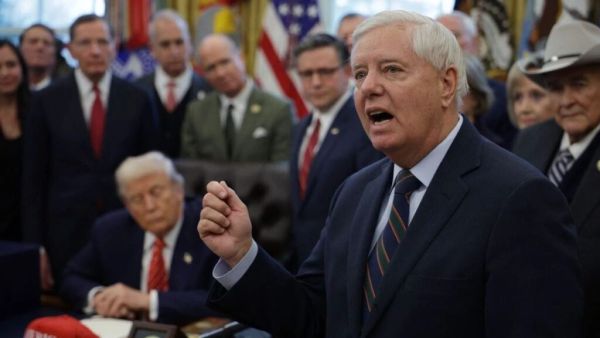
As discussions surrounding a potential agreement between the United States and Iran continue to draw global attention, senior Republican Senator Lindsey Graham has laid out what he believes should be the minimum conditions for any deal to receive approval from US President Donald Trump. His remarks come at a time when diplomatic efforts and military tensions in the Middle East remain closely intertwined.
In a strongly worded statement, Graham said any agreement with Iran should permanently address Tehran’s nuclear ambitions, ensure unrestricted commercial navigation through the Strait of Hormuz, and curb Iran’s alleged support for militant and terrorist groups operating across the region.
According to Graham, a successful agreement must guarantee that Iran abandons any pathway toward developing nuclear weapons and refrains from actions that could threaten international shipping routes. The Strait of Hormuz remains one of the world’s most strategically important maritime chokepoints, carrying a significant share of global oil exports. Concerns over shipping security in the region have intensified in recent months amid military confrontations and repeated threats affecting commercial traffic.
The senator also argued that there should be no linkage between a potential US-Iran agreement and Israel’s ability to continue military operations against Hezbollah in Lebanon or Hamas in Gaza. Graham warned that any deal restricting Israel’s right to respond to security threats would be a strategic mistake and could undermine regional stability from Israel’s perspective.
His comments come amid continued debate in Washington over the shape of any future understanding with Tehran. Reports in recent days have suggested that diplomatic channels remain active, although no final agreement has been officially announced. Multiple issues remain under discussion, including sanctions, regional security arrangements, maritime navigation, and military de-escalation measures.
The remarks are significant because Graham has long been one of the most influential voices in US foreign policy debates concerning Iran, Israel, and Middle East security. His latest intervention reflects broader concerns among several lawmakers who believe that any agreement should address not only Iran’s nuclear activities but also its regional influence and relationships with armed groups across the Middle East.
The statement also comes amid heightened regional uncertainty following recent military exchanges involving US forces, Iranian-backed groups, and ongoing Israeli operations in Gaza and Lebanon. Analysts are closely watching whether future negotiations can bridge deep disagreements between Washington and Tehran while satisfying the security concerns of key regional allies.
For now, Graham’s comments underscore the political hurdles that any potential agreement may face in Washington, even if negotiators move closer to a diplomatic breakthrough.
-
From ‘accidental’ meeting to Assembly coup: How TMC split
-
Three killed in ICU fire at hospital in Bihar’s Muzaffarpur

-
Hariprasad appointed KPCC chief as Congress begins organisational reset

-
WHO chief says Ebola response in DR Congo catching up

-
Five countries elected non-permanent members to UN Security Council