U.S. Citizenship and Immigration Services has directed its officers to treat applications for a green card filed from inside the country as an “extraordinary form of relief,” effectively requiring most foreign nationals on temporary visas to leave the U.S. and apply through a consulate abroad.
The policy memorandum, PM-602-0199, recasts adjustment of status, the long-standing process that lets eligible foreign nationals secure a green card without leaving the U.S., as a discretionary exception rather than the default route. Consular processing abroad is now described as the ordinary pathway.
About 1 million people apply for U.S. green cards each year, roughly half of them from within the country, former USCIS official Doug Rand told NBC News.
“From now on, an alien who is in the U.S. temporarily and wants a Green Card must return to their home country to apply, except in extraordinary circumstances,” USCIS spokesman Zach Kahler said in a statement.
For international students, the change closes the most reliable route from study to permanent residency. The standard sequence has been graduation, Optional Practical Training, an H-1B work visa with an employer sponsor, and adjustment of status to a green card. Staying in the U.S. during adjudication protected employment, prevented breaks in legal status and removed the risk of being stranded abroad if visa problems arose.
Immigration law firms including WR Immigration, Baker Donelson and Newland Chase have flagged international students among the groups most exposed. The Harvard International Office notes on its website that the F-1 student visa is a nonimmigrant category whose sole purpose is study, and that applicants must demonstrate an intent to return home after graduation. F-1 holders who pivot quickly toward a green card are now likely to face sharper scrutiny.
Foreign nationals on dual-intent visas such as H-1B and L-1, which legally permit both temporary work and a future bid for permanent residency, retain a stronger footing, though immigration attorneys warn even they face less certainty. The memo signals that compliance with visa rules and a clean legal status are not by themselves enough to guarantee favorable consideration; applicants must affirmatively show they deserve the discretionary grant.
|
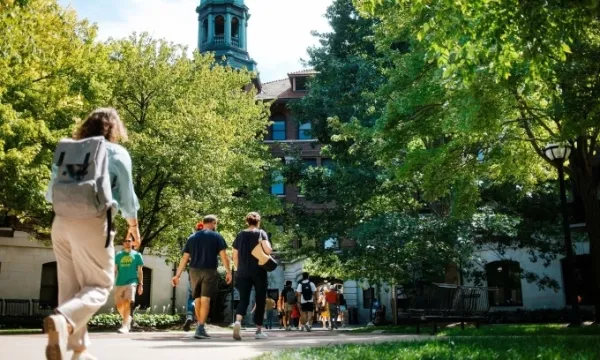
A view of the University of Michigan campus in the U.S. Photo courtesy of the university’s Facebook page |
There are also process gaps between the two routes. Adjustment of status denials can sometimes be revisited through motions to reopen or reconsider, and in narrow cases through judicial review. Consular denials abroad generally cannot be challenged at all under the longstanding doctrine of consular non-reviewability, adding time and uncertainty.
The financial stakes have also risen. Under a separate September 2025 presidential proclamation, an employer filing a new H-1B petition from outside the U.S. faces a US$100,000 fee. Workers forced to leave the country and refile mid-process could effectively trigger that cost on their sponsoring employer.
Some attorneys are already questioning whether the directive can survive court challenge. “You can’t, through a stroke of a pen, overturn a statute,” immigration attorney Todd Pomerleau told ABC News. “I think it’s illegal, and it’s going to get shut down in court very quickly.”
A softening U.S. job market and Washington’s pause on OPT processing for nationals of the roughly 40 countries and territories on the current travel ban list have compounded student anxieties.
Bulusu Janardhan, who lives in Andhra Pradesh, took on debt to send his son to study in the U.S., hoping he would stay on to work and ease the family’s finances. “I thought sending my son to the U.S. would help him become financially independent and also help us clear the debts we accumulated for his education. But the situation now is frightening,” he told The Hindu.
A 2021 FWD.us survey of prospective international students, conducted through QS Quacquarelli Symonds’s annual student poll, found that 73% would seek a visa to stay and work in their country of study if one were easily accessible.
According to the 2025 Open Doors report from the Institute of International Education, about 1.18 million international students were enrolled at U.S. colleges in the 2024-2025 academic year. India led with 363,019 students, followed by China at 265,919, then South Korea, Canada and Vietnam. Vietnam accounted for nearly 25,600 of the total, up about 16% from a year earlier and entering the top five sending countries for the first time.
-
RCB's Rajat Patidar Credits Team Environment And Calm Mindset After Historic Second Consecutive IPL Title Win

-
Filmmaker Sanjay Gupta Takes A Dig At Chunnari Chunnari, Ucha Lamba Kad Remakes: 'What Will They Remix In 2046?'

-
Manchester United Speed Up £38m Transfer Talks for Mateus Fernandes Amid Interest from Arsenal, Chelsea, PSG and Inter

-
Iran Officially Announces 2026 World Cup Squad – ‘Persian Messi’ Left Out, Ragnar Oratmangoen’s Teammate Included

-
European Coach of the Year 2025–26: Luis Enrique, Mikel Arteta and the Top 20 Managers Ranked