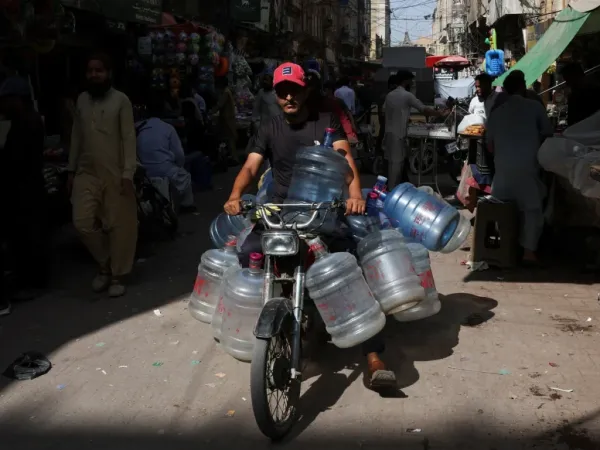
Neighboring country Pakistan is currently in the grip of an unprecedented and extremely severe water crisis. The direct and devastating impact of India’s suspension of the Indus Water Treaty (IWT) is now clearly visible on the people of Pakistan. Due to severe water shortage in Karachi, the financial capital and largest city of Pakistan, life has been completely ruined. In this scorching and record-breaking summer season, people celebrating the festival of Eid are having to run from pillar to post for water. International affairs experts say that this serious crisis has a direct connection with the Indus Water Agreement, which was suspended by India as a punitive action after the Pahalgam terrorist attack in April 2025. Since this decision, Pakistan’s water security, agriculture and economy have completely collapsed.
70% of Karachi is dry, crores of people yearning for every drop
According to a shocking ground report by Pakistani media house ‘ARY News’, the water crisis of Karachi is becoming more dire with each passing day. Statistics show that the government supply of water has come to a complete standstill in more than 70 percent of the city for a long time. Amidst the scorching heat and skyrocketing temperatures, the hapless citizens of Karachi are forced to rely entirely on expensive and illegal private water tankers to quench their thirst.
The situation has become so bad that the taps of the houses in the most prominent and VIP areas of the city like Lyari, Orangi, Korangi, Malir, Gulshan-e-Iqbal, DHA and Clifton have been completely dry for weeks. On the holy occasion of Eid, people did not get water for drinking, bathing, daily cleaning and even for sacrificial animals. There are miles long queues for water tankers and people have to wait for up to 10 days for a tanker. Taking advantage of this compulsion, tanker mafias have started charging more than double the price of water.
The situation is most out of control in these posh and residential areas
In the densely populated areas of Karachi like Gulistan-e-Johar, Gulshan-e-Iqbal, Azizabad, Liaquatabad, North Nazimabad, Nazimabad and North Karachi, not a single drop of water has seeped from the pipeline for the last two to three weeks. The anger of the local people is now at its peak. In fact, Islamabad was already facing all-round economic and diplomatic pressure due to the tough and aggressive strategic steps taken by the Indian government to teach Pakistan a lesson after the cowardly terrorist attack in Pahalgam, Jammu and Kashmir. Meanwhile, this nationwide water crisis has broken the back of the Pakistan government and it has become such a problem for them that it seems impossible to overcome at the moment.
Huge difference between demand and supply, increased risk of spreading diseases
Karachi city, with a huge population of about 25 to 30 million, is the biggest revenue source of Pakistan, but it is completely poor in terms of basic facilities. According to recent government and non-government reports, Karachi’s total daily water demand (MGD) is more than 1200 million gallons (MGD), while the government system is able to supply only 650 million gallons of water. This incomplete gap between demand and supply is the main reason for this outcry.
In this month of May 2026, the bursting of the main water pipeline and frequent major power failures have added fuel to this fire. In poor and backward areas like Orangi Town, people have not even been able to see clean water for months. People are forced to drink dirty and contaminated water, due to which diarrhea, hepatitis, typhoid and many serious stomach diseases are spreading like an epidemic in Karachi. Innocent children and the elderly are becoming the biggest victims of this contaminated water. The city’s unbridled tanker mafia, decades-old and dilapidated pipelines, massive water leakage, illegal hydrants and urban development without any planning are making this entire crisis more deadly.
-
Horoscope Today: Astrological forecast for May 31, 2026, for all zodiac signs

-
Career Horoscope Today, May 31, 2026: Capricorn Natives Likely to Receive New Deals; Find Out What’s in Store for Your Sign

-
Seven Pakistanis named in Forbes 30 Under 30 Asia list 2026

-
It’s Good Luck To Wear The Color Peach To Job Interviews In 2026, According To Feng Shui

-
Hard Times Are Over For 3 Zodiac Signs After The Blue Moon On May 31, 2026