Additional reporting by Haroon Janjua, DW's reporter in Islamabad.
Edited by: Wesley Rahn
Pakistan finds itself in a fix amid US President Donald Trump's latest demand for Islamabad to sign the so-called Abraham Accords to normalize ties with Israel as part of a potential deal to end the Iran war.
Trump said on Monday that any agreement to end the Iran war should see countries like Saudi Arabia, Pakistan and Qatar join the Abraham Accords, which the US President brokered during his first term in 2020.
"After all the work done by the United States to try and pull this very complex puzzle together, it should be mandatory that all of these Countries, at a minimum, simultaneously, sign onto the Abraham Accords," Trump wrote in a social media post. "Those Countries discussed are Saudi Arabia, the United Arab Emirates (already a Member!), Qatar, Pakistan, Turkey, Egypt, Jordan, and Bahrain (already a Member!)."
Trump insisted that Saudi Arabia and Qatar should immediately sign the agreements, "and everybody else should follow suit."
The Abraham Accords are a series of bilateral agreements brokered by the US and are aimed at normalizing ties between Israel and several Arab countries. The first agreements were signed on September 15, 2020, between Israel and the United Arab Emirates, and Israel and Bahrain.
Pros And Cons
Some Pakistani officials have rejected the demand, but there has not been any unanimous or unequivocal response from the government or its powerful military to it — yet.
Islamabad is playing a key role as a mediator to end the US-Israel war against Iran and in April managed to convince the US to cease attacks on Iran that began on February 28. It continues its efforts to broker a deal to end the war permanently.
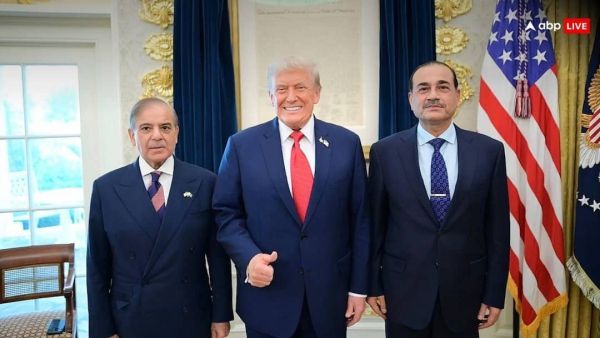
Its role as a mediator has been lauded by Trump several times, with the US president calling Pakistan's military chief Asim Munir and Prime Minister Shehbaz Sharif his "favorite" people.
Islamabad is currently enjoying an elevated global status because of this closeness to Trump. However, joining the Abraham Accords would be way more challenging for the South Asian country than mediating the Iran war.
"The benefits [of joining the Abraham Accords] are real but politically overstated. Pakistan can gain diplomatic goodwill in Washington and some Gulf capitals, and there could be economic or technological openings," Raza Rumi, a political analyst, told DW.
Rumi, however, pointed out that the move could come with substantial risks for Pakistan. "It could damage Pakistan's standing on Palestine, [fuel] further tension with Iran, and [increase] domestic instability," he stressed.
Islamabad does not recognize Israel and has no diplomatic ties with the country. However, in the past, some unofficial interactions were reported between the two sides.
"Unless there is meaningful progress toward Palestinian statehood, normalization would look less like strategic autonomy and more like capitulation. For now, the costs are likely to outweigh the gains," Rumi underlined.
Saudi Arabia's Decision Would Be Key
Pakistan's decision to join or not to join the Abraham Accords would ultimately depend on which direction Saudi Arabia takes on the issue. Islamabad and Riyadh have close diplomatic, economic and security ties, and the Saudis, as custodians of Islam's holiest sites, are held in high esteem by most Pakistanis.
"Saudi Arabia moving first would make the conversation easier for Pakistan, but not easy," according to Rumi. "Islamabad could use Riyadh's decision as political cover, especially because Pakistan often calibrates Middle East policy with Saudi and Gulf positions."
The analyst, however, believes it would still be a complicated move for Pakistan.
"Pakistan is not an Arab monarchy; its domestic politics, religious parties, media ecosystem, and public attachment to Palestine make normalization far more complicated. Riyadh moving first may open the door, but it will not automatically allow Islamabad to walk through it."
Analysts believe that even if Trump's allies like Saudi Arabia and Pakistan are to move toward some kind of normalization with Israel, it might not happen overnight, and it would be conditional.
Maleeha Lodhi, an international affairs expert and former Pakistani ambassador to the US and the UN, told DW that Islamabad could only consider it "if an independent and contiguous Palestinian state is established with Jerusalem as its capital."
"It's a firm position and Pakistan's decision won't be based on what another country does," she added.
On December 6, 2017, Trump formally recognized Jerusalem as the capital of Israel and announced that the US embassy would be moved from Tel Aviv to Jerusalem.
No Easy Way Out
Going against Trump could come at a price for Islamabad. Pakistan has deep economic and military ties with the US, which help it keep the geopolitical balance with its regional archrival and neighbor, India. The US remains Pakistan's largest single export destination, crucial for generating foreign revenue for its struggling economy. Islamabad is also aware that Washington holds significant sway over global monetary institutions like the IMF.
The Iran war has disrupted Pakistan's energy supply, with fuel prices soaring since the start of the conflict. For Pakistan, it is essential that the war ends soon. But Trump's Abraham Accords demand in connection to the Iran war puts the country in a bind with no easy way out.
Pakistani authorities are aware that "the backlash would be serious," according to analyst Rumi.
"Religious parties, Islamist groups, sections of the right-wing media, and even mainstream political actors would frame recognition of Israel as a betrayal of Palestine and Pakistan's ideological commitments," he said.
"Any government attempting such a move would face street agitation, parliamentary criticism, clerical mobilization, and accusations of acting under US or Gulf pressure. The Gaza war has made public opinion even more hostile to normalization."
Whether Pakistan decides to join or not, any decision Islamabad takes now regarding the Abraham Accords would be extremely consequential and will likely determine the future course of the country.
Disclaimer: This report first appeared on Deutsche Welle, and has been republished on ABP Live as part of a special arrangement. Apart from the headline, no changes have been made in the report by ABP Live.
-
Sooryavanshi, Archer power Rajasthan Royals to Qualifier 2

-
Jaishankar, Ukrainian FM discuss war, peace efforts amid evolving battlefield situation

-
Security tightened in Gurugram, Nuh for Eid al-Adha

-
Japan delegation meets DPA officials at Kandla Port; discusses maritime cooperation

-
"Will not be difficult for Jan Suraaj at all": Prashant Kishor backs party to win Bankipur bypolls, conquering BJP bastion