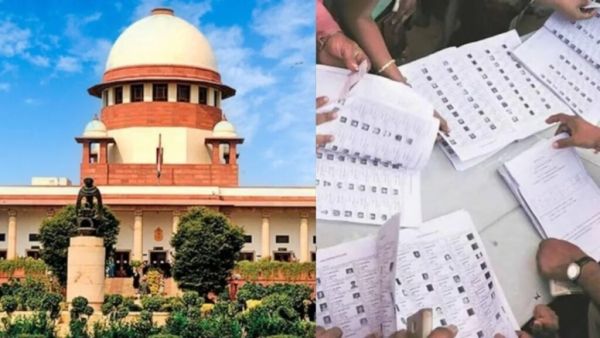
The Supreme Court on Wednesday (May 27) gave a major decision regarding the special intensive review process. A bench of Chief Justice Surya Kant and Justice Joymalya Bagchi delivered the verdict on petitions challenging the Special Intensive Revision (SIR) of voter lists in Bihar.
The petitions challenged the validity of the SIR being conducted by the Election Commission. The court had to decide whether the Election Commission had the authority to conduct the SIR in its present form under Article 326 of the Constitution, the Representation of the People Act, 1950 and the rules attached thereto. During the hearing, Chief Justice Surya Kant said that the court said that removal of a person’s name from the voter list does not mean termination of his Indian citizenship. The court said that the Election Commission’s investigation is limited only to inclusion or deletion of names in the electoral list, it is not its final authority to decide citizenship.
A bench of Chief Justice Surya Kant and Justice Joymalya Bagchi said that the investigation conducted under the SIR process cannot be considered as a citizenship determination process. The Supreme Court said, “The Commission may remove the name from the voter list, but that does not mean that he ceases to be a citizen of India. It has nothing to do with deciding citizenship.”
This comment of the court is being considered very important as the petitioners and opposition parties had alleged that the SIR campaign being run by the Election Commission of India is like a backdoor citizenship check.
The court said in its decision that the Election Commission can do a limited investigation of the aspects to citizenship for adding or removing the name in the voter list, but it does not have the right to terminate or finally decide the citizenship of a person.
The matter came to light after the hearing of petitions that challenged the validity of the SIR process. The controversy began over a rule under which voters whose names were not in the voter list for 2002 or 2003 were asked to prove their ancestral or family ties from old voter records.
The petitioners argued that this process could deny voting rights to the poor, migrant laborers and people who do not have documents. He said that deciding citizenship does not come under the jurisdiction of the Election Commission.
The controversy escalated when the Election Commission started the SIR process in Bihar in June last year and later expanded it to several states including West Bengal, Kerala and Tamil Nadu. Currently, the third and final phase of SIR is going on in 16 states and three union territories.
During the hearing, the Election Commission had told the court that this process is necessary to make the voter list pure and transparent so that the names of fake or ineligible voters can be removed. However, the Supreme Court gave an important direction saying that the cases of those whose names will be removed from the voter list on the basis of doubtful citizenship, will be sent to the Central Government.
“The ECI is directed to refer such cases within four weeks to the competent authority under the Citizenship Act, 1955, to ascertain their citizenship claims,” the Chief Justice said.
Under this order, the Election Commission will have to send such cases within four weeks to the concerned authority under the Union Home Ministry, which will take the final decision under the Citizenship Act 1955. This decision of the Supreme Court is being seen as an important constitutional clarity in matters to electoral rights and citizenship dispute.
Danger of Ebola in India? Symptoms found in a woman who returned from Uganda, isolated in Bengaluru
Piyush Goyal on mission to increase investment in Canada, meets top CEOs
ED action in money laundering case, raids on 10 places including the residence of former Chief Minister Pinarayi Vijayan
-
Mathew Baker Takes Just Two Years to Reach Indonesia Senior Team, Poised to Break Youngest Debut Record

-
Body Parts In Danger From Heat: These body parts get sick quickly due to excessive heat, and their condition becomes so bad

-
Body Parts In Danger From Heat: These body parts get sick quickly due to excessive heat, and their condition becomes so bad

-
8th Pay Commission Faces Inflation Pressure as Employee Unions Demand Simpler Salary Structure
-
A Unique Service Launches in Delhi's Markets! Now Get a 'Helper on Rent' for Your Shopping—Find Out How Much It Costs!