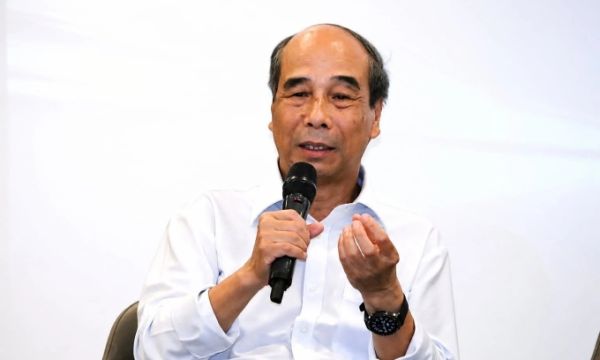
Speaking at the event on AI in schools at the Vietnam Institute for Advanced Study in Mathematics (VIASM) on May 22, professor Ho Tu Bao said the first question worth asking is how deeply AI actually “understands” math. To find out, he ran a striking test.
He asked an AI tool to explain how Ngo Bao Chau, who serves as VIASM’s scientific director, had proved the Fundamental Lemma of the Langlands program, a problem that stumped mathematicians for decades before Chau cracked it in 2008 and won the 2010 Fields Medal for the work.
The AI produced an explanation that “looked very much like understanding,” Bao said. But what looked like comprehension was really just a strong capacity to gather and synthesize information.
Generative AI works on language models, Bao explained. The tools do not grasp the underlying nature of mathematics. They search vast datasets, chain together patterns and produce outputs based on probability.
“AI can understand the components of a mathematical formula and their relationships, but it lacks common sense and cannot connect mathematical knowledge to the stories of real life,” he said, voicing concern about an “intellectual decline” when students rely on AI too much.
|
Professor Ho Tu Bao at the roundtable on AI in schools at the Vietnam Institute for Advanced Study in Mathematics on May 22, 2026. Photo by Thanh Hung |
Ta Ngoc Tri, deputy director of the Department of General Education at the Ministry of Education and Training, said he is troubled by how easily students can now type a homework problem into an AI tool and get an instant solution.
The practice runs against a principle laid out by Hungarian-American mathematician George Pólya in his classic 1945 book “How to Solve It,” he said.
“A math teacher should play the role of a midwife, helping students neither too little nor too much. AI seems to be helping students far too much.”
The goal of math teaching, he added, is to develop metacognition and higher-order thinking, the qualities advanced education systems are aiming for today. That requires leaving students space to discover knowledge on their own and preserve their creativity.
Chau said the downside of AI in education is that a large share of students rely on it entirely to do their work, draining homework of much of its meaning. The flip side is that AI can be a powerful exploratory tool if teachers guide students well.
Vietnam needs a comprehensive rethink of how it teaches and learns, especially in testing and assessment, so AI becomes a means for students to acquire knowledge rather than a way to dodge the work of learning, he said.
“Because without work, there can be no progress,” Chau said.
Bao said he has set himself a personal rule: always work out his own solution before turning to AI. An absolute ban is impossible, he said, but comprehension can be tested through direct conversation. That is why he switched to oral exams when teaching at Foreign Trade University in Hanoi.
“We should require and train students to ask questions, not let them find answers immediately,” he said.
VIASM used the event to launch a new Center for Teaching and Learning Innovation, set up to respond to the challenges and opportunities AI poses for Vietnamese education. The center will pursue research on math education, teacher training, experimental classrooms and a national math club system. Planned for this year are two research projects on AI applications in math teaching and a teacher training program on metacognition.
-
“Zomato Needs To Plug This”: Viral X Post Flags Loophole Used By Customers, Restaurants
-
Black Vision Pro Leak: Stunning New Upgrades

-
Oppo Find X10 vs OPPO Find X9: How different are the two smartphones from each other? Which phone will have more powerful features?

-
India lose 0-2 to Jamaica in Unity Cup 2026 semi-final in London

-
India’s big test before the Women’s T20 World Cup: Series against England starts from today, Harmanpreet Kaur will find the team combination