
Listen to this article in summarized format
Loading...
××
Subscribe to

Unlock AI Briefing and Premium Content
New Year Offer 24 Hours Left
Subscribe NowAlready a member? Sign In
What's Included
- Exclusive Stories
- Daily ePaper Access
- Smart Market Tools
- Curated Investment Ideas
- Ad-lite Experience
Subscription

India on Tuesday issued a sharp rebuttal to references made on Jammu and Kashmir in the latest joint statement released by China and Pakistan, asserting that the Union Territories of Jammu & Kashmir and Ladakh “have been, are and will always remain” integral parts of the country.
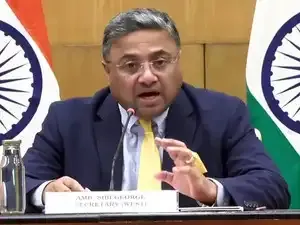
Responding to media queries, Ministry of External Affairs spokesperson Randhir Jaiswal said in an official statement that it “categorically rejects” what it described as “unwarranted references” to Jammu and Kashmir in the joint statement issued by Beijing and Islamabad.
The response comes amid renewed diplomatic signalling between China and Pakistan, including references to the China-Pakistan Economic Corridor (CPEC) and cooperation on water resources — both of which India has repeatedly objected to in the past.
In the statement, the MEA reiterated that no foreign country has the “locus standi” to comment on matters related to Jammu and Kashmir and Ladakh.
India maintained that its position on the issue has remained “consistent and well known” to both countries.
New Delhi also renewed its objections to CPEC projects passing through territories it claims are under Pakistan’s “illegal and forcible occupation”.
The corridor, a flagship component of China’s Belt and Road Initiative, runs through Pakistan-occupied Kashmir before connecting to China’s Xinjiang region.
The MEA statement further said any attempt by external parties to “reinforce or legitimise” such projects directly infringes upon its sovereignty and territorial integrity.
The PM Modi-led Central government added that these concerns have been conveyed to both Chinese and Pakistani authorities on multiple occasions.
In addition, the ministry dismissed references in the joint statement to what was termed “trans-boundary water resources cooperation” between China and Pakistan. India argued that the two countries do not share a direct boundary, making such references untenable from New Delhi’s standpoint.
The statement also revived India’s long-standing rejection of the 1963 boundary agreement signed between Pakistan and China, under which Pakistan ceded the Shaksgam Valley to China. India has consistently maintained that the agreement is invalid as the territory legally belongs to India.
Responding to media queries, Ministry of External Affairs spokesperson Randhir Jaiswal said in an official statement that it “categorically rejects” what it described as “unwarranted references” to Jammu and Kashmir in the joint statement issued by Beijing and Islamabad.
The response comes amid renewed diplomatic signalling between China and Pakistan, including references to the China-Pakistan Economic Corridor (CPEC) and cooperation on water resources — both of which India has repeatedly objected to in the past.
In the statement, the MEA reiterated that no foreign country has the “locus standi” to comment on matters related to Jammu and Kashmir and Ladakh.
India maintained that its position on the issue has remained “consistent and well known” to both countries.
New Delhi also renewed its objections to CPEC projects passing through territories it claims are under Pakistan’s “illegal and forcible occupation”.
The corridor, a flagship component of China’s Belt and Road Initiative, runs through Pakistan-occupied Kashmir before connecting to China’s Xinjiang region.
The MEA statement further said any attempt by external parties to “reinforce or legitimise” such projects directly infringes upon its sovereignty and territorial integrity.
The PM Modi-led Central government added that these concerns have been conveyed to both Chinese and Pakistani authorities on multiple occasions.
In addition, the ministry dismissed references in the joint statement to what was termed “trans-boundary water resources cooperation” between China and Pakistan. India argued that the two countries do not share a direct boundary, making such references untenable from New Delhi’s standpoint.
The statement also revived India’s long-standing rejection of the 1963 boundary agreement signed between Pakistan and China, under which Pakistan ceded the Shaksgam Valley to China. India has consistently maintained that the agreement is invalid as the territory legally belongs to India.