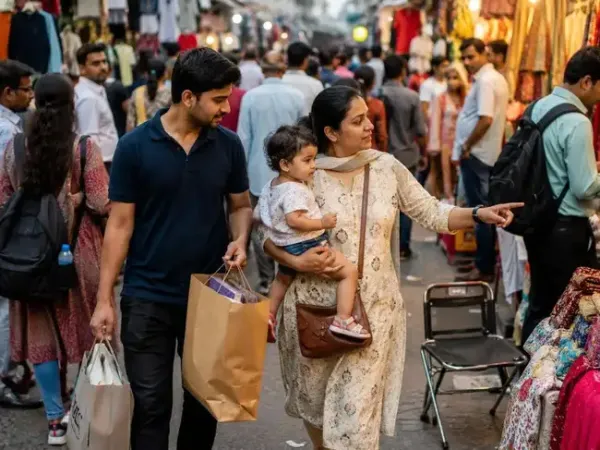
A fresh trend is quietly taking shape in Delhi’s crowded shopping hubs, where people can now hire “personal helpers” by the hour to make market visits easier. These assistants walk alongside shoppers through packed lanes, carry heavy bags, wait in food queues, help locate transport, reserve seating spots and even open a foldable chair when customers need to rest. What earlier existed informally through friends, relatives or local porters has now turned into an organised urban service.
A city learning to outsource everyday effort
The rise of such services reflects a larger shift in urban living, where small everyday tasks are increasingly being handed over to someone else. In busy cities, convenience has become valuable enough for people to pay for even routine assistance.
This culture did not emerge overnight. During demonetisation, many cities saw people hiring others to stand in ATM and bank queues for hours. Over time, the same idea expanded into app-based services handling groceries, food delivery, childcare support, pet walking, parcel collection and waiting for deliveries.
Now, even physical presence itself is becoming a service.
In Delhi’s Nehru Nagar, another unusual support system has already appeared. A helper on an electric bike accompanies runners during jogging sessions and keeps track of their belongings such as wallets, bottles, phones and keys while offering water and assistance when needed.
Convenience or growing dependence?
The growing “errand economy” has sparked a wider conversation about whether cities are becoming too dependent on outsourced help.
Some believe these services simply save energy and time in already exhausting urban schedules. Others feel people are gradually losing the willingness to manage ordinary responsibilities on their own.
For users, however, the issue often feels less philosophical and more practical.
Deepali, who works in an MNC and is raising a two-year-old child, says such services become useful when routines suddenly collapse. If office work overlaps with childcare or domestic help fails to show up, she says quick temporary support through an app can become a major relief. According to her, it works as a backup system during unpredictable days.
Experts say urban pressure is reshaping behaviour
Dr Nimesh Desai, psychiatrist and former director of Institute of Human Behaviour and Allied Sciences, linked the trend to the emotional and social strain of modern city life.
“The stresses of modern urban life like psychological burdens, rising aspirations, and the struggle to meet even basic demands have made dependence increasingly common. At the same time, growing unemployment and social vulnerability have further deepened this tendency.”
He also stressed that support systems should not replace personal independence entirely.
“While support systems are essential for the elderly and persons with disabilities, society must continue to encourage self-reliance, personal freedom and independence as core values.”
Why these services are finding customers
People running such businesses argue that city markets have become physically exhausting, especially for elderly visitors, pregnant women and parents shopping with children.
The founder of one personal shopping assistance service in Lajpat Nagar says crowded lanes, long walking stretches and weekend rushes pushed them to create the model.
“Even a short trip becomes physically draining for mothers with children, elderly visitors navigating lanes, or pregnant women who need basic support,” he says.
According to him, months of conversations with shoppers and traders revealed that many people still enjoyed shopping but struggled with the stress created by congestion and fatigue.
“Many did not dislike shopping itself but found it increasingly stressful because of congestion and physical fatigue,” he said.
Rejecting criticism that such services promote laziness, he argued that long work hours, heavy traffic and exhausting commutes already leave people physically drained.
“These services do not eliminate effort but fill in the gaps,” he added.
Not everyone is comfortable with the shift
Still, many people remain uneasy with the growing dependence on app-based assistance.
Ashutosh, a retired private sector employee, says he feels younger generations are outsourcing even the simplest tasks.
“Even something as simple as a toothbrush gets ordered online while they sit on their phones at home,” he says.
For him, the bigger concern is not technology itself but the slow disappearance of everyday self-reliance from urban life.
(Source: TOI)
A city learning to outsource everyday effort
The rise of such services reflects a larger shift in urban living, where small everyday tasks are increasingly being handed over to someone else. In busy cities, convenience has become valuable enough for people to pay for even routine assistance.This culture did not emerge overnight. During demonetisation, many cities saw people hiring others to stand in ATM and bank queues for hours. Over time, the same idea expanded into app-based services handling groceries, food delivery, childcare support, pet walking, parcel collection and waiting for deliveries.
Now, even physical presence itself is becoming a service.
In Delhi’s Nehru Nagar, another unusual support system has already appeared. A helper on an electric bike accompanies runners during jogging sessions and keeps track of their belongings such as wallets, bottles, phones and keys while offering water and assistance when needed.Convenience or growing dependence?
The growing “errand economy” has sparked a wider conversation about whether cities are becoming too dependent on outsourced help.Some believe these services simply save energy and time in already exhausting urban schedules. Others feel people are gradually losing the willingness to manage ordinary responsibilities on their own.
For users, however, the issue often feels less philosophical and more practical.
Deepali, who works in an MNC and is raising a two-year-old child, says such services become useful when routines suddenly collapse. If office work overlaps with childcare or domestic help fails to show up, she says quick temporary support through an app can become a major relief. According to her, it works as a backup system during unpredictable days.
Experts say urban pressure is reshaping behaviour
Dr Nimesh Desai, psychiatrist and former director of Institute of Human Behaviour and Allied Sciences, linked the trend to the emotional and social strain of modern city life.“The stresses of modern urban life like psychological burdens, rising aspirations, and the struggle to meet even basic demands have made dependence increasingly common. At the same time, growing unemployment and social vulnerability have further deepened this tendency.”
He also stressed that support systems should not replace personal independence entirely.
“While support systems are essential for the elderly and persons with disabilities, society must continue to encourage self-reliance, personal freedom and independence as core values.”
Why these services are finding customers
People running such businesses argue that city markets have become physically exhausting, especially for elderly visitors, pregnant women and parents shopping with children.The founder of one personal shopping assistance service in Lajpat Nagar says crowded lanes, long walking stretches and weekend rushes pushed them to create the model.
“Even a short trip becomes physically draining for mothers with children, elderly visitors navigating lanes, or pregnant women who need basic support,” he says.
According to him, months of conversations with shoppers and traders revealed that many people still enjoyed shopping but struggled with the stress created by congestion and fatigue.
“Many did not dislike shopping itself but found it increasingly stressful because of congestion and physical fatigue,” he said.
Rejecting criticism that such services promote laziness, he argued that long work hours, heavy traffic and exhausting commutes already leave people physically drained.
“These services do not eliminate effort but fill in the gaps,” he added.
Not everyone is comfortable with the shift
Still, many people remain uneasy with the growing dependence on app-based assistance.Ashutosh, a retired private sector employee, says he feels younger generations are outsourcing even the simplest tasks.
“Even something as simple as a toothbrush gets ordered online while they sit on their phones at home,” he says.
For him, the bigger concern is not technology itself but the slow disappearance of everyday self-reliance from urban life.
(Source: TOI)