Economists urge India to adopt a 'selective economic doctrine' to counter the West Asia crisis's impact on its trade deficit. Proposals include tax moderation, restricting luxury imports, and faster enforcement of trade-remedy measures.
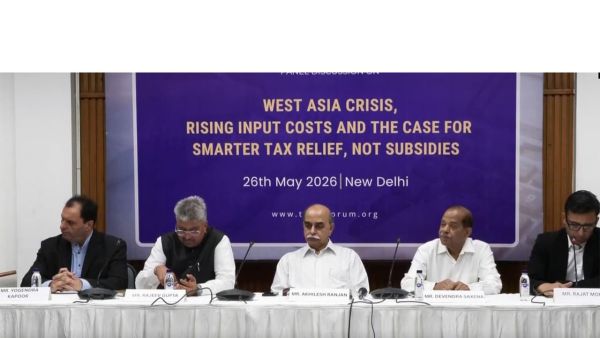
With the West Asia crisis threatening to deepen India's USD 333 billion trade deficit, economists and tax experts at the Think Change Forum roundtable on Monday urged a shift from reactive subsidies to a "selective economic doctrine" built on tax moderation, restricted luxury imports, and faster trade-remedy enforcement to shield domestic industry and conserve foreign exchange.

A new TCF white paper titled "Economic Ringfence Amid the West Asia Crisis: A Three-Point Agenda for Export Competitiveness, Import Discipline and Trade Defence" was debated at India International Centre, with experts arguing India must move beyond fiscal stopgaps as crude volatility, freight disruptions, and supply-chain shocks persist. India's merchandise imports hit $774.98 billion in FY2025-26 against exports of $441.78 billion.
Fostering Domestic Manufacturing
"India now has an opportunity to build a long-term economic doctrine where domestic capability itself becomes aspirational and globally competitive," said Rajeev Gupta, MD RDI and an economist. "The objective should be the creation of strong domestic manufacturing ecosystems that are capable of producing premium, high-value products within the country itself."
Curbing Non-Essential Imports
The white paper flagged rising non-essential imports despite mature local capacity: $81.7 million in bakers' wares, $135.9 million in chocolates, $393 million in beauty products, and $116 million in tobacco products. It recommended moving luxury confectioneries, premium personal care, and demerit goods from Open General Licence to restricted licensing channels, while deferring purchases of luxury watches and cars.
Strategic Policy for Fiscal Stability
"In periods of global volatility, policy responses must carefully balance inflation management, fiscal stability and industrial competitiveness," said Akhilesh Ranjan, Member (retd), Central Board of Direct Taxes. "There is significant scope to reassess the policy treatment of avoidable and demerit consumption imports while simultaneously reducing compliance burdens. Tax policy should be viewed not merely as a revenue tool, but as an instrument for supporting innovation, technology development and long-term economic growth."
Strengthening Trade Defence and Compliance
Experts also highlighted a widening gap in anti-dumping enforcement. DGTR recommendation rejection rates rose from 0.5% between 1991-2020 to 81% in November-December 2025. The panel called for a "comply-or-explain" mechanism and time-bound notification of measures where injury is established. "One of the biggest hidden costs for Indian businesses today is compliance volatility," said Rajat Mohan, Managing Partner, AMRG Global. "Reducing compliance costs and bringing greater stability to tax administration can itself act as an important economic stimulus during periods of global disruption."
Correcting Inverted Duty Structures
On inverted duty structures hurting sectors like chemicals, electronics, agri-processing and textiles, Yogendra Kapoor, economist and tax expert, noted: "If Indian industry has to compete globally, then the policy framework must ensure that taxes, duties and compliance structures do not unnecessarily inflate the final cost of production." Former Principal Chief Commissioner Income Tax Devendra Saxena added: "There is a fundamental difference between subsidies and incentives. Subsidies merely reduce an immediate burden, whereas intelligently designed incentives can shape the direction of economic growth itself."
The white paper further proposed a 12-month correction of inverted duties and a dynamic tariff calibration framework for crude, fertiliser feedstocks and steel with pre-announced price triggers and 90-day reviews. (ANI)
(Except for the headline, this story has not been edited by Asianet Newsable English staff and is published from a syndicated feed.)-
Bakrid 2026: Inside the kitchens of Hyderabad’s top food creators

-
Hyderabad: Cyber fraudster posing as bureaucrat tries to dupe Raja Singh
-
AP police reach Prof K Nageshwar’s Hyderabad home over remarks on Jana Sena
-
Newly discovered galaxy structure named after Manipur’s Loktak Lake

-
Bengaluru man’s smart lifestyle changes to cut expenses goes viral