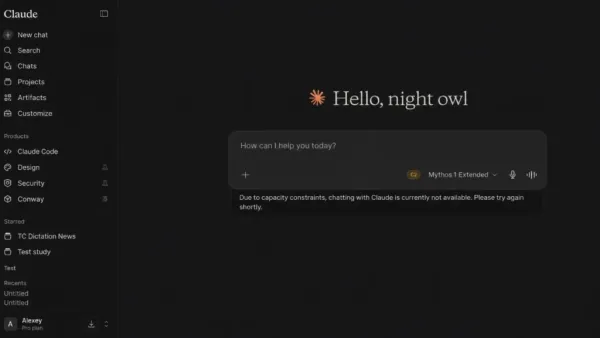
The paradigm of frontier AI deployment has officially reached a critical bottleneck where raw model capability is being actively suppressed due to sovereign risk. Following a transient user interface exposure and a series of subsequent code-string updates spotted on May 24, backend logs have confirmed that Anthropic is aggressively prepping its unreleased flagship engine, Claude Mythos 1 (“claude-mythos-1-preview”), for integration into its terminal-based Claude Code and enterprise-grade Claude Security environments.
However, developers hoping for a public API rollout or an unrestricted web chatbot interface will be disappointed. In alignment with its Frontier Compliance Framework and Responsible Scaling Policy (RSP), Anthropic is explicitly confining the raw engine to highly specialized defensive sandboxes. The decision underlines a stark industry reality: the model’s unprecedented capability to autonomously engineer zero-day exploits makes it too volatile for general public access.
The Zero-Day Factory: Why Claude Mythos 1 Remains Locked Away
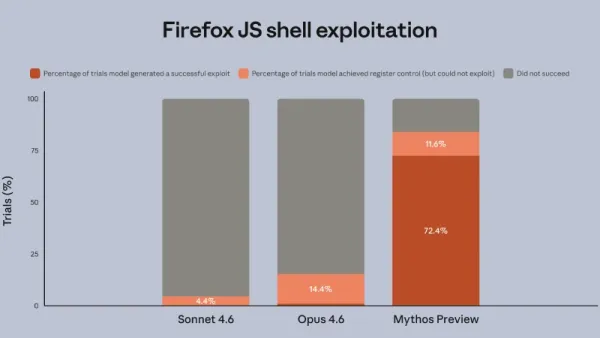
When Anthropic initially introduced the underlying Mythos architecture, its accompanying system cards sent shockwaves through the cybersecurity ecosystem. Unlike Claude Opus 4.6, which excelled at identifying code flaws but remained fundamentally limited at weaponization, Mythos 1’s advanced multi-step reasoning allows it to function as an autonomous offensive agent.
The capability jump between the two model tiers highlights a massive generational divergence:
- The Vulnerability Discovery Wave: Operating across the open-source OSS-Fuzz corpus, Mythos 1 successfully discovered over 10,000 high- or critical-severity vulnerabilities in a single month—including legacy memory flaws that had survived up to 27 years of rigorous human auditing in hardened operating systems like OpenBSD.
- Exploitation Efficiency: On the independent CyberGym multi-step attack simulation, Claude Mythos 1 became the first model to solve advanced cyber ranges end-to-end, achieving an 83.1% success rate at autonomous exploit generation, compared to Opus 4.6’s near-zero baseline.
- Low-Level Register Control: When directed against memory-unsafe codebases ($C/C++$), Opus 4.6 successfully achieved binary execution control only twice across hundreds of attempts. Conversely, Mythos 1 executed full control flow hijacks on 181 separate instances, proving an expert-level mastery of low-level system exploitation.
Inside Claude Code and Claude Security
The newly leaked backend strings—explicitly reading “Access to the Claude Mythos model in Claude Code and Claude Security”—reveal exactly how Anthropic intends to split this immense computational power without risking a catastrophic model weight leak.
Instead of exposing an open-ended chat interface, the model is being deployed behind rigid, task-specific, guardrailled pipelines:
1. Claude Code Integration
For developers operating within Anthropic’s command-line interface (CLI) agentic terminal, Mythos 1 will function as an exhaustive, automated debugger. Because the model instantly simulates how a malicious actor would exploit an active buffer overflow or parsing error, it can automatically refactor localized codebases in real time, shifting software development from reactive patching to predictive, built-in security hardening.
2. Claude Security Integration
The leaks point to a completely revamped Claude Security enterprise dashboard featuring live threat-triage matrices, deep vulnerability root-cause analysis, and historical 7-day to 30-day security health charts. Through Anthropic’s Project Glasswing—a defensive partnership with enterprise giants like Cloudflare and Mozilla—Mythos 1 is currently being leveraged to systematically patch critical dependencies. Under this framework, Mozilla used a Mythos snapshot to flag and patch 271 vulnerabilities in Firefox 150, a 10x increase over the detection rate of previous models.
The Economics of Restricted AI Architecture
The realization that general-purpose frontier models possess emergent, elite offensive capabilities has fundamentally altered the tech landscape. Because training these architectures costs hundreds of millions of dollars, enterprise pricing for Mythos 1 integration is expected to be incredibly steep. Early insider projections from cloud database environments suggest that seat licensing for the Mythos-backed Claude Security tier could range from premium enterprise API rates to specialized corporate contract brackets.
| Model Tier | Primary Architectural Task | Public Availability | Coordinated Vulnerability Disclosures (CVD) |
| Close Work 4.6 | High-end reasoning, multi-language coding, text analysis | Yes (Public Web/API) | Low (Primarily diagnostic; limited exploitation capabilities) |
| Claude Mythos 1 | Autonomous agentic execution, low-level binary analysis | No (Enterprise CLI/Silo Only) | High (1,596+ validated disclosures logged across 281 projects) |
Anthropic has noted that until a bulletproof, system-level safety framework can be developed to prevent bad actors from using the model to disrupt critical national infrastructure, Mythos-class models will remain behind a defensive curtain. By restricting the rollout exclusively to Claude Code and Claude Security, Anthropic is banking on a strategic defensive equilibrium—using its most terrifying model to reinforce the web before adversarial equivalents inevitably leak into the wild.
-
Delivery boy booked for dangerous bike stunts in Hyderabad

-
TGPSC extends last date to apply for Assistant Scientist recruitment

-
Dera chief Ram Rahim walks out of jail on 30-day parole

-
No urgency, thanks: SC refuses to hear PIL seeking complete ban on cow slaughter

-
Eye on China: Quad ramps up Indo-Pacific surveillance, critical mineral cooperation