
Listen to this article in summarized format
Loading...
××
Subscribe to

Unlock AI Briefing and Premium Content
New Year Offer 24 Hours Left
Subscribe NowAlready a member? Sign In
What's Included
- Exclusive Stories
- Daily ePaper Access
- Smart Market Tools
- Curated Investment Ideas
- Ad-lite Experience
Subscription

Some people are moved by adversity, while others take responsibility into their own hands, becoming the torchbearers of change. Sharvan Patel, a wildlife photographer from the Melwa village in the Jodhpur district of Rajasthan, belongs to the latter category. His life took a dramatic turn one scorching summer afternoon in 2022. Sharvan was visiting the Tal Chhapar Wildlife Sanctuary in Churu, tucked away in the hot and arid Thar desert. The sanctuary is home to several wildlife species like blackbuck, chinkara, desert fox and migratory birds. During his time there, Sharvan encountered a heartbreaking incident that changed him forever.
A promise born from wildlife’s struggle
According to a report by The Better India, Sharvan Patel was deeply disturbed by the endless stretch of cracked land and dried-up waterholes. An animal-lover himself, he could not see the plight of the poor animals, searching for a drop of water but in vain. One heartbreaking incident especially moved him, prompting the photographer to dig as many as 130 khailis or ponds to save the desert animals.
Sharvan Patel saw a herd of blackbucks hovering around a shallow pit, their hooves sinking into dust but finding no water to quench their thirst. Around the same time, a mongoose darted in looking for water, but as soon as the animal’s nose touched the muddy trickle, it quickly scurried away due to the foul smell. The sight of the desperate animals repeatedly searching the parched ground, hoping to find even a small puddle, left a lasting impact on Sharvan. Unable to ignore their pain and suffering, he made a promise to himself: to bring back water for wildlife.
130 ponds transformed Rajasthan’s desert ecosystem
During his time in Tal Chhapar Wildlife Sanctuary, Sharvan Patel took active note of the traditional khailis, aka shallow village ponds built with earth and natural clay to hold monsoon water. Taking the idea, he and his group of friends built a pond in their village with the use of local soil and cement. After a few days, animals and birds started arriving at the spot and drinking fresh water. The visuals, uploaded by Sharvan on social media, went viral and many people reached out to him to create a similar water facility for animals. What started as a thought of concern became a full-fledged movement.
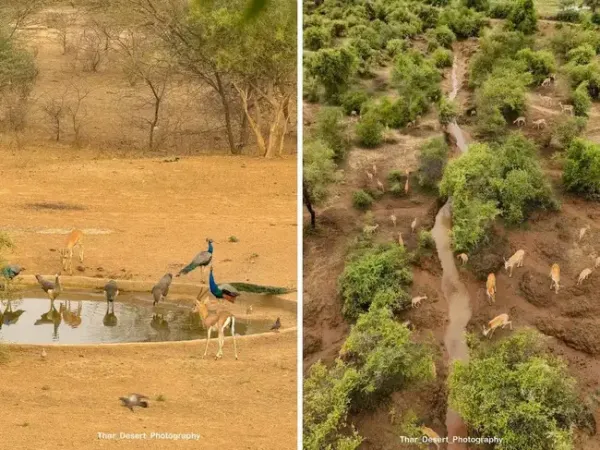
According to a report by Down To Earth, each pond cost about Rs 30,000-35,000 to construct and was filled through a 5,000-litre water tanker, priced at Rs 1,500 per trip. The impact was huge as these ponds became lifelines for animals. Camera traps showed mongooses, peacocks, and migratory birds around the ponds, turning the desert into what looked like an oasis. What’s more, the number of blackbucks also started increasing in areas near the ponds. At present, Sharvan Patel has created more than 130 ponds in Rajasthan’s drylands.
A promise born from wildlife’s struggle
According to a report by The Better India, Sharvan Patel was deeply disturbed by the endless stretch of cracked land and dried-up waterholes. An animal-lover himself, he could not see the plight of the poor animals, searching for a drop of water but in vain. One heartbreaking incident especially moved him, prompting the photographer to dig as many as 130 khailis or ponds to save the desert animals.
Sharvan Patel saw a herd of blackbucks hovering around a shallow pit, their hooves sinking into dust but finding no water to quench their thirst. Around the same time, a mongoose darted in looking for water, but as soon as the animal’s nose touched the muddy trickle, it quickly scurried away due to the foul smell. The sight of the desperate animals repeatedly searching the parched ground, hoping to find even a small puddle, left a lasting impact on Sharvan. Unable to ignore their pain and suffering, he made a promise to himself: to bring back water for wildlife.
130 ponds transformed Rajasthan’s desert ecosystem
During his time in Tal Chhapar Wildlife Sanctuary, Sharvan Patel took active note of the traditional khailis, aka shallow village ponds built with earth and natural clay to hold monsoon water. Taking the idea, he and his group of friends built a pond in their village with the use of local soil and cement. After a few days, animals and birds started arriving at the spot and drinking fresh water. The visuals, uploaded by Sharvan on social media, went viral and many people reached out to him to create a similar water facility for animals. What started as a thought of concern became a full-fledged movement.
According to a report by Down To Earth, each pond cost about Rs 30,000-35,000 to construct and was filled through a 5,000-litre water tanker, priced at Rs 1,500 per trip. The impact was huge as these ponds became lifelines for animals. Camera traps showed mongooses, peacocks, and migratory birds around the ponds, turning the desert into what looked like an oasis. What’s more, the number of blackbucks also started increasing in areas near the ponds. At present, Sharvan Patel has created more than 130 ponds in Rajasthan’s drylands.