

Listen to this article in summarized format
Loading...
××
Subscribe to

Unlock AI Briefing and Premium Content
New Year Offer 24 Hours Left
Subscribe NowAlready a member? Sign In
What's Included
- Exclusive Stories
- Daily ePaper Access
- Smart Market Tools
- Curated Investment Ideas
- Ad-lite Experience
Subscription


Your portfolio is costing you years of savings.
Free Mutual Funds Workshop
The world remains mired in chaos and uncertainty. This anxiety now reflects starkly in the bond yields. The yield on the 30-year US Treasury bond recently jumped to 5.2%—its highest since 2007. In India, the yield on the benchmark 10-year government bond has jumped from 6.6% to 7.1% in three months. Long-term yields rise when investors demand a higher return for holding bonds. This is compensation for the loss of purchasing power from higher expected inflation.
The West Asia conflict and the continued blockade of the Strait of Hormuz have become severely destabilising, stoking global inflation risks.
Domestically, while inflation has so far remained contained, continued disruptions to critical supply chains threaten to send prices soaring. The rising crude oil bill is likely to widen India’s current account deficit (CAD), contributing to a steadily weakening rupee. Forecasts of uneven or sporadic monsoon pose additional risk to inflation. This build-up of a ‘perfect storm’ has effectively shut the door on any rate cuts in the near future.
Kunal Valia, Founder and Compliance Officer of StatLane, a Sebi-registered research analyst, says, “At this stage, the rate easing cycle appears largely complete. Going forward, a combination of domestic and global factors is likely to keep bond yields elevated and limit the scope for any meaningful decline.”
Also read: International mutual funds deliver strong returns, but overseas investment limits restrict access
With markets adjusting to higher inflation expectations, Valia reckons bond yields will remain broadly range-bound, albeit with a mild upward bias. The 10-year government bond yield is likely to trade in the 6.9– 7.3% range over the coming quarters.
Experts suggest rate hikes could happen sooner than expected.
“The RBI is likely to hike rates as well imminently,” believes Vishal Goenka, Co- Founder, Indiabonds.com. If the current situation persists, the path of least resistance would be for the regulator to hike rates sooner than expected, insists Suyash Choudhary, Head–Fixed Income, Bandhan Mutual Fund. “With average Consumer Price Inflation (CPI) for the current financial year likely to be in the 5–6% band, it almost automatically follows that the RBI will have to undertake some rate hikes.”
As a base case, one should expect hikes of 50-75 bps over the course of the rest of this fiscal year, according to Choudhary.
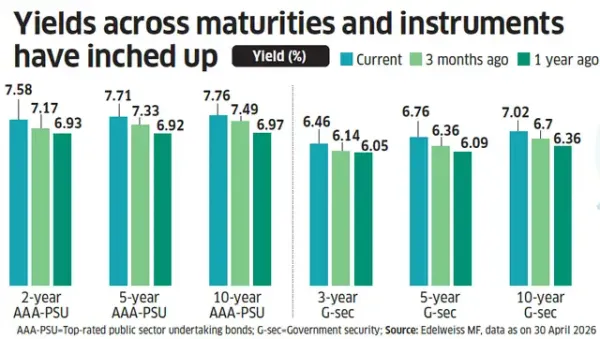
Accrual strategies have offered superior returns
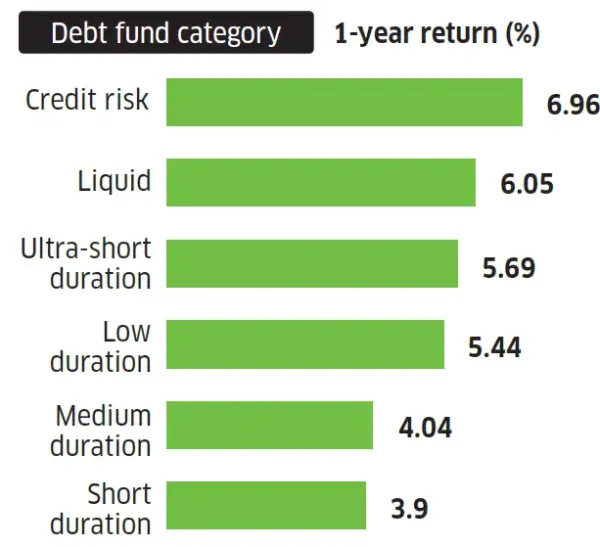
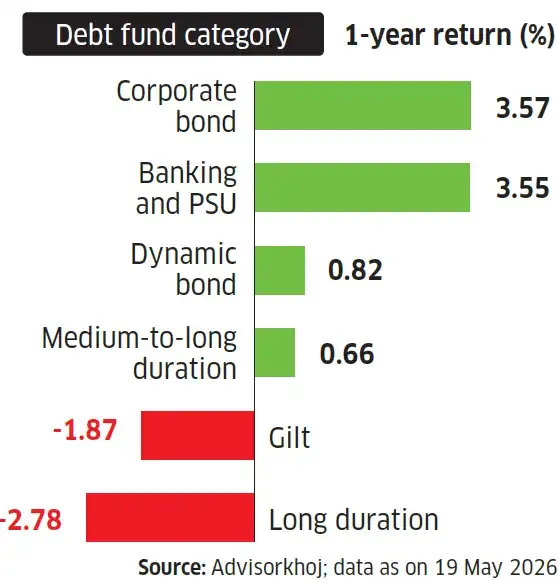
Specifically, taking duration risk is turning unfavourable. This refers to moving to longer tenure bonds, which are more sensitive to interest rates. After initially adding duration risk on the market’s aggressive pricing on rate hikes, Bandhan Mutual Fund has shifted its stance. “Reflecting the evolving dynamics, we have again gone underweight duration across a host of our funds (subject to individual mandates and positionings),” indicates Choudhary.
The absence of a clear and sustained rate-cut cycle has reduced the effectiveness of aggressive duration strategies, making accrual-oriented portfolios better suited to this phase, according to Axis MF in a note. “Against this backdrop, discipline matters more than directional rate calls. Allowing accrual to compound steadily is often more effective than reacting to short-term global or geopolitical developments,” it suggests.
At current levels, duration risk seems asymmetrically skewed to the downside, suggests Valia. In contrast, the short-tomedium- end of the yield curve continues to offer attractive accrual opportunities.
Valia adds, “For investors, short-duration funds, corporate bond funds and mediumterm debt funds focused on the 2–4 year maturity bucket remain suitable vehicles to build a robust accrual-oriented fixed income portfolio.” For investors with a 2–3-year investment horizon, Axis MF suggests that a short-to-medium-duration, accrual-oriented approach, complemented by income-plusarbitrage strategies, remains appropriate.
On the credit side, selective exposure to high-quality issuers remains favourable. AA+ and AAA-rated corporate bonds, particularly those issued by well-capitalised corporates, non-banking finance companies and public sector entities, continue to offer attractive spreads over comparable government securities, Valia observes. However, he cautions against moving excessively down the credit curve purely in pursuit of higher yields, particularly in an environment where tighter global financial conditions could lead to spread widening and weaker liquidity in lower-rated segments.
The sharp rise in US bond yields presents another interesting option. US Treasury Bond funds earned outsized gains in the past year, outperforming both Indian bonds and equity funds. Valia maintains that US Treasury bond funds continue to offer a reasonable opportunity, particularly at the short end of the curve (1–3-year Treasuries), where yields remain attractive with relatively low duration risk.
The West Asia conflict and the continued blockade of the Strait of Hormuz have become severely destabilising, stoking global inflation risks.
How should bond investors position themselves?
From rate cuts to rate hikes When the Reserve Bank of India (RBI) initiated its much-anticipated rate cuts in early 2025, it seemed like bonds were set for a prolonged spell of gains. When interest rates fall, bond prices rise. But after front-loading rate cuts by June 2025, the RBI quickly pivoted to a neutral stance, signalling limited room for further cuts. After a final 25-basis points (bps) rate cut in December, the central bank ended the year with a cumulative easing of 125 bps (one basis point is one-hundredth of a percentage point). It has since kept rates unchanged, keeping a wary eye on significant developments globally.Best MF to invest
Looking for the best mutual funds to invest? Here are our recommendations.
Domestically, while inflation has so far remained contained, continued disruptions to critical supply chains threaten to send prices soaring. The rising crude oil bill is likely to widen India’s current account deficit (CAD), contributing to a steadily weakening rupee. Forecasts of uneven or sporadic monsoon pose additional risk to inflation. This build-up of a ‘perfect storm’ has effectively shut the door on any rate cuts in the near future.
Kunal Valia, Founder and Compliance Officer of StatLane, a Sebi-registered research analyst, says, “At this stage, the rate easing cycle appears largely complete. Going forward, a combination of domestic and global factors is likely to keep bond yields elevated and limit the scope for any meaningful decline.”
Also read: International mutual funds deliver strong returns, but overseas investment limits restrict access
With markets adjusting to higher inflation expectations, Valia reckons bond yields will remain broadly range-bound, albeit with a mild upward bias. The 10-year government bond yield is likely to trade in the 6.9– 7.3% range over the coming quarters.
Experts suggest rate hikes could happen sooner than expected.
“The RBI is likely to hike rates as well imminently,” believes Vishal Goenka, Co- Founder, Indiabonds.com. If the current situation persists, the path of least resistance would be for the regulator to hike rates sooner than expected, insists Suyash Choudhary, Head–Fixed Income, Bandhan Mutual Fund. “With average Consumer Price Inflation (CPI) for the current financial year likely to be in the 5–6% band, it almost automatically follows that the RBI will have to undertake some rate hikes.”
As a base case, one should expect hikes of 50-75 bps over the course of the rest of this fiscal year, according to Choudhary.
Accrual strategies have offered superior returns
Bonds:Time to reposition portfolios
A storm is coming- Ongoing West Asia conflict fuels inflation concerns
- Weakening rupee and poor monsoon also add to worries
- Anxiety now reflects in higher bond yields
- Rate easing cycle appears firmly over
- Rate hikes could happen sooner than expected
- Taking duration risk is turning unfavourable
- Accrual-oriented portfolios better suited for this phase
- Short-duration funds, corporate bond funds, medium-term debt funds focused on 2-4 year maturity bucket
- Selective exposure to high-quality issuers remains favourable
- US Treasury bond funds continue to offer a reasonable opportunity
What to do now
Given the volatility and uncertainty stemming from macro factors, Goenka maintains that a higher allocation to fixed income would help investors buffer against economic slowdowns. Before the war began, bond markets globally were still hopeful of rate cuts by central banks. The length of the disruption has forced a rethink among investors and fund managers alike.Specifically, taking duration risk is turning unfavourable. This refers to moving to longer tenure bonds, which are more sensitive to interest rates. After initially adding duration risk on the market’s aggressive pricing on rate hikes, Bandhan Mutual Fund has shifted its stance. “Reflecting the evolving dynamics, we have again gone underweight duration across a host of our funds (subject to individual mandates and positionings),” indicates Choudhary.
The absence of a clear and sustained rate-cut cycle has reduced the effectiveness of aggressive duration strategies, making accrual-oriented portfolios better suited to this phase, according to Axis MF in a note. “Against this backdrop, discipline matters more than directional rate calls. Allowing accrual to compound steadily is often more effective than reacting to short-term global or geopolitical developments,” it suggests.
At current levels, duration risk seems asymmetrically skewed to the downside, suggests Valia. In contrast, the short-tomedium- end of the yield curve continues to offer attractive accrual opportunities.
Valia adds, “For investors, short-duration funds, corporate bond funds and mediumterm debt funds focused on the 2–4 year maturity bucket remain suitable vehicles to build a robust accrual-oriented fixed income portfolio.” For investors with a 2–3-year investment horizon, Axis MF suggests that a short-to-medium-duration, accrual-oriented approach, complemented by income-plusarbitrage strategies, remains appropriate.
On the credit side, selective exposure to high-quality issuers remains favourable. AA+ and AAA-rated corporate bonds, particularly those issued by well-capitalised corporates, non-banking finance companies and public sector entities, continue to offer attractive spreads over comparable government securities, Valia observes. However, he cautions against moving excessively down the credit curve purely in pursuit of higher yields, particularly in an environment where tighter global financial conditions could lead to spread widening and weaker liquidity in lower-rated segments.
The sharp rise in US bond yields presents another interesting option. US Treasury Bond funds earned outsized gains in the past year, outperforming both Indian bonds and equity funds. Valia maintains that US Treasury bond funds continue to offer a reasonable opportunity, particularly at the short end of the curve (1–3-year Treasuries), where yields remain attractive with relatively low duration risk.