

Listen to this article in summarized format
Loading...
××
Subscribe to

Unlock AI Briefing and Premium Content
New Year Offer 24 Hours Left
Subscribe NowAlready a member? Sign In
What's Included
- Exclusive Stories
- Daily ePaper Access
- Smart Market Tools
- Curated Investment Ideas
- Ad-lite Experience
Subscription

India’s television broadcast industry came under deeper structural pressure in FY26 as slowing advertising demand and a shrinking pay-TV subscriber base underscored the accelerating shift of audiences and marketers toward digital platforms.
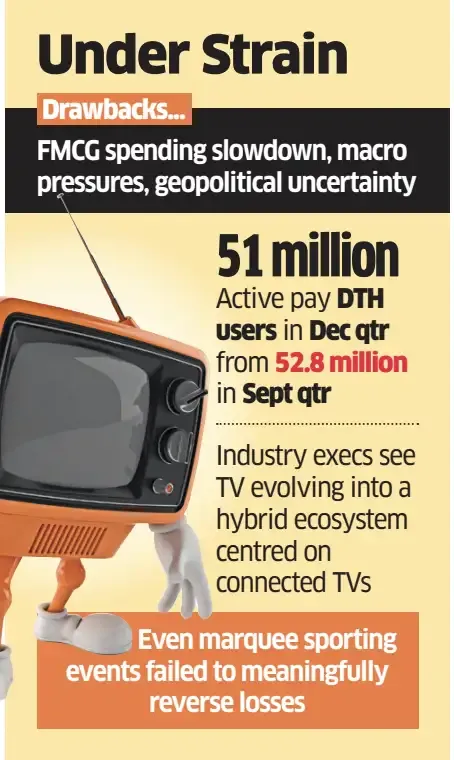
Even marquee sporting events, historically a key driver of television subscriptions, failed to meaningfully reverse subscriber losses as viewers increasingly migrated online, highlighting the structural challenges confronting broadcasters.
According to Broadcast Audience Research Council (BARC) data, weekly TV reach declined to 741 million in FY26 from 750 million in FY25 and 757 million in FY24.
Broadcasters, including Zee Entertainment Enterprises and Sun TV Network, reported weaker advertising revenue during the year, reflecting lower spending by FMCG companies, traditionally among television’s largest advertiser categories. Advertisers are also increasingly shifting budgets to performance-led digital platforms that offer sharper targeting and measurable returns.
JioStar, the entertainment arm of Reliance Industries, also flagged softness in linear television advertising due to lower FMCG spending. Despite pressure on traditional television, the company remained profitable in FY26, reporting a net profit of Rs 3,210 crore for the year ended March 31, 2026, according to Reliance Industries’ quarterly filings.
JioStar, which operates more than 100 entertainment and sports channels alongside streaming platform JioHotstar, recorded operating revenue of Rs 31,048 crore and EBITDA of Rs 4,885 crore during the year.
“The TV entertainment ad revenue remained under some pressure, especially due to spending cuts that we saw on the FMCG side,” said Ishan Chatterjee, CEO, Sports, JioStar, during Reliance’s Q4 earnings call.
Sports broadcasting, however, remained relatively resilient. Chatterjee said the T20 World Cup became the most-watched edition of the tournament while delivering record monetisation despite restrictions on real-money gaming advertising.
According to the Telecom Regulatory Authority of India, the active subscriber base of pay DTH services declined from 52.78 million in the quarter ended September 2025 to 50.99 million in the quarter ended December 2025, reflecting continued migration toward streaming platforms.
Sun TV Network reported a mixed FY26 performance. Consolidated revenue rose 8% to Rs 4,335 crore and EBITDA increased 4% to Rs 2,214 crore, but profit after tax declined to Rs 1,441 crore from Rs 1,704 crore in FY25.
“Ad revenue declined 10.1% year-on-year in Q4 and 11.4% in FY26, reflecting structural shifts by advertisers toward digital platforms. We expect muted advertising growth ahead,” said Karan Taurani, executive vice president at Elara Capital, in an analyst note on Sun TV.
During Zee Entertainment Enterprises’ investor call, CEO Punit Goenka pointed to macroeconomic pressures and geopolitical uncertainty affecting consumer sentiment. The company’s FY26 advertising revenue declined 4% to Rs 808 crore, while subscription revenue rose 4% to Rs 1,025 crore, largely driven by digital.
Industry executives increasingly see television evolving into a hybrid ecosystem centred on connected TVs, where households combine cable or DTH services with OTT subscriptions.
Speaking to analysts, GTPL Hathway chief strategy officer Piyush Pankaj said broadcasters will need to remain relevant across screens as content consumption becomes increasingly platform-agnostic.
Even marquee sporting events, historically a key driver of television subscriptions, failed to meaningfully reverse subscriber losses as viewers increasingly migrated online, highlighting the structural challenges confronting broadcasters.
According to Broadcast Audience Research Council (BARC) data, weekly TV reach declined to 741 million in FY26 from 750 million in FY25 and 757 million in FY24.
Broadcasters, including Zee Entertainment Enterprises and Sun TV Network, reported weaker advertising revenue during the year, reflecting lower spending by FMCG companies, traditionally among television’s largest advertiser categories. Advertisers are also increasingly shifting budgets to performance-led digital platforms that offer sharper targeting and measurable returns.
JioStar, the entertainment arm of Reliance Industries, also flagged softness in linear television advertising due to lower FMCG spending. Despite pressure on traditional television, the company remained profitable in FY26, reporting a net profit of Rs 3,210 crore for the year ended March 31, 2026, according to Reliance Industries’ quarterly filings.
JioStar, which operates more than 100 entertainment and sports channels alongside streaming platform JioHotstar, recorded operating revenue of Rs 31,048 crore and EBITDA of Rs 4,885 crore during the year.
“The TV entertainment ad revenue remained under some pressure, especially due to spending cuts that we saw on the FMCG side,” said Ishan Chatterjee, CEO, Sports, JioStar, during Reliance’s Q4 earnings call.
Sports broadcasting, however, remained relatively resilient. Chatterjee said the T20 World Cup became the most-watched edition of the tournament while delivering record monetisation despite restrictions on real-money gaming advertising.
According to the Telecom Regulatory Authority of India, the active subscriber base of pay DTH services declined from 52.78 million in the quarter ended September 2025 to 50.99 million in the quarter ended December 2025, reflecting continued migration toward streaming platforms.
Sun TV Network reported a mixed FY26 performance. Consolidated revenue rose 8% to Rs 4,335 crore and EBITDA increased 4% to Rs 2,214 crore, but profit after tax declined to Rs 1,441 crore from Rs 1,704 crore in FY25.
“Ad revenue declined 10.1% year-on-year in Q4 and 11.4% in FY26, reflecting structural shifts by advertisers toward digital platforms. We expect muted advertising growth ahead,” said Karan Taurani, executive vice president at Elara Capital, in an analyst note on Sun TV.
During Zee Entertainment Enterprises’ investor call, CEO Punit Goenka pointed to macroeconomic pressures and geopolitical uncertainty affecting consumer sentiment. The company’s FY26 advertising revenue declined 4% to Rs 808 crore, while subscription revenue rose 4% to Rs 1,025 crore, largely driven by digital.
Industry executives increasingly see television evolving into a hybrid ecosystem centred on connected TVs, where households combine cable or DTH services with OTT subscriptions.
Speaking to analysts, GTPL Hathway chief strategy officer Piyush Pankaj said broadcasters will need to remain relevant across screens as content consumption becomes increasingly platform-agnostic.