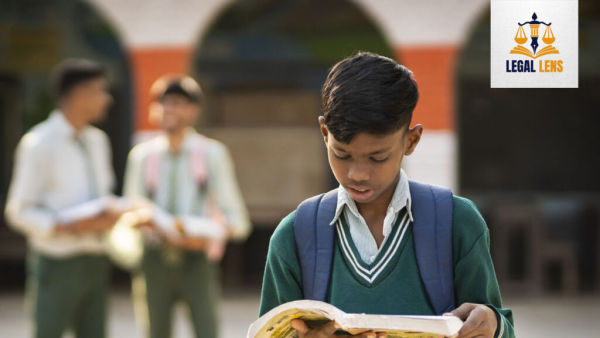
A cartoon, Solicitor General Tushar Mehta told the Supreme Court last week, has no place in a school textbook. Children of an “impressionable age” should not have to read one. The Bench agreed that the propriety of cartoons in NCERT textbooks be examined by the Indu Malhotra Committee.
The committee, headed by Malhotra, a former Supreme Court judge, was set up earlier to review the Class VIII chapter on judicial corruption that prompted the court’s February cognizance, and is now to take up the cartoons too. The phrase and the reflex are familiar. They are nearly 14 years old.
The 2012 Shankar cartoon case
In May 2012, a Shankar cartoon from 1949 was found in the Class XI political science textbook Indian Constitution at Work. It depicted Dr BR Ambedkar astride a snail, with Jawaharlal Nehru wielding a whip behind him. A protest erupted.
Also read | Cartoonists: Putting art to the practice of everyday resistance
Kapil Sibal, then Union HRD Minister, told the Lok Sabha the textbook would be withdrawn because it had “a tendency to influence impressionable minds”. Fourteen years later, the Solicitor General’s vocabulary is identical.
So is the Bench’s vocabulary. On February 26, taking suo motu cognizance of the Class VIII chapter on the judiciary, the Court used the same phrase. Unchecked criticism, it warned, would erode the sanctity of the judicial office “within impressionable minds of youth”.
About ‘impressionable minds’
There is, in fact, a serious body of work behind “impressionable minds”. Political psychologists call it the impressionable years hypothesis. Karl Mannheim sketched it in 1928. Jon Krosnick and Duane Alwin gave it empirical foundation in 1989, in a paper in the Journal of Personality and Social Psychology.
The hypothesis is precise: individuals are most susceptible to attitude change in late adolescence and early adulthood. After that window closes, attitudes harden and resist revision.
Read carefully, this finding does not support the Solicitor General. It contradicts him. The cohort he wants to shield, students in Class XI, is exactly the cohort the hypothesis identifies as forming durable political attitudes.
Also read: How Abu Abraham, the legendary cartoonist, skewered power with wit
The question is not whether they will be shaped during these years. They will. The question is whether they will be shaped through engagement with political argument, including its uncomfortable forms, or through curated silence.
Shielding and protecting
To shield is not to protect. It is to delay formation. A young reader who never encounters a cartoon does not stop forming political attitudes. She forms them through whatever else reaches her, often unmediated by school.
14 years apart…nothing changed
The 2012 cartoon row ended with removal and silence. The 2026 version has a committee, a court, and the same phrase: “impressionable minds.” Same instinct, bigger machinery.
The textbook’s task, on the science, is the opposite of what the State proposes. It must introduce political argument in its various registers, including the satirical. The reader meets these forms while still inside a setting where a teacher can help her think about what she has seen. That is what the textbook the Solicitor General objects to was trying to do.
Indian Constitution at Work was written under the National Curriculum Framework of 2005. Its chief advisors, Suhas Palshikar and Yogendra Yadav, addressed a “Letter to You” to the student.
The cartoons in the book, they wrote, were not there as “comic relief”. They drew attention to “the criticisms, about the weak spots, about near-failures”. The point was to teach students “about politics and about how to think about politics”.
That intent was already defended in scholarship more than a decade ago. Writing in the Economic and Political Weekly in June 2012, historian G Arunima of Jawaharlal Nehru University called the parliamentary outrage a “misrecognition of the visual content of the cartoon”. The objection, she argued, was a “peculiar reading of the pedagogical intent” of the books.
The debate did not advance from there. The cartoon was dropped. The pedagogy went quieter. The phrase, “impressionable minds”, was left undisturbed in official vocabulary, where it has now reappeared.
Not all cartoons are equal
A serious counterargument deserves recognition. Not all cartoons are equal. Some caricature in ways that wound. The 2012 protest against the Shankar cartoon was not frivolous. Dalit organisations argued, with reason, that the image was ambiguous. A young reader, unaware of the iconography of the late 1940s, could read it as a ridicule of the Constitution’s architect.
Also read: NCERT textbook ban: Judiciary moves fastest when it’s the one being judged
The cartoon required context. The textbook did not supply enough. The answer the episode warranted was not removal but better pedagogical apparatus around the cartoon. A caption to explain the iconography. A teacher’s note placing Shankar’s 1949 humour in the politics of constitutional drafting.
A classroom exercise asking the student to weigh the cartoon and judge it. That is the work a textbook in a serious republic ought to do. It is the work the State, in both 2012 and 2026, has refused.
Trusting the citizen reader
The Supreme Court itself once said as much, though about adults. In Indibily Creative Pvt Ltd v. Government of West Bengal (2019), Justice DY Chandrachud defended satire as a constitutionally protected genre that holds “topical issues” up to “scorn by means of ridicule or irony”.
The Madras High Court, in a 2020 judgment by Justice GR Swaminathan, held that “law envisages a reasonable person and not a touchy and hyper-sensitive individual”.
Both rulings trust the citizen reader. According to the science of impressionable years, the schoolchild is in fact much closer to that reasonable citizen than the State’s framing suggests.
The current proceeding compounds the difficulty. The Court has not held cartoons impermissible. It has referred the question to the Indu Malhotra Committee. But the referral, combined with the Bench’s own deployment of “impressionable minds of youth”, places the burden on the cartoon, not on its proposed excision.
That asymmetry is what the 2012 reflex bequeathed to 2026. It now carries the judicial weight it did not have the first time.
Thinking too soon?
There is a constitutional point here that deserves naming. The architecture of Indian schooling assumes that the State will be a poor judge of what children should read. That is why curriculum is, by statute and convention, an autonomous matter.
Also read: NCERT textbook row: Has SC overreacted? | AI With Sanket
The Solicitor General’s intervention, and the Court’s accommodation of it, mark a small but real erosion of that autonomy. It travels under a vocabulary of solicitude. Children must be protected. From what? From thinking too soon. That is the unspoken second half of the sentence.
The phrase “impressionable minds” should retire from official vocabulary. It misreads the science it borrows from. It misnames its object. And it has done enough damage to Indian textbooks already.
-
India’s realty sector sees rise in ESG-linked fundraising amid tighter lending

-
Delhi weather: IMD issues yellow alert, check next week’s forecast and safety precautions
-
Pearl Harbor attack bombing survivor is keeping memory of Japanese attack at 106

-
Hezbollah chief says hopes for Iran-US deal and that it includes Lebanon
-
Iran says truce agreement 'may be cancelled' due to US 'obstruction' of frozen assets