
The proposal sits inside the ministry’s draft amendments to the Law on Prevention and Control of Tobacco Harms. The drafting process is largely complete, and the government is preparing the resolution needed to advance the bill to the 16th National Assembly’s second session in October 2026.
Tran Thi Van Ngoc, Deputy Chief of Office at the Medical Services Administration under the ministry, outlined the draft at a workshop marking World No Tobacco Day on May 22. The bill carries two main policy clusters: a comprehensive ban on the production, trade, transport, advertising, sponsorship and use of e-cigarettes, heated tobacco and other new tobacco products, and a separate prohibition on wholesale and retail outlets displaying tobacco in any form.
On top of those measures, the ministry has urged the government to consider adding the 2010 generational cutoff, either to this round of amendments or to a later legislative timetable aligned with the country’s socioeconomic conditions. The drafting agency described the cutoff as a step toward producing a generation of Vietnamese who never start smoking, lowering nicotine addiction among young people and cutting exposure to secondhand smoke.
A policy impact assessment found rigorous enforcement could sharply reduce smoking rates, save healthcare costs and limit productivity losses from tobacco- illness, the ministry said. But putting the rule into practice would demand alignment among the National Assembly, the government, relevant ministries and the public, along with coordinated measures including age verification at the point of sale, fewer retail outlets, tougher penalties and sustained cessation support.
|
An e-cigarette set of a student in Vietnam. Photo by Phan Duong |
The “smoke-free generation” model has been studied in multiple countries as a way to prevent adolescents from ever starting to smoke rather than focusing on current smokers. New Zealand pioneered the approach in 2022 but its incoming government repealed the law in 2024. The U.K. became the first major economy with a smoke-free generation law that remains in force, passing the Tobacco and Vapes Act 2026, which makes it illegal to sell tobacco to anyone born on or after Jan. 1, 2009.
Health experts say children and adolescents are particularly vulnerable to nicotine addiction because the brain continues developing until around age 25. They are also the group most aggressively targeted by the tobacco industry through disguised social-media advertising, event sponsorships, eye-catching packaging and celebrity marketing.
Research by a University of Nottingham team, published in February in the journal Tobacco Control, modeled the U.K. law’s likely impact. Under the team’s central scenario, smoking prevalence among 12-to-30-year-olds in England could fall below 5% by the late 2040s and approach zero by 2050. The study projected around 88,000 additional years of healthy life by 2075 compared with a no-policy baseline, with the largest gains concentrated in the most deprived communities.
The theme of World No Tobacco Day 2026, announced by the World Health Organization in October last year, is “Unmasking the appeal: countering nicotine and tobacco addiction.” It targets how the tobacco industry is repackaging nicotine products as “modern,” “less harmful” or “fashionable” to draw in young users.
Vietnam currently has roughly 15.8 million adult smokers, with about 41% of adult men smoking, placing the country among the world’s heaviest tobacco-consuming nations. Health officials estimate around 100,000 deaths each year are caused directly or indirectly by smoking, with the disease load weighing on cardiovascular health, lung function and cancer outcomes.
The country already enforces a range of tobacco control measures. Selling tobacco to minors under 18, advertising or promoting tobacco products, and smoking in hospitals, schools, public transport and many other public places are prohibited. National Assembly Resolution 173, passed in November 2024, banned the production, trade, import, possession, transport and use of e-cigarettes and heated tobacco effective Jan. 1, 2025.
Vietnam also levies a high special consumption tax on tobacco. Under the amended Law on Special Consumption Tax that took effect Jan. 1, 2026, cigarettes carry a 75% percentage-based rate. From 2027 they will additionally face an absolute levy starting at VND2,000 ($0.08) per pack and rising in annual increments to VND10,000 ($0.38) per pack by 2031, a roadmap health officials see as a key lever for cutting smoking rates and easing the public health burden.
-
CBI Takes Over Twisha Sharma Dowry Death Case, Re-Registers FIR Against Husband

-
Avaada-Otters Club All-India Squash 2026: Vedansh Kushwaha Edges Aayush Verma In Thrilling Round-64 Battle

-
Indore's Holkar Science College Attracts 8 First-Time Recruiters In 2025-26 Placement Season

-
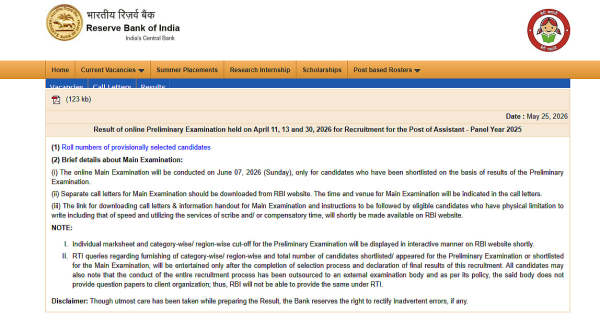
RBI Assistant Prelims Result 2026 Released At opportunities.rbi.org.in; Check PDF Here
-
Drishyam 3 Box Office Collection Day 5 Prediction: After A Good Weekend, Will Mohanlal Starrer Pass The Monday Test?