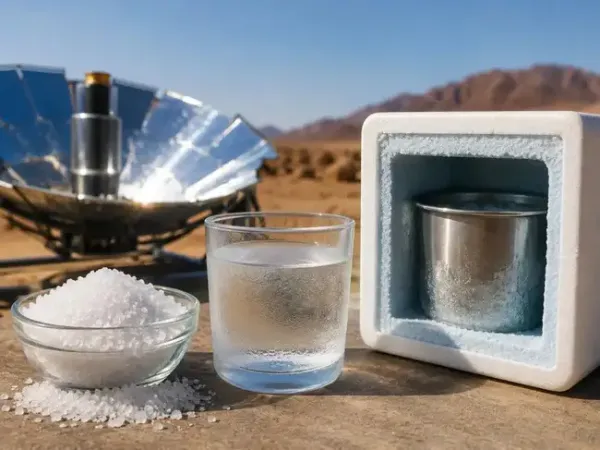
More than 700 million people across the world still live without reliable electricity, and a team of researchers in Saudi Arabia now says a new cooling system could offer relief without plugging into a power source. Scientists at King Abdullah University of Science and Technology recently developed a technology that rapidly cools water using a chemical reaction and later resets itself using only sunlight.
Also Read: China develops fibre that is 10 times stronger than steel, but thinner than hair, can pull coach carrying 54 adults
The system, named NESCOD, short for No Electricity and Sustainable Cooling on Demand, managed to reduce the temperature of a mixture from 25 degrees Celsius to 3.6 degrees Celsius in about 20 minutes during laboratory testing. Researchers said the setup then remained below 15 degrees Celsius for more than 15 hours, a range close to basic refrigeration needs. The project was led by Professor Peng Wang, while postdoctoral researcher Wenbin Wang carried out much of the experimental work.
Wenbin Wang explained that ammonium nitrate dissolves far more easily in water than many competing salts. It can reach a solubility of 208 grams per 100 grams of water, while most alternatives stay below 100 grams. Because more salt can dissolve, more heat gets absorbed during the process. The compound also comes with practical advantages. It is already produced on a large scale worldwide as a fertilizer, making it relatively cheap and widely available.
Researchers used a simple insulated box to test food storage potential
To test whether the system could help preserve food, the team placed the salt solution inside a metal cup kept in a polystyrene foam insulation box. As the salt dissolved gradually, the temperature inside the cup dropped sharply.
Also Read: ‘T. rex of the Sea’: Scientists discover 43-foot ‘King of the Tylosaurs’ that terrorized oceans 145 million years ago
The cup stayed around 3.6 degrees Celsius initially and remained below 15 degrees Celsius for more than 15 hours. Researchers said this could make the technology useful for storing food and temperature-sensitive materials in places where electricity is unreliable or unavailable.
Sunlight helps the system reset itself for reuse
One of the biggest challenges with chemical cooling systems is that many work only once. The KAUST researchers said NESCOD solves that problem by using solar energy to regenerate the salt after each cycle. Once the dissolved salt solution returns to room temperature, the researchers expose it to concentrated sunlight through a specially designed cup-shaped solar regenerator. The material used in the device absorbs a large portion of sunlight and heats the liquid until water begins to evaporate.
As the water leaves the solution, ammonium nitrate crystals form along the walls of the cup. Wenbin Wang noted that the crystals naturally detach and fall due to gravity, allowing easy collection for reuse in another cooling cycle. The researchers also said the evaporated water can be condensed and reused through solar distillation. That could become especially important in dry and hot regions where both electricity and freshwater are limited.
Why researchers believe the idea matters
Cooling systems already consume a major share of global electricity. According to the International Energy Agency, air conditioning accounts for nearly 10 percent of electricity use worldwide, and demand is expected to rise further as temperatures increase.
Countries with extremely hot summers, including Saudi Arabia, spend a large amount of electricity on cooling buildings and preserving food supplies.
Wenbin Wang described the project as an off-grid solar energy conversion and storage system designed for inexpensive and environmentally low-impact cooling. Researchers said using direct sunlight instead of grid electricity could make the system more practical in remote or underdeveloped areas.
Beyond homes, the team believes the technology could support community refrigeration, food storage, and preservation of temperature-sensitive supplies in places lacking dependable infrastructure.
The system still faces unanswered questions
The research remains at the laboratory stage, and the published findings do not mention large-scale field testing or commercial deployment. The cooling results came from controlled experiments using insulated containers rather than real homes or buildings.
The study also does not discuss regulatory concerns linked to ammonium nitrate, which is tightly monitored in several countries because it can also be used in explosives.
Researchers have not announced a commercial launch timeline or named any industry partner for large-scale manufacturing.
Also Read: China develops fibre that is 10 times stronger than steel, but thinner than hair, can pull coach carrying 54 adults
The system, named NESCOD, short for No Electricity and Sustainable Cooling on Demand, managed to reduce the temperature of a mixture from 25 degrees Celsius to 3.6 degrees Celsius in about 20 minutes during laboratory testing. Researchers said the setup then remained below 15 degrees Celsius for more than 15 hours, a range close to basic refrigeration needs. The project was led by Professor Peng Wang, while postdoctoral researcher Wenbin Wang carried out much of the experimental work.
How ordinary salt and water created a cooling effect
The cooling process depends on a scientific reaction known as endothermic dissolution. In simple terms, some salts absorb heat from their surroundings when they dissolve in water instead of releasing it. That heat absorption quickly lowers the temperature. Researchers tested several salts before identifying ammonium nitrate as the strongest performer. According to the team, it delivered more than four times the cooling effect of ammonium chloride, which came second in testing.Wenbin Wang explained that ammonium nitrate dissolves far more easily in water than many competing salts. It can reach a solubility of 208 grams per 100 grams of water, while most alternatives stay below 100 grams. Because more salt can dissolve, more heat gets absorbed during the process. The compound also comes with practical advantages. It is already produced on a large scale worldwide as a fertilizer, making it relatively cheap and widely available.
Researchers used a simple insulated box to test food storage potential
To test whether the system could help preserve food, the team placed the salt solution inside a metal cup kept in a polystyrene foam insulation box. As the salt dissolved gradually, the temperature inside the cup dropped sharply.Also Read: ‘T. rex of the Sea’: Scientists discover 43-foot ‘King of the Tylosaurs’ that terrorized oceans 145 million years ago
The cup stayed around 3.6 degrees Celsius initially and remained below 15 degrees Celsius for more than 15 hours. Researchers said this could make the technology useful for storing food and temperature-sensitive materials in places where electricity is unreliable or unavailable.
Sunlight helps the system reset itself for reuse
One of the biggest challenges with chemical cooling systems is that many work only once. The KAUST researchers said NESCOD solves that problem by using solar energy to regenerate the salt after each cycle. Once the dissolved salt solution returns to room temperature, the researchers expose it to concentrated sunlight through a specially designed cup-shaped solar regenerator. The material used in the device absorbs a large portion of sunlight and heats the liquid until water begins to evaporate.As the water leaves the solution, ammonium nitrate crystals form along the walls of the cup. Wenbin Wang noted that the crystals naturally detach and fall due to gravity, allowing easy collection for reuse in another cooling cycle. The researchers also said the evaporated water can be condensed and reused through solar distillation. That could become especially important in dry and hot regions where both electricity and freshwater are limited.
Why researchers believe the idea matters
Cooling systems already consume a major share of global electricity. According to the International Energy Agency, air conditioning accounts for nearly 10 percent of electricity use worldwide, and demand is expected to rise further as temperatures increase.Countries with extremely hot summers, including Saudi Arabia, spend a large amount of electricity on cooling buildings and preserving food supplies.
Wenbin Wang described the project as an off-grid solar energy conversion and storage system designed for inexpensive and environmentally low-impact cooling. Researchers said using direct sunlight instead of grid electricity could make the system more practical in remote or underdeveloped areas.
Beyond homes, the team believes the technology could support community refrigeration, food storage, and preservation of temperature-sensitive supplies in places lacking dependable infrastructure.
The system still faces unanswered questions
The research remains at the laboratory stage, and the published findings do not mention large-scale field testing or commercial deployment. The cooling results came from controlled experiments using insulated containers rather than real homes or buildings.The study also does not discuss regulatory concerns linked to ammonium nitrate, which is tightly monitored in several countries because it can also be used in explosives.
Researchers have not announced a commercial launch timeline or named any industry partner for large-scale manufacturing.