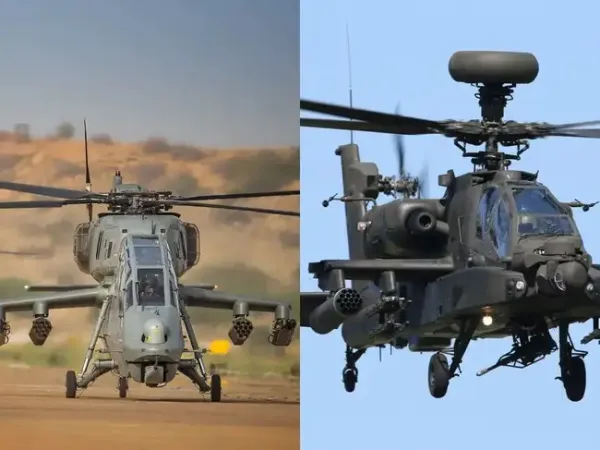
The US State Department recently approved a possible sale of support services and related equipment for Boeing AH-64E Apache attack helicopters to India in a deal worth more than USD 198.2 million.
The approval has also drawn attention to India’s indigenous Light Combat Helicopter (LCH) Prachand, developed by Hindustan Aeronautics Limited (HAL).
The development has renewed discussion on India’s continued reliance on foreign-made attack helicopters alongside indigenous platforms, and how the Apache compares with the LCH Prachand.
Under the agreement, 66 helicopters will be delivered to the Indian Air Force and 90 to the Indian Army.
HAL stated that Prachand became the first attack helicopter to land in Siachen, the world’s highest battlefield. The helicopter weighs 5.8 tonnes, nearly half that of the Apache.
The Boeing AH-64E Apache is designed for operations in plains, deserts and semi-desert regions along India’s western and northwestern borders, including Rajasthan and Punjab. Its higher weight supports its role in these environments.
India continues to require both platforms due to their distinct operational roles across varied terrains.
Boeing states that the AH-64E Apache has a maximum take-off weight of 10,432 kg, top speed of 300 km/h and cruise speed of 265 km/h. It has a combat range of 480–500 km, a service ceiling of 6,400 metres and a climb rate of about 14.2 metres per second.
Prachand offers a higher operational ceiling and longer range, while Apache provides greater payload capacity, higher speed and faster climb performance.
During the 2019 induction ceremony of Apache helicopters, then Air Chief Marshal BS Dhanoa said the aircraft were being acquired to replace the Mi-35 fleet and meet the Indian Air Force’s operational standards.
The Apache AH-64E is among the most advanced multi-role combat helicopters globally. It is equipped with a 30 mm chain gun, Hellfire anti-tank missiles, Hydra rockets and advanced targeting systems including Longbow radar and night-vision sensors. It can operate in all-weather and night conditions, similar to Prachand.
On April 9, the Indian Army demonstrated Apache capabilities during the live firing exercise ‘Brahmastra’ at the Pokhran Firing Range, highlighting its focus on precision and network-centric warfare.
The approval has also drawn attention to India’s indigenous Light Combat Helicopter (LCH) Prachand, developed by Hindustan Aeronautics Limited (HAL).
The development has renewed discussion on India’s continued reliance on foreign-made attack helicopters alongside indigenous platforms, and how the Apache compares with the LCH Prachand.
India’s Prachand fleet
The Ministry of Defence signed two contracts with Hindustan Aeronautics Limited worth Rs 62,700 crore in March last year, excluding taxes, for the supply of 156 Light Combat Helicopters (LCH) Prachand along with training and associated equipment.Under the agreement, 66 helicopters will be delivered to the Indian Air Force and 90 to the Indian Army.
How many Apache helicopters does India have
At present, the Indian Air Force operates 22 AH-64E Apache helicopters, while the Indian Army has inducted six Apache helicopters into service.Operational roles of Prachand and Apache
According to HAL, Prachand was developed after operational lessons from the Kargil War, when the need emerged for a light combat helicopter capable of operating in high-altitude Himalayan regions such as Siachen, Ladakh and Arunachal Pradesh.HAL stated that Prachand became the first attack helicopter to land in Siachen, the world’s highest battlefield. The helicopter weighs 5.8 tonnes, nearly half that of the Apache.
The Boeing AH-64E Apache is designed for operations in plains, deserts and semi-desert regions along India’s western and northwestern borders, including Rajasthan and Punjab. Its higher weight supports its role in these environments.
India continues to require both platforms due to their distinct operational roles across varied terrains.
HAL Prachand vs Boeing Apache: Specifications and capability
HAL data shows Prachand has a two-pilot crew, maximum take-off weight of 5,800 kg, top speed of 280 km/h and cruise speed of 260 km/h. Its operational range varies between 550 and 700 km depending on payload, with a climb rate of 12 metres per second and an operational ceiling of 6,500 metres.Boeing states that the AH-64E Apache has a maximum take-off weight of 10,432 kg, top speed of 300 km/h and cruise speed of 265 km/h. It has a combat range of 480–500 km, a service ceiling of 6,400 metres and a climb rate of about 14.2 metres per second.
Prachand offers a higher operational ceiling and longer range, while Apache provides greater payload capacity, higher speed and faster climb performance.
IAF bought US Apache helicopter to replace older Russian Mi-35 fleet
India’s armed forces are undergoing modernisation, with older platforms being phased out and replaced.During the 2019 induction ceremony of Apache helicopters, then Air Chief Marshal BS Dhanoa said the aircraft were being acquired to replace the Mi-35 fleet and meet the Indian Air Force’s operational standards.
The Apache AH-64E is among the most advanced multi-role combat helicopters globally. It is equipped with a 30 mm chain gun, Hellfire anti-tank missiles, Hydra rockets and advanced targeting systems including Longbow radar and night-vision sensors. It can operate in all-weather and night conditions, similar to Prachand.
On April 9, the Indian Army demonstrated Apache capabilities during the live firing exercise ‘Brahmastra’ at the Pokhran Firing Range, highlighting its focus on precision and network-centric warfare.