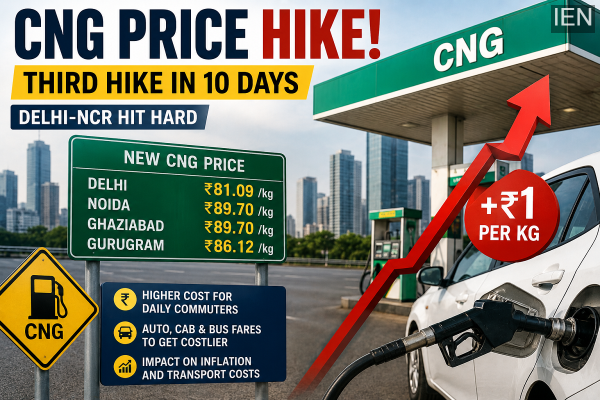
People living in Delhi-NCR and depending on CNG vehicles are facing another blow from rising fuel costs. Compressed Natural Gas prices have once again been increased, marking the third hike within just 10 days. The latest revision has raised concerns among daily commuters, transport operators, and households already struggling with inflationary pressure.
Government-linked fuel retailers have increased CNG prices by ₹1 per kilogram with immediate effect. Following this fresh hike, consumers in Delhi will now pay ₹81.09 per kg for CNG, while residents in Noida, Ghaziabad, and Greater Noida will have to spend ₹89.70 per kg.
The repeated increase in CNG prices is expected to impact transportation expenses, ride fares, logistics costs, and eventually the prices of essential goods and services across the region.
Third Consecutive CNG Price Hike Within Days
This latest price revision comes shortly after two earlier hikes announced during the past 10 days. Fuel companies had already increased prices by ₹2 per kg on May 15, followed by another ₹1 hike on May 18.
With the newest increase now in effect, CNG prices in the National Capital Region have climbed significantly in a very short period, putting additional financial pressure on middle-class families and daily commuters.
Industry experts say the continuous rise indicates that energy companies are struggling to absorb rising global fuel procurement costs.
Latest CNG Prices in Major Cities
After the revised rates became effective, CNG prices in key cities are now as follows:
| City | New CNG Price (Per Kg) |
|---|---|
| Delhi | ₹81.09 |
| Noida | ₹89.70 |
| Ghaziabad | ₹89.70 |
| Greater Noida | ₹89.70 |
| Gurugram | ₹86.12 |
| Ajmer | ₹90.44 |
The widening price gap across cities is mainly linked to local taxes, transportation expenses, and regional distribution costs.
Why Are CNG Prices Increasing Repeatedly?
Experts believe the recent surge in global energy prices is the biggest reason behind the continuous increase in domestic CNG rates.
The ongoing geopolitical tensions and energy supply disruptions in the Middle East have sharply increased international oil and gas costs. One major concern has been disruptions around the Strait of Hormuz, one of the world’s most critical oil and gas shipping routes.
Since a substantial portion of global crude oil and natural gas trade passes through this route, supply concerns have pushed international energy prices higher. As a result, Indian oil marketing companies have reportedly been forced to gradually transfer the additional burden to consumers.
Fuel companies had earlier avoided major price jumps to prevent sudden inflation shocks. However, rising import costs have made it difficult to maintain older rates.
Public Transport and Daily Travel May Become Costlier
The latest CNG hike is likely to directly affect transportation expenses in Delhi-NCR, where a large number of public and commercial vehicles operate on compressed natural gas.
Vehicles likely to be impacted include:
- Auto-rickshaws
- App-based taxis such as Ola and Uber
- City buses
- Delivery vehicles
- Goods transport carriers
Transport operators are expected to face increased operational costs due to higher fuel expenses. Industry analysts believe many operators may eventually pass this additional burden on to customers through higher fares and transportation charges.
This could significantly impact office-goers, students, and daily commuters who rely heavily on affordable public transport systems.
Rising Fuel Costs Could Push Inflation Higher
Economists warn that sustained fuel price increases often create a ripple effect across the economy. When transportation becomes expensive, logistics and delivery costs also rise, eventually increasing the prices of food items, consumer products, and essential services.
The latest CNG price hike may therefore contribute to higher retail inflation in the coming weeks if fuel costs continue to rise further.
Businesses dependent on transportation networks could also experience increased operating costs, especially small traders and local supply-chain operators.
Oil Companies Reportedly Facing Heavy Losses
The gradual increase in fuel prices comes amid reports that India’s major oil marketing companies are dealing with massive financial pressure.
Public sector companies such as Indian Oil Corporation, Bharat Petroleum, and Hindustan Petroleum are reportedly purchasing crude oil and natural gas at significantly higher international rates.
However, domestic retail fuel prices were not revised immediately in the same proportion, leading to substantial financial losses for these companies.
Reports suggest the combined daily losses of oil marketing firms had crossed nearly ₹1,600 crore due to the widening gap between import costs and retail prices.
To avoid a sudden burden on consumers, companies are now increasing prices gradually in smaller increments rather than implementing one major hike at once.
Government’s Focus on Fuel Conservation
Amid growing concerns over energy costs and foreign exchange outflow, Prime Minister Narendra Modi had recently appealed to citizens and businesses to focus on fuel conservation measures.
The Prime Minister reportedly encouraged companies to maximize work-from-home arrangements wherever possible to help reduce overall fuel consumption and lower pressure on crude oil demand.
Experts believe that if global energy tensions continue for a longer period, domestic fuel prices may remain under pressure in the coming months, making fuel-efficient transportation and energy-saving measures increasingly important for consumers.
-
Easy ways to keep clay pot water cool in summer

-
Congress targeted Modi government by distributing ‘Melody’, Manoj Shukla said – ‘Be it a laborer or a student, they are making rounds of petrol pumps’

-
Sui Dhaga Earrings: 9KT Gold Earrings, 7 Lightweight Designs to Wear in 30+

-
Delhi: Four injured in cylinder blast in Shahdara’s Ajit Nagar area

-
Tomorrow’s Horoscope: Great coincidence of Jyeshtha Shukla Ashtami on 24th May, blessings of Goddess Lakshmi will shower on these 4 zodiac signs.