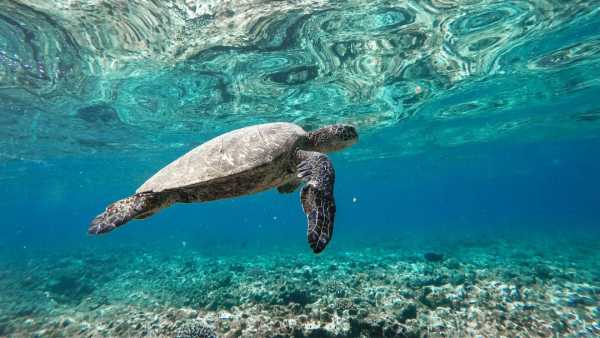
For millions of years, sea turtles have crossed vast oceans, survived changing climates, and quietly shaped marine ecosystems beneath the waves. Yet despite their incredible resilience, these ancient reptiles now face mounting challenges as their habitats continue to shrink.
Observed every year on May 23, World Turtle Day shines a spotlight on the urgent need to protect turtles, tortoises, and the environments they depend on. Established in 2000 by American Tortoise Rescue, the day encourages awareness and action to support the survival of some of Earth’s oldest living creatures.
Sea turtles, in particular, remain among the ocean’s most fascinating inhabitants. From deep-sea dives to globe-spanning migrations, their lives reveal extraordinary adaptations that continue to amaze researchers and wildlife enthusiasts alike.
On World Turtle Day 2026, here’s a closer look at some remarkable facts that uncover the hidden world of sea turtles.
Green Sea Turtles Are Named After What They Eat
Despite their name, green sea turtles are not identified by the colour of their shells.
Their name actually comes from the greenish tint found in their body fat and cartilage, which develops because of their largely plant-based diet. They feed mainly on seagrasses and algae found in coastal waters.
Sea Turtles Lay More Than 100 Eggs In One Nest
Female sea turtles return to sandy shores to build nests using their rear flippers.
A single nest, known as a clutch, can contain around 100 to 125 eggs. After nearly two months beneath the sand, hatchlings emerge and instinctively move toward the ocean.
The Sand’s Temperature Decides Their Gender
One of the most unusual aspects of sea turtle life happens before hatchlings are even born.
The temperature of the sand determines whether hatchlings become male or female. Cooler sand typically produces males, while warmer temperatures lead to females. Intermediate temperatures can produce both.
Hawksbill Turtles Use Their Beaks Like Precision Tools
Hawksbill turtles are recognised for their distinctive pointed beaks.
These narrow beaks help them reach into small openings and crevices inside coral reefs, where they search for one of their preferred foods, sponges.
Leatherback Turtles Carry A Dinosaur-Era Legacy
Among sea turtles, leatherbacks stand out not only for their size but also for their history.
Scientists believe they have existed in their present form since the age of dinosaurs, making them one of the oldest surviving turtle species.
Their abilities are equally impressive. Leatherbacks can travel more than 10,000 miles annually between feeding and nesting grounds and are capable of diving nearly 4,000 feet underwater.
Loggerhead Turtles Spend Years Drifting Across Oceans
The early years of a loggerhead turtle’s life are spent far from coastlines.
Researchers have observed that some loggerheads cross the Pacific Ocean during their development stage. Hatchlings from beaches in Japan and Australia can migrate toward feeding grounds near Mexico, Peru, and Chile.
These migrations may stretch close to 8,000 miles, making loggerheads some of the ocean’s most remarkable long-distance travellers.
Sea Turtles Cannot Retreat Into Their Shells
Unlike many land turtles, sea turtles cannot pull their heads or flippers into their shells.
Their bodies have evolved specifically for life in the ocean. They possess streamlined shells and strong paddle-shaped flippers built for efficient swimming.
Thousands Of Turtles Sometimes Nest Together
Some species display one of nature’s most extraordinary nesting events.
Olive ridley and Kemp’s ridley turtles participate in a behaviour known as 'arribada,' a Spanish term meaning arrival. During these events, thousands of females gather simultaneously on beaches to lay eggs over several hours.
-
8th Pay Commission: How much will the salary hike be under the 8th Pay Commission? Understand the complete math behind the 'Fitment Factor' here.

-
Petrol-Diesel: The Country Has Ample Fuel Supply—So Why Are Prices Still Rising? Indian Oil Reveals the Truth

-
Bihar: Receive ₹1 Lakh Upon Clearing the UPSC CSE Prelims—Are You Aware of This Bihar Government Scheme?

-
Numerous Vacancies Including Special Educators and Therapists; An Opportunity for 12th Pass Candidates and Degree/Diploma Holders..

-
HPSC Job 2026: Application Window for 255 ADA Posts in Haryana to Reopen; Fill Out Forms Starting May 25..