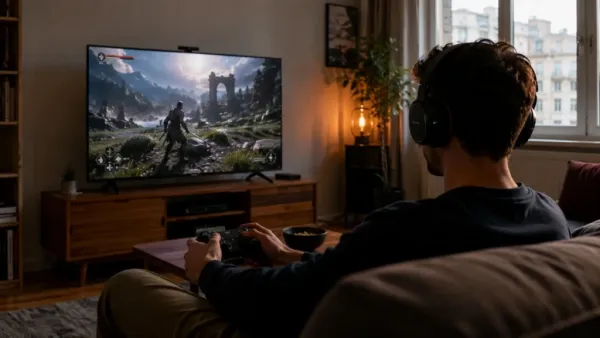
The teenager in a busy Manila apartment waits for his game to load, which he accesses through remote data retrieval services instead of physical discs or downloaded content. He is streaming the gameplay live, interacting with his subscribers. The screen displays a shining logo which blinks while the Wi-Fi symbol shows intermittent movement. The system experiences a delay that lasts for half a second. The character freezes at the highest point of his jump. The magical elements of the story stop functioning.
Elsewhere, in a quiet suburb of Lyon, a young professional plugs a cheap laptop into a monitor after work. No GPU, no updates, no worries or so he thought. Tonight, the connection feels off. The game stutters, a boss fight ruined by a hiccup in the network. The frustration is familiar.
Cloud gaming was supposed to erase those barriers, to make high-end play as simple as pressing “Play.” Yet for millions, the story teeters between liberation and latency.
How close are we, really, to the promise?
What Cloud Gaming Really Is — Without the Buzzwords
Forget the pitch decks. Cloud gaming is essentially a rental.
You stream a game like you’d stream a movie, except the movie reacts to you. The heavy lifting happens on faraway servers running top-tier hardware, while your screen displays the results in real time.
Companies like Nvidia (GeForce Now), Microsoft (Xbox Cloud Gaming), and Boosteroid say you can play on almost anything, with phones, tablets, low-end PCs, with nothing more than a steady internet connection. But “steady” hides a world of detail. It’s not just about speed; it’s about stability, latency, and data limits. A momentary drop can turn an immersive fight into a slide show.
Think of it as remote work for your GPU. It’s convenient, flexible, and freeing. Until the office Wi-Fi sputters. Then you remember there’s no local copy and nothing to fall back on.
How much control are we willing to surrender for ease?
Where It Actually Shows Up in Daily Life
You might not notice it, but cloud gaming is already woven into random corners of life. On trains across Japan, commuters play lightweight titles via mobile streaming apps. In Indian college dorms, shared-budget setups rely on it to avoid shelling out for gaming rigs.
In budget minded homes in Europe or the U.S., it’s often used as a second option, as a way to sneak a quick session on a tablet while the living room console is occupied. Small business owners have discovered it doubles as a demonstration tool: show a client a simulation without needing an expensive workstation.
Yet, under all this, there’s always a silent condition; the assumption that the connection will hold. When it doesn’t, the illusion collapses fast. Can a digital life built on responsiveness really rely on a network that still falters at peak hours?
How It Affects Different Types of People
Students
For students, cloud gaming feels like a loophole, there is no need to buy a $1,500 gaming laptop. Shared plans like GeForce Now’s free tier are lifesavers for those juggling tuition and tech cravings. But there’s a catch: dorm Wi-Fi, throttled networks, or campus firewalls can make it unplayable.
Paradoxically, the demographic that benefits most from the cost-saving can least guarantee the conditions it needs.
Budget Minded Families
Parents see it as clutter-free.
No consoles, no downloads, no patches. Just a smart TV and a controller. But family Wi-Fi isn’t built for simultaneous streams, between Zoom calls, Netflix, and homework, someone’s bandwidth loses.
When that happens, frustration multiplies across devices.
Convenience reveals its own cost, which is, shared dependency.
Young Professionals
Casual gamers treat it like Netflix for nostalgia, where they are dipping back into old favorites during commutes or downtime.
Yet gaming professionals often demand mobility, and mobile data still doesn’t love 1080p gaming streams. Many find themselves rationing playtime not by energy, but by megabytes.
The cloud saves time but steals autonomy in subtle ways.
Small Business Owners
For small studios or arcade cafés, cloud gaming opens possibilities.
They can host virtual experiences without major investments. But the dependency on data centers raises a quiet fear; if the provider changes pricing or pulls support, an entire setup can vanish overnight.
Is “ownership” becoming an outdated idea in gaming too?
Developing Economies
Here, cloud gaming gets tangled in contradictions. In places like the Philippines, Kenya, or Brazil, hardware costs make local gaming ecosystems difficult. Cloud gaming sounds perfect until you factor in data costs and uneven connectivity.
It’s no exaggeration to say a single gaming session can burn half a day’s worth of household broadband.
So is accessibility really accessibility if the gatekeeper is your ISP?
Where It Falls Short
Cloud gaming’s limitations live in milliseconds, where the human perception of lag.
The time taken for the system to respond after users provide their input creates an invisible delay which prevents them from using the service. Even the best internet services face difficulties maintaining their ability to deliver less than 50 milliseconds response times throughout all regions of the world.
There’s also the issue of library fragmentation. You might find your favorite indie on one service and your AAA blockbuster on another, each with separate fees and regions.
A “Netflix for games” model only works when the catalog feels unified, not chopped up by contracts.
Then come data caps. A single hour of 4K streaming can eat up to 15 GB. Multiply that by a few sessions a week, and even “unlimited” plans start to sweat.
What happens when the joy of cloud gaming starts to look like the anxiety of streaming bills?
The Negative Consequences People Don’t Talk About
The environmental expense remains hidden because marketing presents a polished image. Data centers need substantial electrical power together with cooling systems and continuous operational capacity.
The carbon emissions from each digital session still exist in a concrete physical space.
Then there’s permanence. When cloud gaming replaces ownership, licenses become fleeting. A service update, a new agreement, a regional policy and your entire library could evaporate. The laughter during a co-op campaign might outlive the ability to replay it.
The majority of people ignore the privacy implications which arise from cloud-based gaming because they track every button press and performance data and session duration. The hidden costs of convenience create an invisible record.
How much are we willing to trade for seamlessness?
Pros and Cons
| What Works | What Does Not |
| No need for expensive hardware | Depends entirely on stable, fast internet |
| Play instantly across devices | Limited or fragmented game libraries |
| Environmentally lighter than mass-producing consoles | Heavy energy use in data centers |
| Useful for travel, rentals, or shared spaces | Visible lag in fast-paced genres |
| Saves space and avoids maintenance | Data caps and ISP throttling |
| Reduces upfront cost barriers | Lack of true ownership and permanence |
A Practical Reflection Checklist
- Is this an effective problem-solving for my gaming issue while maintaining its futuristic appearance?
- The current internet service can handle 15 to 20 Mbps stable speed requirements which I need for my daily activities. Can I work with this constraint?
- Can I accept game access loss because of provider plan changes?
- Do I want new things or actual functional value?
- If the ads disappeared tomorrow, would I still want it?
- Is this saving me money, or slowly shifting costs into subscriptions?
- What’s the backup plan when the connection fails and it will?
Before diving in, it’s worth asking not just what you gain, but what control you’re quietly giving up.
Pricing & Accessibility
On paper, cloud gaming feels cheaper.
Xbox Cloud Gaming’s Ultimate plan sits around $17 per month. Nvidia’s premium GeForce Now tier around $20. Add-ons and network upgrades, though, can easily push monthly costs past that of a discounted console over time.
In regions where median monthly income hovers near $300, even a few dollars a month becomes significant. Providers try free tiers, but latency and queue limits often push users toward paid versions. The democratizing promise buckles under local economics, with technology outpaces the wallets meant to use it.
What happens when innovation is designed globally but experienced unequally?
Final Thoughts
Cloud gaming exists as both a technological achievement and a demonstration of infrastructure limitations. It provides users with a replacement for hardware upgrades because it delivers both operational flexibility and user-friendly access.
For others, it exposes a fragile truth: that “everywhere access” still depends on invisible threads controlled by someone else.
Maybe the right move isn’t a full leap into the cloud but a hybrid rhythm, with local when it matters, streamed when it fits. The world rarely selects extremes; it adapts.
If you’re curious, test it; not for novelty, but for fit.
Try a free session.
Observe how it feels, not just how it looks. Ask who benefits most from this model and whether you’re one of them.
The future of gaming, like every digital promise, is about technology and about what kind of control and compromise we’re willing to live with.
-
Hyderabad: Customer attacks tiffin centre staff after not getting extra chutney

-
Sana Makbul on marriage: ‘Boy doesn’t have to be a Muslim’

-
K'taka on high alert after WHO declares Ebola outbreak as global health emergency
-
Bollywood's Invisible Man: How Killer Acted Alongside Amitabh Bachchan & Fooled Everyone for 12 Years

-
ABS Marine Services Reports Strong Margin Growth with EBITDA Margin up 1,667 Bps in H2 FY26 and 1,763 Bps in FY26