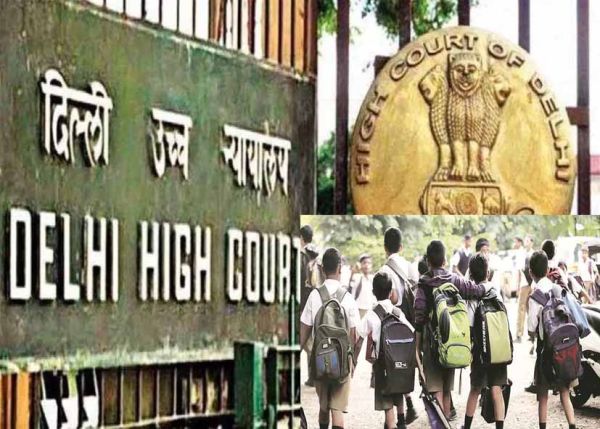
Delhi High Court has given an important decision in favor of private schools, giving a big blow to the Directorate of Education (DoE). The court has said that there is no legal requirement for Delhi’s private and unaided recognized schools to seek prior permission from the Directorate of Education to increase fees in the new academic session. The High Court clarified in its decision that if any private and unaided recognized school makes changes in the fee structure, then it is not obliged to take prior government approval for the same. The court said that no such requirement has been laid down in the applicable law in this regard.
A bench of Justice Anup Jairam Bhambhani clarified that prior permission would be required only in case a school wants to suddenly increase the fees in the middle of the ongoing academic session. The court said that it is not legally mandatory to seek prior approval for fee revision at the beginning of the new academic session. The court also said in its decision that just because a school has ‘surplus funds’ in its account, it cannot be assumed that the school is commercializing education. According to the court, schools have the right to have appropriate funds for their financial stability and future needs.
High Court’s seal on autonomy to increase fees
A bench of Justice Anup Jairam Bhambhani said that the fee increase proposed by the schools will be applicable only from the academic session of 2027. The court also made it clear that no school will be allowed to demand or recover arrears of fees or other charges for previous academic sessions retrospectively. The court said in its decision that prior permission would be necessary only in case a school wants to increase the fees in the middle of the current academic session.
The bench said schools that wish to increase fees at the beginning of a new academic session will have to submit a statement of the proposed fees to the Directorate of Education before the start of the session. However, it will not be mandatory to take prior approval for this. The court also made it clear that prior permission would be required only if a school wants to increase the fees in the middle of the current academic session. According to the court, the role of the Directorate of Education is that of a regulator, and not of direct interference in the financial decisions of schools.
DoE’s regulatory powers limited
It has been said that the regulatory powers of the Directorate of Education (DoE) are limited and it cannot interfere in the financial affairs of private, unaided and recognized schools under normal circumstances. The bench of Justice Anup Jairam Bhambhani said in its decision that such schools have the right to decide their fees and manage finances. According to the court, the role of DoE is only regulatory and it cannot be allowed to ‘micro-manage’ the day-to-day financial decisions of schools. The Court also clarified that mere presence of excess funds or ‘surplus funds’ in the accounts of a school cannot lead to the conclusion that the school is commercializing or profiteering from education.
DoE will have to take a decision on the proposals in 2 months
A bench of Justice Anup Jairam Bhambhani said that if a private, unaided and recognized school proposes to increase fees during the ongoing academic session, it will have to submit its proposal to the DoE at least two months before the date of implementation of the proposed increase. The court also directed that it would be mandatory for the Directorate of Education to take a decision on such proposal within two months. If DoE does not take any decision within the stipulated time limit, the proposal of the concerned school will be considered automatically approved.
Decision came on the petition of 137 private schools
This whole matter started when 137 private schools of Delhi had approached the High Court. These schools had made proposals to increase fees at different times between 2016-17 and 2022-23, but these were rejected by the Directorate of Education. The schools had filed a petition in the court challenging the DoE decisions. The bench of Justice Anup Jairam Bhambhani said in its judgment that the government orders were ‘based on misunderstanding’ and are set aside in their entirety. The court clarified that private, unaided and recognized schools are not required to seek prior permission from the DoE to increase fees at the beginning of the new academic session. The court also made it clear that the same rule will apply to schools which have received government land under the ‘land clause’ i.e. the conditions of land allotment. This means that such schools will also not be obliged to take prior approval for increasing fees at the beginning of the session.
-
A car can turn into a ball of fire in 50 degree heat! Don’t leave these 5 things inside even by mistake in the sun

-
Does greed make a person blind? Understand from the story of Jesus’ disciple Judas

-
Priyanka Chopra Enjoys Himayat Mangoes In Hyderabad: Here’s All You Need To Know About The Variant

-
The deadline for free Aadhaar update has increased! Learn how

-
Will AI summaries eliminate the need for news websites? Increased concern of publishers