From the plains to the mountains of North India, the weather pattern has been very aggressive for some time now. Banda district of Uttar Pradesh is currently making new records in terms of heat, where the mercury has been hovering around 48°C for the last several days. Not just the plains, but Una district of Himachal Pradesh—which is generally considered a cool and pleasant area—is also currently facing the scorching heat of 44°C.
Seeing this continuously increasing geographical temperature, a big question has now started resonating among environmentalists and the general public: Is India now formally moving towards a ‘Climate Emergency’? Has the time now come for India to take strict and emergency steps like European countries to save the environment? Let us understand closely the changing patterns of the main cities of the country and the bitter reality of this serious crisis.
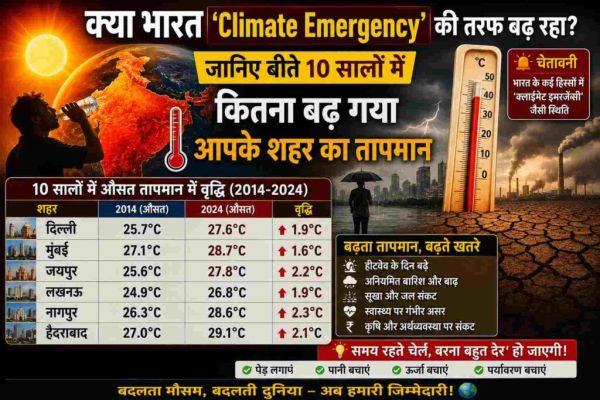
How has the mood of your city changed in the last 10 years?
The climate of India’s major metropolitan cities has undergone unprecedented changes over the past decade due to global warming and rapidly expanding concrete forests:
-
Delhi (capital of the country): Delhi’s heat has now become drier and more deadly than before. Not only has the number of hot days increased in the city, but the nights have also started becoming unusually hot. In some posh and industrial areas of Delhi, the temperature has reached the scary figure of 52°C. caused by urbanization ‘Heat Island Effect’ Due to this, the urban areas of Delhi are getting hotter by 4% to 8% compared to their rural surroundings.
-
Mumbai: Mumbai, once famous for its pleasant sea breeze, has now become a dangerous combination of heat and humidity. In the last decade the average temperature here has increased by 0.5°C to 0.6°C, while the humidity level in the air has gone up by 7%. Because of this, people remain drenched in sweat all the time. Moreover, now even the slightest heavy rain during monsoon submerges the entire financial capital.
-
Bengaluru: This city, called the ‘Silicon Valley’ of South India, was once considered the city with the coldest and best weather in India. But due to unplanned development, indiscriminate cutting of trees and concrete buildings, the temperature here has increased by more than 0.5°C in the last 10 years. Because of this concrete trap, even the nights here are no longer cold.
-
Chennai: The combination of extreme temperatures and extreme humidity in Chennai is directly increasing ‘heat stress’ on human health, leading to an increase in the number of patients in hospitals. Along with the heat, the incidents of cyclonic rains and sudden severe floods have also increased much more than before, which slows down the pace of the entire city.
-
Kolkata: This historical metropolis of Eastern India has now turned into a city with heavy humidity. Due to high day temperatures as well as hot nights, people’s daily performance and sleep is being affected. Frequent cyclones and heavy rains in the Bay of Bengal have now become the new identity of this place.
-
Hyderabad: Although the temperature of Hyderabad is slightly stable compared to other cities, the humidity level in the atmosphere here has increased by 10%. The spread of concrete around the city has affected the local environment to a great extent.
-
Ahmedabad and Jaipur: It has now become a common occurrence for the mercury to cross the harsh 50°C mark during summer in these two major cities of Gujarat and Rajasthan. There has been a huge increase in the number of days of heat wave in both the states.
Is the first ‘Climate Emergency’ going to occur in the country?
If we look at the broader scenario of the entire country, the environmental crisis in India is not limited to theory only. The number of days of heatwave is continuously increasing, due to which the country is facing huge loss of life and property.
Global example: In view of this dire environmental threat UK on 1 May 2019 It became the first country in the world to officially declare ‘Climate Emergency’ in its country. Under this, the government gives top priority to environmental policies and enforces strict laws to reduce carbon emissions.
Talking about India, the central and state governments have not yet declared any such formal emergency. But seeing the way the country’s average temperature has increased by 0.3°C to 0.4°C in the last decade, the ground water level is falling rapidly, and farmers’ crops are getting ruined due to untimely storms and rains, it is clear that we are rapidly moving on the same path. If strict steps like stopping the spread of concrete, planting trees on a large scale and reducing dependence on traditional fuels are not taken in time, then in the coming times the governments will be forced to take strict steps like green-emergency.
Do you want to customize this article for a specific digital platform (like a news website or social media blog), or should we add some practical government efforts to environmental protection?
-
The Imperial New Delhi Launches Haute Patisserie, Bringing Parisian and Viennese Pastry Craft to Janpath

-
IPL 2026: Punjab keeps playoff hopes alive by defeating Lucknow

-
Get others trolled by him… Arshdeep himself gets beaten badly, shameful record

-
Big meeting of ICC regarding major changes in cricket rules, proposal to make innings-break of 15 minutes in T20

-
IPL 2026: Big blow to RCB before the playoffs, star player returns home after getting injured