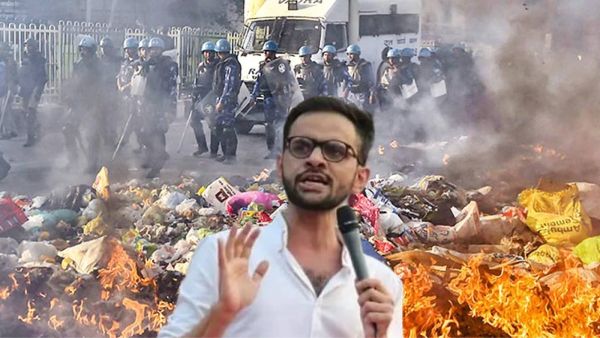
New Delhi: In the 2020 Delhi riots case, arguments took a pointed turn this week when Additional Solicitor General SV Raju, appearing for Delhi Police, invoked the example of 26/11 Mumbai terror attacker Ajmal Kasab to oppose bail pleas of Umar Khalid and Sharjeel Imam. The hearing revolved around whether prolonged pre-trial incarceration under the Unlawful Activities (Prevention) Act (UAPA) could itself become grounds for release.
As per reports, the reference to Kasab, who was hanged in 2012, was invoked as the court weighed the balance between liberty and the gravity of terror charges. ASG SV Raju questioned whether a “blanket rule” on bail for long incarceration could logically extend to high-profile terrorists.
The proceedings have now led to moves to place the matter before Chief Justice of India (CJI) Surya Kant for consideration by a larger Bench, after 2-judge Benches of the apex court took differing positions on bail in UAPA cases where trials have been delayed.
Prosecution's Arguments Against ‘Blanket Rule’ for Bail
While appearing for the Delhi Police, ASG Raju and Advocate Rajat Nair emphasised that the question of bail should depend on the facts of each case, with a direct relation to the gravity of each offence. To illustrate the point further, the ASG asked the court to consider extreme scenarios involving dreaded terrorists.
“If you take the case of Ajmal Kasab, there are a large number of witnesses. Will you grant him bail, given that he has been in jail for 7 or 8 years? It can’t be done. Therefore, you have to examine the facts of each case,” ASG Raju submitted. He extended the hypothetical further, saying, “Suppose if terrorist Hafiz Saeed is brought from Pakistan and tried, and he is in jail for 5 years because there are a large number of witnesses (because) you have to collect evidence from abroad, will you release him on bail, saying no, no 5 years (has passed)?”
The Additional Solicitor General stressed that a blanket rule granting bail for long incarceration would be absurd when applied to high-profile terrorists like Kasab. He appealed the court to assess each matter individually, noting the complication and scale of evidence in terror-related trials.
Recent Interim Relief For Umar Khalid
Amid the ongoing legal battle, Umar Khalid was granted 3-day interim bail by the Delhi High Court to attend his mother’s surgery. The court asserted an empathetic view considering his family’s situation. Given the condition to secure a bail, Khalid is required to remain within the National Capital Region and visit only the hospital during this period.
The reports suggested that the interim order is separate from his main bail plea, which remains pending as part of the larger UAPA proceedings linked to the 2020 riots. Notably, Khalid, along with Sharjeel Imam and others, has been in custody for nearly 5 years without the trial commencing.
Call For Larger Bench
During the hearing, ASG Raju referred to a recent judgment by a 2-judge Bench of the Top Court criticising the denial of bail. He was referring to a recent judgment by a 2-judge Bench of Justice BV Nagarathna and Justice Ujjak Bhuyan criticising the denial of bail to prime accused Umar Khalid and Sharjeel Imam, citing their around 5 years in jail and the trial not commencing, and urging that the original judgment denying bail to the 2 be referred to a larger Bench following contradictory views.
The Bench later directed that the matter be placed before CJI Surya Kant for the constitution of a larger Bench. The Bench of Justice Aravind Kumar and Justice PB Varale was hearing the bail pleas of Tasleem Ahmed and Khalid Saifi, who were granted interim bail.
The Bench led by Justice Nagarathna not only questioned the denial of bail to Umar Khalid and Sharjeel Imam by another 2-judge Bench in January 2026, after they underwent almost 6 years of pre-trial incarceration. “Will the principle that bail is the rule and jail is the exception apply in cases involving serious terror charges if trials are delayed?” ASG Raju asked, citing examples such as the 2008 Mumbai terror attack convict Ajmal Kasab or Lashkar-e-Taiba founder Hafiz Saeed, and asking whether they would have been granted bail under such circumstances.
UAPA Conviction Rates Cited
The Justice Nagarathna Bench of the Supreme Court had said that in the KA Najeeb case (2021), a 3-judge Bench of the Apex Court ruled that undue delay in trial and prolonged incarceration function as valid grounds for granting bail. The Bench said that the Najeeb judgment held that prolonged incarceration overrides the stringent bail restrictions under the UAPA.
When the SC reiterated that bail is the rule, jail is an exception, even in a UAPA case, it was while granting bail to a J&K resident narco-terror accused (UAPA case), Syed Ifthikar Andrabi, who has been in jail for the past 6 years.
The SC had noted that smaller Benches cannot “dilute, circumvent, or disregard” larger Bench rulings and, if they disagree, can only refer the matter to the CJI for the constitution of a larger Bench. The SC had said, “2-judge Bench ruling in Gurminder Singh and Gulfisha Fatima cannot dilute or depart from the binding three-judge Bench ruling in KA Najeeb on grant of bail under the UAPA.”
Importantly, the Supreme Court in that judgment also took note of the abysmal conviction rate in UAPA cases. “We have quoted statistics from the National Crime Records Bureau. For the all-India figures, we have 2% to 6% convictions, meaning that there is a 94% to 98% possibility of acquittal in such cases in the country. So an accused should not be in prolonged pre-trial incarceration for years together, like 4 years or 5 years, especially if there is a delay in the commencement of trial.”
Further details regarding the ongoing hearing in the Delhi Riots case are awaited.
-
Iran-Trained Operative Accused Of Plotting To Kill Donald Trump's Daughter Ivanka: Report
-
SRH Vs RCB: Sunrisers Thrash RCB In Hyderabad; Patidar & Co Still Secure Top 2 Finish

-
Aishwarya Rai Bachchan Returns To Cannes Film Festival 2026 Red Carpet In Dupatta-Style Gown Which Took '1500 Hours' To Create
-
Vashu Bhagnani Claims Coolie No. 1 Caused Rs 27 Crore Loss; Says Varun Dhawan 'Never Bothered To Check'
-
Anusha Dandekar Shares New 'Kindness Hurting' Post After Clarifying Cryptic Note Linked To Karan Kundrra-Tejasswi Prakash