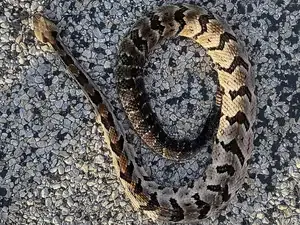
The timber rattlesnake is considered one of the rare venomous snakes in North America that many find easy to recognize, although wildlife management bodies consistently advise that incorrect field identifications are common, as field observers typically focus on a single distinct aspect of the animal while neglecting to consider the surrounding environment.
The Rattlesnake’s habitat frequently turns out to be the more useful indicator well before any identification of the tail is made possible, even though the rattle tends to be its primary characteristic that draws most of the attention, as per the Massachusetts Timber Rattlesnake information page. Habitat association with the timber rattlesnake is so strong that an observer starts judging the environmental background long before considering any characteristics about the snake itself.
This fact is important because many non-venomous snakes have features that can cause confusion. In a dried-up forest floor surrounded by foliage and sticks, tail vibration can be magnified to produce a sound similar to that of rattling without the snake being venomous. It is wise, therefore, not to panic upon hearing or observing only one sign from a snake. For example, timber rattlesnakes can be distinguished in the state of Massachusetts through their broad triangular head, vertical pupil, heat-sensing pits in the face, and possession of a rattle – all of which should be observed at once.
Timber Rattlesnakes tend to be stocky snakes that look bulky compared to some of the thinner and nonpoisonous woodland snakes. However, these features should also be carefully assessed, as wildlife professionals warn against assuming that all broad-headed snakes are venomous, since certain behaviors can cause other types of snakes to adopt this body shape. The aim is not quick identification.
In addition, a sighting of timber rattlesnakes in association with rocky ridges, forest bluffs, and hill sides is far more consistent with timber rattlesnake behavior than a sighting in open areas or marsh habitats. Similarly, timber rattlesnakes in Nebraska are identified as specialist habitat inhabitants that are located in woodlands with rocky openings and steep stream banks.
The importance of ecological specialization lies in its ability to allow narrowing of identification prior to being able to examine more obvious physical characteristics. Identification must always be tentative if the setting isn’t right. Moreover, wildlife agencies provide identical cautionary information regarding what to do if encountering any type of snake. According to the advice provided by the U.S. Forest Service, snakes bite only when startled or threatened.
This warning acquires an even more serious meaning in relation to timber rattlesnakes, since they are often considered to be rare or endangered in some states, due to their loss of habitat, road mortality, and killings. Thus, there are two goals behind accurate identification: protecting people from potential danger and conserving one of the most maligned species on Earth. A timber rattlesnake can best be identified by combining the knowledge of appropriate habitat, anatomical features, and behavior, rather than using just one characteristic.
The Rattlesnake’s habitat frequently turns out to be the more useful indicator well before any identification of the tail is made possible, even though the rattle tends to be its primary characteristic that draws most of the attention, as per the Massachusetts Timber Rattlesnake information page. Habitat association with the timber rattlesnake is so strong that an observer starts judging the environmental background long before considering any characteristics about the snake itself.
This fact is important because many non-venomous snakes have features that can cause confusion. In a dried-up forest floor surrounded by foliage and sticks, tail vibration can be magnified to produce a sound similar to that of rattling without the snake being venomous. It is wise, therefore, not to panic upon hearing or observing only one sign from a snake. For example, timber rattlesnakes can be distinguished in the state of Massachusetts through their broad triangular head, vertical pupil, heat-sensing pits in the face, and possession of a rattle – all of which should be observed at once.
Timber rattlesnake | Image Credit: Wikimedia Commons
The head shape and body structure matter more than the sound alone
One thing that often comes up in wildlife guidance is the realization that rattling itself does not automatically indicate the snake is a timber rattler. The wildlife guidance issued by the state of Massachusetts stresses that there are snakes that may rattle their tails very quickly among dry leaves or brush, producing a very realistic rattling noise. However, this becomes particularly confusing in rocky woodlands, where sounds echo irregularly and are distorted by the foliage. Pit vipers, such as timber rattlesnakes, have broad, triangular heads, vertical pupils, and facial pits between the nostrils and eyes.Timber Rattlesnakes tend to be stocky snakes that look bulky compared to some of the thinner and nonpoisonous woodland snakes. However, these features should also be carefully assessed, as wildlife professionals warn against assuming that all broad-headed snakes are venomous, since certain behaviors can cause other types of snakes to adopt this body shape. The aim is not quick identification.
Timber rattlesnake | Image Credit: Wikimedia Commons
Habitat often narrows the possibilities before the snake is fully visible
For timber rattlesnakes, the surrounding environment is much more than merely a background setting, as it is integral to the identification process. Timber rattlesnakes have a close affinity for rocky upland woodland environments that contain rock ledges and outcroppings, forest openings for basking sites, and cover. The presence of such habitat preferences is responsible for the non-random distribution of sightings among suburban areas.In addition, a sighting of timber rattlesnakes in association with rocky ridges, forest bluffs, and hill sides is far more consistent with timber rattlesnake behavior than a sighting in open areas or marsh habitats. Similarly, timber rattlesnakes in Nebraska are identified as specialist habitat inhabitants that are located in woodlands with rocky openings and steep stream banks.
The importance of ecological specialization lies in its ability to allow narrowing of identification prior to being able to examine more obvious physical characteristics. Identification must always be tentative if the setting isn’t right. Moreover, wildlife agencies provide identical cautionary information regarding what to do if encountering any type of snake. According to the advice provided by the U.S. Forest Service, snakes bite only when startled or threatened.
This warning acquires an even more serious meaning in relation to timber rattlesnakes, since they are often considered to be rare or endangered in some states, due to their loss of habitat, road mortality, and killings. Thus, there are two goals behind accurate identification: protecting people from potential danger and conserving one of the most maligned species on Earth. A timber rattlesnake can best be identified by combining the knowledge of appropriate habitat, anatomical features, and behavior, rather than using just one characteristic.