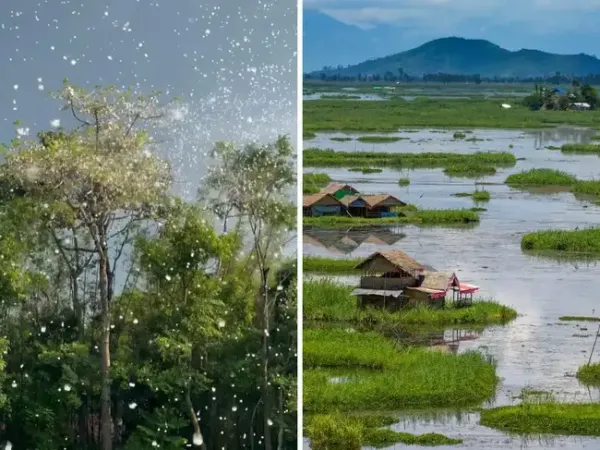
Imagine witnessing snowfall in peak summer. If this sounds like a distant dream, then chances are you have not visited Manipur yet. Yes, this North Eastern state, known for its lush green landscapes, mesmerising Loktak Lake and rich cultural heritage, turns into a magical and snowy wonderland in the hot season. This fantasy-like spectacle comes from towering cotton trees, commonly known as Semal or silk cotton trees, scientifically classified as Bombax ceiba. Every part of nature, from the streets to the fields, the riverbanks and the valleys, is filled with drifting white fibres, carried by the wind, floating in the sky, painting a picture of surrealism.
Scientific phenomenon behind summer snowfall
The remarkable transformation begins with the silk cotton tree aka Bombax ceiba, a striking species known for its towering height and vibrant scarlet-red blooms that brighten the landscape during the warmer months. Once the flowering season comes to an end, elongated seed pods develop and remain suspended from the branches, gradually maturing under the summer sun. For weeks, the trees appear ordinary, offering little hint of the spectacle that is about to unfold.
As temperatures rise and the pods dry out, they naturally split apart, revealing clusters of seeds nestled within soft, cotton-like fibres. With the arrival of gentle breezes, these silky white strands are released into the atmosphere, creating a mesmerising display that resembles drifting snowflakes. Travellers exploring Manipur during this period are often treated to scenes of countless white tufts floating across open fields, winding riverbanks, village roads and lush valleys, lending the region an almost dreamlike charm.
Ecological purpose behind spectacular summer snow
The floating fibres serve a vital ecological purpose beyond their visual appeal, as per The Better India. Each seed is equipped with an ultra-light, fluffy covering specially adapted for wind dispersal. This natural design allows the seeds to remain airborne for extended periods, enabling them to travel far beyond the parent tree. While some settle nearby, others are carried across vast stretches of land and water before finding a suitable place to germinate.
This ingenious process is nature’s way of ensuring the survival and expansion of the species. Since the silk cotton tree cannot spread on its own, it relies on seasonal winds as a natural transportation system. By scattering thousands of seeds in different directions, the tree increases the likelihood that new saplings will take root in favourable conditions. The result is a self-sustaining cycle that not only helps preserve the species but also creates one of Manipur’s most captivating natural phenomena, drawing nature lovers, photographers and curious travellers eager to witness the state's enchanting summer ‘snowfall.’
Scientific phenomenon behind summer snowfall
The remarkable transformation begins with the silk cotton tree aka Bombax ceiba, a striking species known for its towering height and vibrant scarlet-red blooms that brighten the landscape during the warmer months. Once the flowering season comes to an end, elongated seed pods develop and remain suspended from the branches, gradually maturing under the summer sun. For weeks, the trees appear ordinary, offering little hint of the spectacle that is about to unfold.
As temperatures rise and the pods dry out, they naturally split apart, revealing clusters of seeds nestled within soft, cotton-like fibres. With the arrival of gentle breezes, these silky white strands are released into the atmosphere, creating a mesmerising display that resembles drifting snowflakes. Travellers exploring Manipur during this period are often treated to scenes of countless white tufts floating across open fields, winding riverbanks, village roads and lush valleys, lending the region an almost dreamlike charm.
Ecological purpose behind spectacular summer snow
The floating fibres serve a vital ecological purpose beyond their visual appeal, as per The Better India. Each seed is equipped with an ultra-light, fluffy covering specially adapted for wind dispersal. This natural design allows the seeds to remain airborne for extended periods, enabling them to travel far beyond the parent tree. While some settle nearby, others are carried across vast stretches of land and water before finding a suitable place to germinate.
This ingenious process is nature’s way of ensuring the survival and expansion of the species. Since the silk cotton tree cannot spread on its own, it relies on seasonal winds as a natural transportation system. By scattering thousands of seeds in different directions, the tree increases the likelihood that new saplings will take root in favourable conditions. The result is a self-sustaining cycle that not only helps preserve the species but also creates one of Manipur’s most captivating natural phenomena, drawing nature lovers, photographers and curious travellers eager to witness the state's enchanting summer ‘snowfall.’