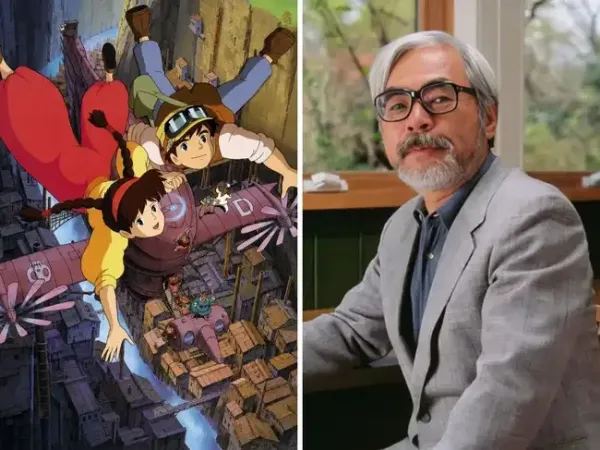
Long before streaming platforms became mainstream, Studio Ghibli made a deep impact on audiences and pop culture with its visually aesthetic storytelling, powerful hand-drawn characters, layered life lessons and unforgettable animation. The acclaimed Japanese animation film studio, headquartered in Tokyo, was founded in 1985 by animators and directors Miyazaki Hayao and Takahata Isao and producer Suzuki Toshio. Studio Ghibli is known for the high quality of its filmmaking and artistry, comprising feature films that have won both critical and popular praise, heavily influencing other animation studios. Today’s quote of the day is from Studio Ghibli’s famous film Castle in the Sky (1986).
Quote of the day by Studio Ghibli: Castle in the Sky context
The quote of the day, which goes like this, ‘The world cannot live without love; no matter how many weapons you have or how great your technology might be,’ occurs during the dramatic climax of the movie. The main antagonist, a power-hungry government agent, Muska, has successfully seized control of Laputa, a mythical flying island packed with highly advanced, ancient technology and devastating weapons of mass destruction.
Muska boasts about Laputa’s absolute power, declaring that the floating city once ruled the entire world through fear and technology, and that he intends to use it to do so again. He views humanity on the ground as inferior. But Sheeta, who is actually the rightful heir to the throne of Laputa, confronts Muska, triggering the spell of destruction. But before she stops his malicious plan, Sheeta delivers this iconic line that holds true even in today’s world.
Sheeta explains to Muska that the people of Laputa did not perish because their technology failed; they perished because they isolated themselves from the Earth. Sheeta emphasizes that no amount of military might, robotic armies, technological supremacy or groundbreaking advancements can sustain humanity if people discard human connection, stop bonding with nature, and fail to show empathy and love.
Quote of the day by Studio Ghibli: Deeper meaning and modern relevance
At its core, the message highlights that human connection, compassion and empathy are the true foundations of a meaningful society. Material progress can make life more convenient and powerful, but it cannot replace the emotional bonds that bring people together. History has repeatedly shown that strength, wealth and innovation alone cannot create lasting peace or happiness. Without kindness, understanding and genuine care for one another, even the most advanced civilizations risk becoming divided and emotionally disconnected. The idea reminds us that the value of humanity lies not in what it builds or possesses, but in how people treat and support one another.
The message feels especially relevant in today's world, where technological advancements are transforming nearly every aspect of life. Artificial intelligence, social media and digital communication have connected billions of people, yet many individuals continue to struggle with loneliness, stress and social isolation. Nations invest heavily in defence capabilities and technological competition, but global challenges such as conflict, inequality and mental health concerns persist. In workplaces, schools and communities, cooperation and emotional intelligence often achieve more than authority or power. The message serves as a reminder that progress becomes truly meaningful only when it is guided by compassion, understanding and shared humanity.
More about Studio Ghibli
Castle in the Sky was the very first Studio Ghibli release, as per a report by Britannica. Most of the films produced by Studio Ghibli were written and directed by Miyazaki, including My Neighbor Totoro (1988), Kiki’s Delivery Service (1989) and Porco Rosso (1992). The studio’s best-known movie, Spirited Away(2001), won several awards, such as the Golden Bear at the 2002 Berlin International Film Festival and the 2003 Academy Award for best animated feature. Later films that were widely loved by audiences and art enthusiasts were Howl’s Moving Castle (2004), Ponyo (2008), The Wind Rises (2013) and The Tale of the Princess Kaguya (2013).
In March 2025, Studio Ghibli found itself at the centre of a growing conversation surrounding artificial intelligence and artistic rights after OpenAI introduced an image-generation tool that could recreate visuals resembling the studio’s distinctive aesthetic. Social media platforms were soon flooded with Ghibli-style creations, ranging from lighthearted tributes to more unsettling interpretations. While many users embraced the technology for its nostalgic appeal, numerous artists and industry observers questioned the ethics of replicating a renowned creative style without permission and its implications for original artistry. The debate also revived earlier remarks from Miyazaki, who had famously denounced AI-generated art as something deeply contrary to the essence of life.
Quote of the day by Studio Ghibli: Castle in the Sky context
The quote of the day, which goes like this, ‘The world cannot live without love; no matter how many weapons you have or how great your technology might be,’ occurs during the dramatic climax of the movie. The main antagonist, a power-hungry government agent, Muska, has successfully seized control of Laputa, a mythical flying island packed with highly advanced, ancient technology and devastating weapons of mass destruction.
Muska boasts about Laputa’s absolute power, declaring that the floating city once ruled the entire world through fear and technology, and that he intends to use it to do so again. He views humanity on the ground as inferior. But Sheeta, who is actually the rightful heir to the throne of Laputa, confronts Muska, triggering the spell of destruction. But before she stops his malicious plan, Sheeta delivers this iconic line that holds true even in today’s world.
Sheeta explains to Muska that the people of Laputa did not perish because their technology failed; they perished because they isolated themselves from the Earth. Sheeta emphasizes that no amount of military might, robotic armies, technological supremacy or groundbreaking advancements can sustain humanity if people discard human connection, stop bonding with nature, and fail to show empathy and love.
Quote of the day by Studio Ghibli: Deeper meaning and modern relevance
At its core, the message highlights that human connection, compassion and empathy are the true foundations of a meaningful society. Material progress can make life more convenient and powerful, but it cannot replace the emotional bonds that bring people together. History has repeatedly shown that strength, wealth and innovation alone cannot create lasting peace or happiness. Without kindness, understanding and genuine care for one another, even the most advanced civilizations risk becoming divided and emotionally disconnected. The idea reminds us that the value of humanity lies not in what it builds or possesses, but in how people treat and support one another.
The message feels especially relevant in today's world, where technological advancements are transforming nearly every aspect of life. Artificial intelligence, social media and digital communication have connected billions of people, yet many individuals continue to struggle with loneliness, stress and social isolation. Nations invest heavily in defence capabilities and technological competition, but global challenges such as conflict, inequality and mental health concerns persist. In workplaces, schools and communities, cooperation and emotional intelligence often achieve more than authority or power. The message serves as a reminder that progress becomes truly meaningful only when it is guided by compassion, understanding and shared humanity.
More about Studio Ghibli
Castle in the Sky was the very first Studio Ghibli release, as per a report by Britannica. Most of the films produced by Studio Ghibli were written and directed by Miyazaki, including My Neighbor Totoro (1988), Kiki’s Delivery Service (1989) and Porco Rosso (1992). The studio’s best-known movie, Spirited Away(2001), won several awards, such as the Golden Bear at the 2002 Berlin International Film Festival and the 2003 Academy Award for best animated feature. Later films that were widely loved by audiences and art enthusiasts were Howl’s Moving Castle (2004), Ponyo (2008), The Wind Rises (2013) and The Tale of the Princess Kaguya (2013).
In March 2025, Studio Ghibli found itself at the centre of a growing conversation surrounding artificial intelligence and artistic rights after OpenAI introduced an image-generation tool that could recreate visuals resembling the studio’s distinctive aesthetic. Social media platforms were soon flooded with Ghibli-style creations, ranging from lighthearted tributes to more unsettling interpretations. While many users embraced the technology for its nostalgic appeal, numerous artists and industry observers questioned the ethics of replicating a renowned creative style without permission and its implications for original artistry. The debate also revived earlier remarks from Miyazaki, who had famously denounced AI-generated art as something deeply contrary to the essence of life.