High in Morocco’s dry Anti-Atlas Mountains, an extraordinary project is showing the world how communities can literally turn fog into water. In villages near the edge of the Sahara Desert, where drought and water shortages have become a harsh part of daily life, women are now collecting drinking water straight from clouds passing over the mountains.
For years, families in this region struggled with disappearing wells, extreme heat and worsening desertification. Women and children often spent hours every day walking long distances just to fetch water. Today, thanks to a remarkable fog-harvesting system, many villages can now turn fog into water using giant mesh nets installed across mountain ridges.
The project, led by the women of the Dar Si Hmad Foundation, has become one of the world’s most famous examples of how communities can turn fog into water using sustainable technology.
How Morocco’s Fog Harvesting Technology Works
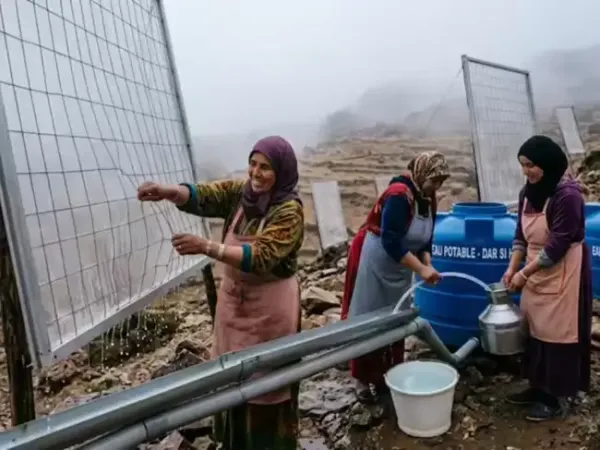
The idea behind the system that helps villages turn fog into water is surprisingly simple. Massive mesh nets are placed high in the mountains where thick fog from the Atlantic Ocean frequently rolls through.
As the fog passes through the nets, tiny water droplets stick to the mesh. These droplets slowly collect and turn into water, which is then channelled through pipes into storage tanks for local communities.
According to climate experts and environmental researchers, the technology is both scientifically proven and environmentally friendly. In remote areas where pipelines and traditional water systems do not exist, the ability to turn fog into water has become a life-changing solution.
Researchers from the University of La Laguna have also highlighted how the project combines engineering, climate adaptation and community participation to tackle water scarcity and poverty at the same time.
Women Leading the Mission to Turn Fog Into Water
One of the most inspiring parts of the initiative is that local women are at the centre of the effort to turn fog into water.
Before the project began, women in these mountain villages reportedly spent nearly four hours each day collecting water from distant sources. The exhausting routine affected education, health and economic opportunities for entire families.
Now, the fog-harvesting system is supplying safe drinking water to hundreds of people across multiple villages. The project has also helped many rural women gain literacy skills and participate in training programmes linked to water management and sustainability.
Speaking to The Guardian, project founder Jamila Bargach explained that water scarcity was forcing people to leave their villages. The decision to turn fog into water was not just about technology, it was about helping communities survive and stay connected to their homes.
Climate Change Is Forcing New Ways to Turn Fog Into Water
Southwest Morocco has faced worsening drought conditions for years. Environmental groups and scientists warn that climate change and rising temperatures are accelerating desertification across North Africa, placing even more pressure on already limited water resources.
That is why projects that turn fog into water are now being seen as important climate adaptation tools.
The United Nations Framework Convention on Climate Change (UNFCCC) has recognised Morocco’s fog-harvesting initiative as a successful grassroots climate solution. The project demonstrates how sustainable methods can help vulnerable communities adapt to changing environmental conditions without damaging ecosystems.
Over the years, the initiative has expanded significantly. According to the Dar Si Hmad Foundation, the system that helps villages turn fog into water now serves more than 16 communities across the Anti-Atlas region.
Why the World Is Watching Morocco Turn Fog Into Water
As water shortages become more common across different parts of the world, Morocco’s ability to turn fog into water is attracting global attention. Countries dealing with drought and declining freshwater supplies are increasingly studying similar systems as possible long-term solutions.
What makes the project especially powerful is its simplicity. Instead of relying on expensive infrastructure or energy-intensive technology, the communities found a way to use the natural environment around them.
In these mountains near the Sahara Desert, fog was once just another weather condition drifting through the valleys. Today, thanks to innovation and determination, people can turn fog into water that supports homes, schools and entire communities.
For many villagers, especially women who once spent hours carrying heavy containers every day, the ability to turn fog into water has completely transformed daily life.
Inputs from agencies
For years, families in this region struggled with disappearing wells, extreme heat and worsening desertification. Women and children often spent hours every day walking long distances just to fetch water. Today, thanks to a remarkable fog-harvesting system, many villages can now turn fog into water using giant mesh nets installed across mountain ridges.
The project, led by the women of the Dar Si Hmad Foundation, has become one of the world’s most famous examples of how communities can turn fog into water using sustainable technology.
How Morocco’s Fog Harvesting Technology Works
The idea behind the system that helps villages turn fog into water is surprisingly simple. Massive mesh nets are placed high in the mountains where thick fog from the Atlantic Ocean frequently rolls through.As the fog passes through the nets, tiny water droplets stick to the mesh. These droplets slowly collect and turn into water, which is then channelled through pipes into storage tanks for local communities.
According to climate experts and environmental researchers, the technology is both scientifically proven and environmentally friendly. In remote areas where pipelines and traditional water systems do not exist, the ability to turn fog into water has become a life-changing solution.
Researchers from the University of La Laguna have also highlighted how the project combines engineering, climate adaptation and community participation to tackle water scarcity and poverty at the same time.
Women Leading the Mission to Turn Fog Into Water
One of the most inspiring parts of the initiative is that local women are at the centre of the effort to turn fog into water.Before the project began, women in these mountain villages reportedly spent nearly four hours each day collecting water from distant sources. The exhausting routine affected education, health and economic opportunities for entire families.
Now, the fog-harvesting system is supplying safe drinking water to hundreds of people across multiple villages. The project has also helped many rural women gain literacy skills and participate in training programmes linked to water management and sustainability.
Speaking to The Guardian, project founder Jamila Bargach explained that water scarcity was forcing people to leave their villages. The decision to turn fog into water was not just about technology, it was about helping communities survive and stay connected to their homes.
Climate Change Is Forcing New Ways to Turn Fog Into Water
Southwest Morocco has faced worsening drought conditions for years. Environmental groups and scientists warn that climate change and rising temperatures are accelerating desertification across North Africa, placing even more pressure on already limited water resources.That is why projects that turn fog into water are now being seen as important climate adaptation tools.
The United Nations Framework Convention on Climate Change (UNFCCC) has recognised Morocco’s fog-harvesting initiative as a successful grassroots climate solution. The project demonstrates how sustainable methods can help vulnerable communities adapt to changing environmental conditions without damaging ecosystems.
Over the years, the initiative has expanded significantly. According to the Dar Si Hmad Foundation, the system that helps villages turn fog into water now serves more than 16 communities across the Anti-Atlas region.
Why the World Is Watching Morocco Turn Fog Into Water
As water shortages become more common across different parts of the world, Morocco’s ability to turn fog into water is attracting global attention. Countries dealing with drought and declining freshwater supplies are increasingly studying similar systems as possible long-term solutions.What makes the project especially powerful is its simplicity. Instead of relying on expensive infrastructure or energy-intensive technology, the communities found a way to use the natural environment around them.
In these mountains near the Sahara Desert, fog was once just another weather condition drifting through the valleys. Today, thanks to innovation and determination, people can turn fog into water that supports homes, schools and entire communities.
For many villagers, especially women who once spent hours carrying heavy containers every day, the ability to turn fog into water has completely transformed daily life.
Inputs from agencies